By Interest · Natural Wonders

China's landscapes for travellers who want the actual mountain

Karst peaks at Guilin, sandstone pillars at Zhangjiajie, terraced rice fields in Yunnan, Tibetan turquoise lakes, the Huangshan cloud sea. A guide to where, when, and how to see them without the tour-bus rhythm.

  • 12UNESCO natural sites
  • 4climate zones to traverse
  • 3,500+metres of altitude range
Reading guide

China's landscapes change continent every 500 km

The country runs from the subtropics of southern Yunnan to the high Tibetan plateau, with five distinct landscape types each producing its own visual signature. Knowing which one you actually want to see is the first design decision.

Most travellers come to China with a generic 'I want nature' brief. The country has at least five distinct landscape categories that produce dramatically different experiences:

  • Karst limestone at Guilin and Yangshuo (south), Wulingyuan and Zhangjiajie (central), and the lesser-known Wulong (Sichuan). The most photographed landscape type in China; defined by vertical limestone peaks rising sharply from flat valleys.
  • Alpine valley at Jiuzhaigou, Huanglong, and parts of Sichuan-Tibet. Turquoise pools, travertine terraces, snow-capped peaks behind them. Strictly seasonal.
  • Terraced rice at Yuanyang (Yunnan), Longji (Guangxi), Jiabang (Guizhou). Built by Hani, Yao, Zhuang, and Miao communities over 1,300 years. The look depends entirely on what stage of the agricultural cycle you visit — flooded, planted, ripening, or harvested.
  • Granite mountain at Huangshan, Sanqingshan, Wuyishan. Defined by exposed granite faces, twisted pines, cloud seas. The classical Chinese landscape-painting subjects.
  • High plateau in Tibet (Namtso, Yamdrok, Manasarovar), parts of Sichuan-Tibet, Qinghai. Lakes, grasslands, yak country, snow peaks. Altitude is the operative constraint.

The question to answer before designing a route: which two of these five do you most want to see? Three is possible across 12-14 days; four requires 18+. Combining karst with terraced rice fields in southwest China is the most common and most rewarding combination for first-time visitors. Combining alpine valley with high plateau (Jiuzhaigou plus Tibet) requires careful altitude management.

The question to answer first: which two of the five landscapes do you most want to see?

Three patterns into China's landscapes

Each pattern requires different fitness, different season, different prior planning. Match your interests to one of these three first.

First time, karst focus

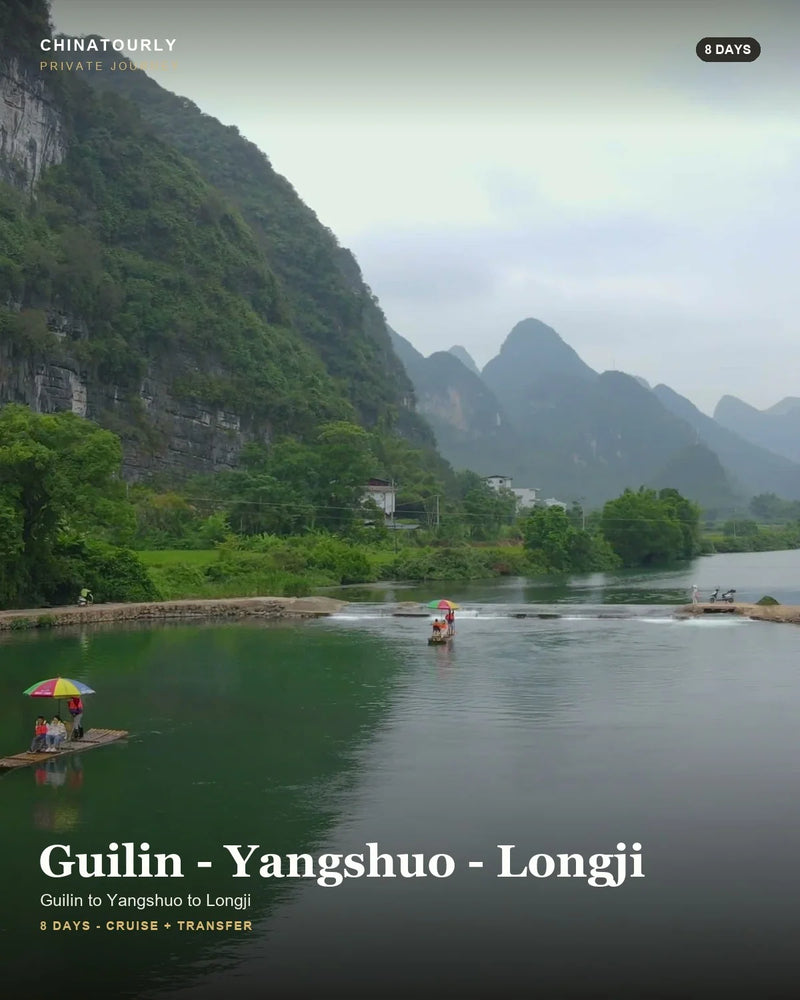
Guilin–Yangshuo–Longji 8 days

The classic southern China landscape combination. River cruise, bamboo raft, Zhuang minority terraces. Easiest physical pace.

Alpine valley

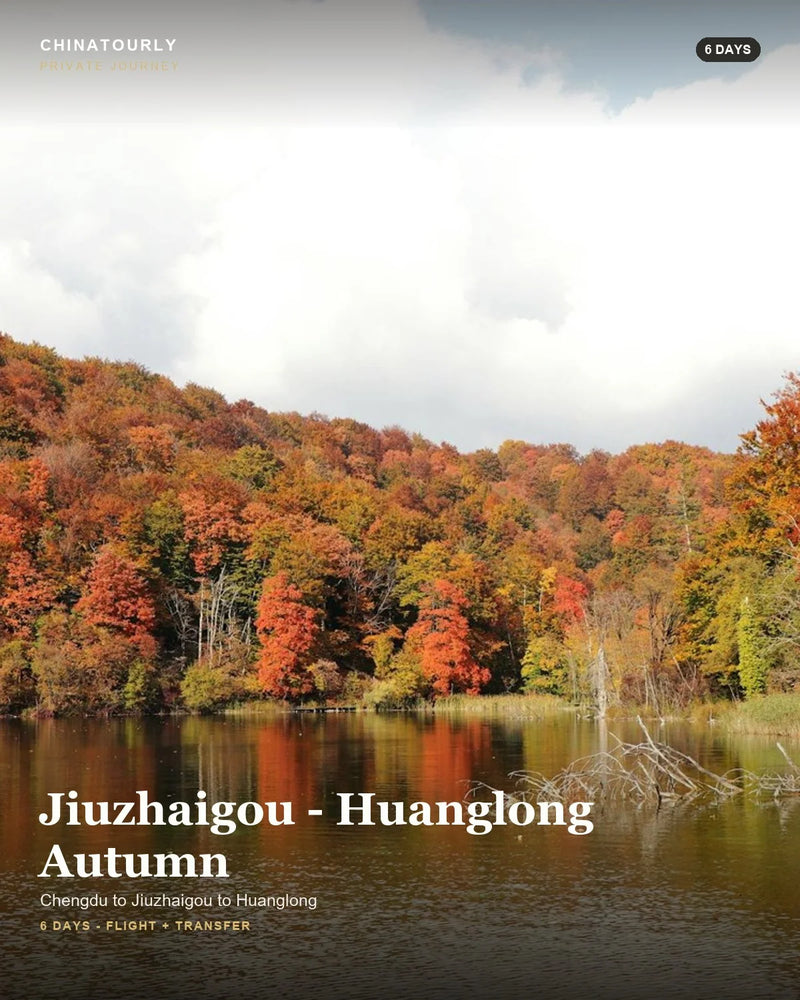
Jiuzhaigou & Huanglong 6 days

The strictest-seasonal trip in the country. Turquoise pools at their peak in October. Closed January–March.

Multi-landscape sweep

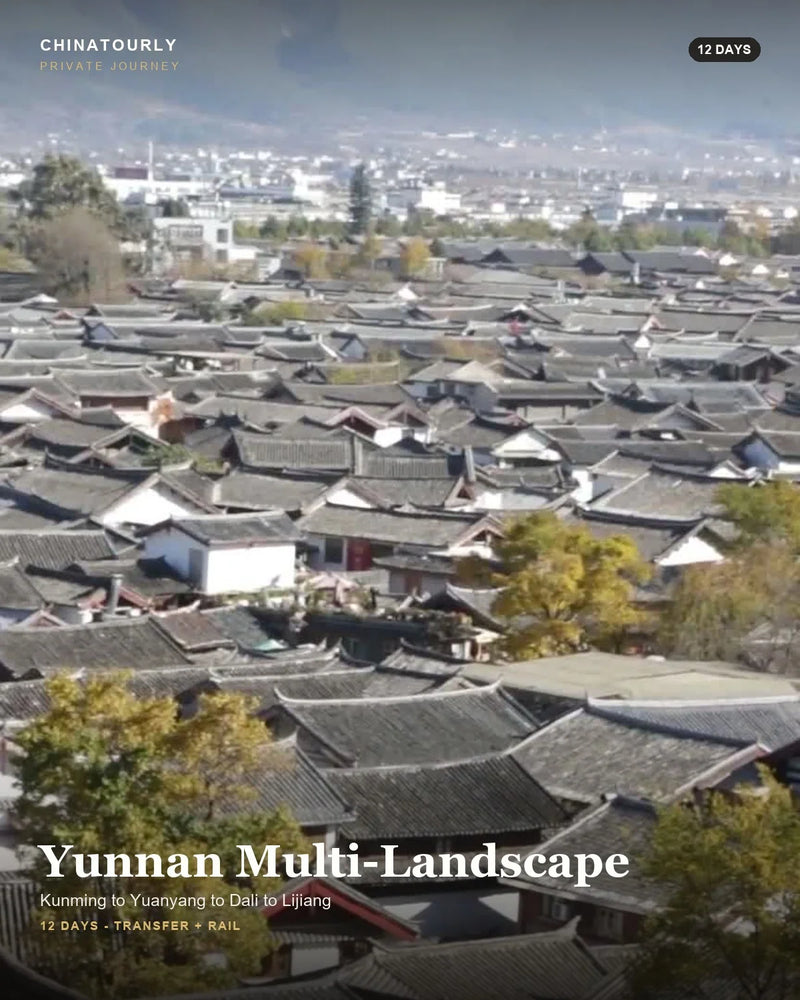
Yunnan 12 days

Stone Forest karst, Yuanyang terraces, Shangri-La grasslands, Meili snow peaks. The deepest single-province natural diversity.

Four landscape geographies, four design logics

The country's natural geography splits into four broad regions, each with its own season and logistics.

Southwest karst belt

March–May, September–November

Guilin · Yangshuo · Longji · Wulingyuan

Limestone peaks, river valleys, terraced minority villages. The most accessible landscape region for first-time visitors.

Sichuan alpine

May–June, September–October

Jiuzhaigou · Huanglong · Mt. Siguniang · Danba

Alpine valleys, turquoise pools, Tibetan grass country. Strictly seasonal, closed parts of winter.

Yunnan multi-zone

March–April, October–November

Lijiang · Shangri-La · Yuanyang · Meili

Five distinct landscapes in one province. Altitude rises north to south.

Tibet & high plateau

May–June, September–October

Yamdrok · Namtso · Manasarovar · Everest base camp

High plateau lakes and snow peaks. Permit required, altitude acclimatisation mandatory.

Site-by-site planning notes

When to go, how long to stay, what to plan around. The crowds, the climate, the constraints.

Site Best window Days needed Pace Watch out for
Guilin / Yangshuo April–October 3–4 days Slow, river-led Summer humidity; January–February haze
Zhangjiajie April–June, Sept–Oct 3 days Vertical, cable car-assisted Weekend crowds at Wulingyuan; winter ice on trails
Jiuzhaigou May–June, Sept–Oct 2–3 days Wooden boardwalk paced Closed Dec–Mar; reopens incrementally
Yuanyang Nov–Apr 2 days Photo-led, dawn/dusk Flooded terraces only in winter; brown summer
Huangshan April–June, Sept–Nov 2 days Cable car or full climb Cloud sea unpredictable; Friday crowds
Tibet plateau lakes May–Oct 2–3 days per lake Altitude-adjusted Yamdrok 4,400 m; Namtso 4,718 m

Four common situations, four specific routes

Each scenario produces a clear itinerary recommendation.

If

You want the iconic Chinese landscape painting feel

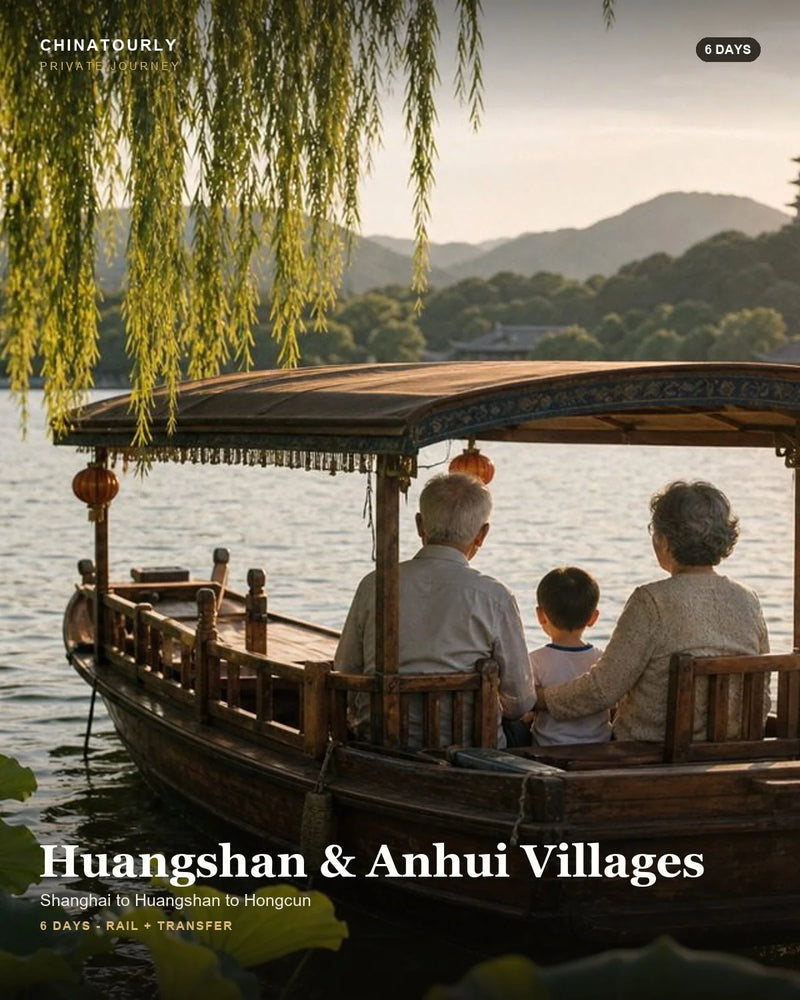
Best pick Huangshan + Hongcun villages 5 days

Huangshan is the granite mountain that defined classical landscape painting from Song to Qing. The pre-dawn cloud sea is the specific phenomenon to time for. Pair with Hongcun and Xidi (Ming-Qing villages, UNESCO).

Also consider: Photographers should consider Sanqingshan as the quieter alternative to Huangshan.

Watch out: Cloud sea visibility is genuinely weather-dependent; allow buffer.

If

You want flooded rice terraces at their photographic peak

Best pick Yuanyang November–February

The Hani terraces in southern Yunnan are flooded for the dry-season winter. Dawn fog over the flooded tiers is the specific scene most photographers come for. The brown summer terraces are an entirely different (and less photogenic) landscape.

Also consider: Add Jianshui ancient town for the evening rhythm.

Watch out: Winter mornings can drop below freezing at 1,800 m.

If

You want turquoise alpine pools

Best pick Jiuzhaigou September–October

The water colour depends on water level, sunlight angle, and algae conditions. Mid-September to mid-October is the photographic peak. The valley operates a strict shuttle-bus system; we book the early entry slot before the day groups arrive.

Also consider: Combine with Huanglong (different scale, same season).

Watch out: Closed late November to mid-March; reopens partially.

If

You want the Tibetan plateau without sacrificing altitude comfort

Best pick Yamdrok lake 1-day from Lhasa

Yamdrok is reachable as a day excursion from Lhasa (4,400 m pass with views to the lake). Skips the 5+ hour drives to Namtso or further. Good for first-Tibet visitors who want the high-plateau visual without the deeper acclimatisation commitment.

Also consider: Day excursion only if Lhasa acclimatisation went well.

Watch out: The pass road is closed in heavy snow; check 24 hours before.

Moments timed for the right hour

Two specific arrangements that distinguish a private landscape itinerary from a generic group nature tour.

The bamboo raft segment after the cruise boats turn around
Yulong River · Yangshuo

The bamboo raft segment after the cruise boats turn around

The day cruise on the Li River runs Guilin to Yangshuo and turns around at the famous bend that appears on the 20 RMB note. The most rewarding 90 minutes — the Yulong River tributary south of Yangshuo — is mostly unvisited by the day boats. We arrange a private bamboo raft segment for the late afternoon, when the karst peaks throw long shadows across the rice fields.

The Yulong is shallow enough for the rafts to drift; you do not paddle, you watch.

Best window: late March to early November. Local bamboo rafts only.

View Yangshuo itineraries
Tianzi Mountain at first cable car
Tianzi Mountain · Wulingyuan

Tianzi Mountain at first cable car

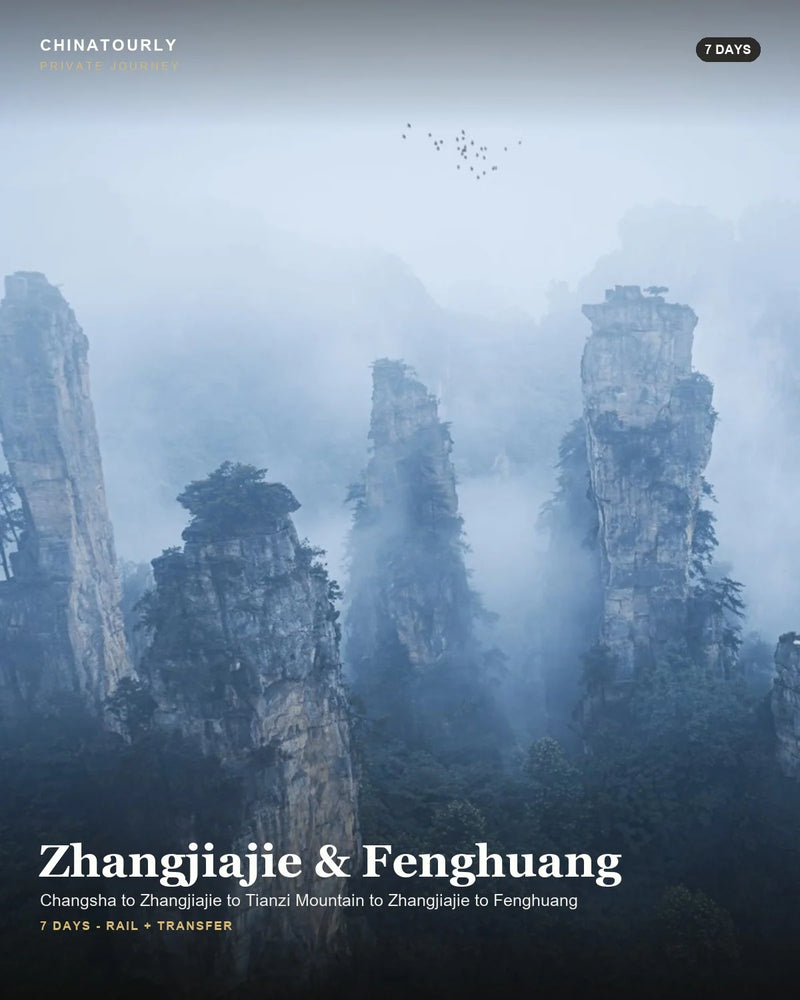
The Wulingyuan scenic area at Zhangjiajie covers 264 km² with 3,000+ sandstone pillars rising 200 metres from the valley floor. The Tianzi Mountain peak gives the most photographed view across the pillar forest. The first cable car at 07:00 puts you at the peak with the morning fog still in the valleys — by 09:30 the photo viewpoint is dense with day groups.

Allow a full day to walk the connecting trails to the Yuanjiajie 'Avatar' floating peaks.

Three-day park ticket; we book Tianzi access for early entry.

Zhangjiajie itineraries

Six landscapes to know by name

Each is a serious destination in its own right. We treat each one as worth at least two full days of attention.

Karst · UNESCO 1992

Zhangjiajie & Wulingyuan

Hunan

The pillar-forest landscape that inspired the floating mountains in James Cameron's Avatar. 3,000+ sandstone columns rising 200 metres from forested valleys, formed by 380 million years of erosion. The Wulingyuan National Park covers Zhangjiajie, Suoxiyu, and Tianzi mountain across 264 km².

Best walked across three days: Tianzi Mountain day, Yuanjiajie peaks day, Yellow Stone Village ridge day. The Bailong elevator (335 m glass-walled outdoor lift) is itself worth experiencing.

  • Tianzi Mountain (07:00 cable car)
  • Yuanjiajie 'Avatar' floating peaks
  • Bailong elevator + Yellow Stone ridge
Karst · UNESCO 2014

Guilin and the Li River

Guangxi

The most iconic Chinese landscape, depicted on Yuan-era ink paintings and the modern 20 RMB note. The 83-km river cruise from Guilin to Yangshuo passes the karst peaks that define the visual. The town of Yangshuo and its surrounding rice fields are the practical base; Guilin itself is the gateway city.

The Reed Flute Cave (a karst cavern with coloured lighting) and the Longji Rice Terraces (3 hours north) make natural day extensions.

  • Li River cruise (full day)
  • Yulong River bamboo raft afternoon
  • Longji terraces day excursion
Alpine · UNESCO 1992

Jiuzhaigou & Huanglong

Sichuan

The Y-shaped alpine valley at Jiuzhaigou contains 108 turquoise lakes formed by travertine deposits and glacial moraines. The valley sits at 2,000–3,100 m altitude with full deciduous forest cover. The 2017 earthquake damaged sections but the park has been progressively reopened with new wooden boardwalk infrastructure.

Huanglong, two hours south, contains the travertine pool terraces — a different landscape type from Jiuzhaigou's lakes but the same alpine context.

  • Five Flower Lake morning
  • Long Lake (highest point)
  • Huanglong terrace pools day
Terraced rice · 1,300 years

Yuanyang Hani Terraces

Yunnan

UNESCO 2013. The Hani ethnic community has built and maintained these terraces for 1,300 years across the Ailao Mountains in southern Yunnan. 17,000 hectares of carved terracing across three principal viewing zones (Duoyishu, Bada, Laohuzui).

The visual depends entirely on season: flooded mirror surface in winter (best for sunrise reflections), planted green in spring, ripe gold in October just before harvest. Winter dry-season fog at dawn is the photographic peak.

  • Duoyishu sunrise viewpoint
  • Bada sunset viewpoint
  • Hani village morning walk
Granite mountain · UNESCO 1990

Huangshan Yellow Mountain

Anhui

The classical Chinese landscape painting subject. Exposed granite peaks 1,800 m above the Yangtze plain, with twisted Huangshan pines clinging to the cliffs and a cloud sea that forms most mornings between October and May. The mountain has 72 named peaks; three (Lotus, Brightness, Heavenly Capital) are climbable to the summit.

Spend at least one night at the summit area to catch the dawn cloud sea. Pair with Hongcun (Ming-Qing village, UNESCO) 30 minutes from the base.

  • Lotus Peak sunrise
  • Beihai cloud sea (dawn)
  • Hongcun & Xidi heritage villages
Plateau lakes · 4,400+ m

Yamdrok, Namtso, Manasarovar

Tibet

The Tibetan Buddhist sacred lakes. Yamdrok (4,441 m) is the most accessible from Lhasa as a day excursion. Namtso (4,718 m) requires an overnight at the lake or in Damxung. Manasarovar (4,590 m) is in far-western Tibet near Mount Kailash and requires a 4–5 day expedition.

The water colour is the operative phenomenon: deep blue, turquoise, jade-green depending on light angle, sky condition, and depth. All three are pilgrimage sites for Tibetan Buddhists.

  • Yamdrok Lake pass overlook
  • Namtso south shore (overnight)
  • Manasarovar circumambulation (specialist itinerary)

Six specific moments we arrange

Timing-led arrangements at the most photographic moments of the major sites.

Five Flower Lake at the right colour
Jiuzhaigou

Five Flower Lake at the right colour

The shallowest of Jiuzhaigou's 108 lakes shows underwater fallen tree trunks through perfectly clear turquoise water. October mid-morning gives the saturated colour.

Park shuttle bus only; private vehicles prohibited.

Duoyishu sunrise with the dry-season fog
Yuanyang

Duoyishu sunrise with the dry-season fog

The mid-December to early January window combines flooded terraces with thick dawn fog. Sunrise breaks through fog onto the mirror surface around 07:30.

Local Hani guide can read the fog probability.

Lotus Peak at the cloud sea dawn
Huangshan

Lotus Peak at the cloud sea dawn

The summit at 06:00 in October. The cloud sea fills the valleys below; the granite peaks emerge like islands. The phenomenon is genuinely weather-dependent — allow two summit nights.

Summit hotel booking required 60+ days ahead.

The Kamba La pass overlook
Yamdrok

The Kamba La pass overlook

The 4,800 m pass on the Lhasa-Yamdrok road gives the postcard view of the turquoise lake. Best in the late morning hours when the eastern sun warms the colour.

Day excursion from Lhasa; altitude considerations apply.

Meili Snow Mountain at first light
Meili

Meili Snow Mountain at first light

The 13-peak sacred Tibetan range rising 6,740 m above the Lancang River. The dawn alpenglow on the main Kawagebo peak is the specific phenomenon. Visible perhaps 40 days a year on average.

Three-night Feilai Temple stay maximises probability.

Longji terraces in late spring planting
Longji

Longji terraces in late spring planting

The Zhuang minority terraces north of Guilin. May-June planting season floods the terraces and reflects the surrounding peaks. October ripening gives golden colour.

Three-hour drive from Guilin; overnight in Ping'an village.

Honest answers before you commit

Which landscape type is best for first-time China visitors?

Karst (Guilin-Yangshuo) is the easiest to combine with first-time China logistics. Direct flights from Beijing or Shanghai, low altitude, manageable Chinese-English language transitions, and the iconic 20 RMB-note landscape is genuinely satisfying to see in person. Add Longji terraces north of Guilin for the second landscape type and you have a complete southern-China nature itinerary.

Is Jiuzhaigou worth the seasonal commitment?

If you can travel mid-September to mid-October, yes — it is the most distinctive alpine landscape in China and arguably the most beautiful single nature destination in the country. Outside that window, performance varies: November can be excellent if the autumn colour holds; May-June lacks the deep colour; December-March the park is largely closed. We do not recommend Jiuzhaigou outside the prime windows.

How does Yuanyang terraces work for non-photographers?

The visual reward is fundamentally about the flooded winter terraces and dawn fog. If you are not specifically chasing the photographic phenomenon, Yuanyang's appeal is more limited — the villages are interesting but the overall depth-of-engagement is more modest than alpine valleys or karst landscapes. Honest assessment: it rewards photographers and minority-culture travellers more than general nature travellers.

Can I do Tibet and Jiuzhaigou in the same trip?

Yes, but pace it carefully. The most efficient sequence is Chengdu → Jiuzhaigou (2,000-3,000 m) → Chengdu → Lhasa. Jiuzhaigou serves as moderate pre-acclimatisation for Lhasa's 3,656 m. The opposite sequence (Tibet first, then Jiuzhaigou) is also possible but you spend the high altitude before the lower visit, missing the acclimatisation benefit. Plan minimum 14 days for the combination.

What is the best season for Zhangjiajie?

April-June and September-October. Summer is hot, humid, and crowded with domestic tourists. Winter (December-February) sees ice on the higher trails and the pillars look less dramatic without their forest canopy. The two shoulder windows are clearly best, with April-May fresh greens and September-October autumn colour.

Can children walk the trails at these sites?

Yes for most sites, with caveats. Guilin-Yangshuo and Longji terraces are entirely accessible to children. Jiuzhaigou operates on shuttle buses with wooden boardwalks — children handle it well. Zhangjiajie has cable cars and elevators reducing the climbing requirement. Huangshan can be cable-car-accessed but the summit walks involve some genuine elevation. Tibet altitude restrictions apply to children under 12 — see our family travel guide.

Build your own

Tell us which landscape draws you

Send us your travel dates, fitness, and any altitude history. We respond within 24 hours with a draft itinerary and the season-aware logistics already worked through.

Prefer to talk first? hello@chinatourly.com  ·  WhatsApp +1 725 303 6645  ·  A real planner replies within 24 hours.