Destination Hub · Tibet

Tibet: the sacred plateau, permits required, altitude respected

The Jokhang Temple at 06:30, the Potala Palace on Red Hill, Tashilhunpo at Shigatse, the Yamdrok and Namtso plateau lakes. The most permit-sensitive and altitude-affected region of China, and one of the most genuinely rewarding for travellers who arrive prepared.

  • April-OctoberOpen season
  • 3,656mLhasa altitude
  • 8-9 daysPermit lead time
Reading guide

What Tibet travel actually requires in 2026

Three hard prerequisites: a Tibet Travel Permit arranged through a licensed operator, a registered tour group (solo travel not permitted), and altitude acclimatisation planning. These are non-negotiable. Once they are arranged, Tibet rewards travellers like few other destinations.

The Tibet Travel Permit (TTP) is mandatory for all foreign visitors in addition to a Chinese tourist visa. It can only be applied for by a licensed Tibetan operator — we hold this relationship in Lhasa and handle the application on your behalf. Processing takes 8-9 business days; we require passport scans 25+ working days before your Tibet entry to provide buffer.

Foreign visitors must travel in a registered tour group with a licensed guide. Independent travel is not permitted. Our private itineraries meet this requirement automatically. As of June 2025, several routes — Nyingchi, Shigatse (including Everest Base Camp), and the Sichuan-Tibet Highway — no longer require the Aliens' Travel Permit (ATP) in addition to the TTP. Mount Kailash and Ngari still require the additional ATP.

The best season is April to October, with the strongest windows in April-May and September-October. April-May brings the Nyingchi peach blossoms (pink and white against snow-capped peaks). October offers the clearest skies — many of our guests get their best Mount Everest view at this time. May to October averages above 10°C and offers higher oxygen levels.

Altitude acclimatisation is mandatory. Lhasa sits at 3,656m. Our standard practice: two to three full nights in Lhasa with light walking only, before any higher-altitude excursion. About 30-40% of first-time visitors experience some altitude symptoms in the first 48 hours; severe altitude sickness is rare but possible. Travellers with cardiopulmonary conditions, certain pregnancies, and recent surgery should consult a physician before booking.

The TTP, the registered group, and the acclimatisation days are non-negotiable. Once arranged, Tibet rewards travellers like few other destinations.

Three Tibet patterns

Each is a different altitude commitment.

First Tibet, 10 days

Lhasa + Shigatse + Gyantse

Three Tibetan cities, four major monasteries, gradual altitude. Best for first-time TAR visitors with no high-altitude history.

Sacred deep, 14 days

Adding Namtso + Yamdrok lakes

Plateau lake excursions for acclimatised travellers. Namtso at 4,718m on day 8 or later.

Pilgrimage extension

+5 days for Mount Kailash circumambulation

Far-western Tibet pilgrimage. Requires additional Aliens' Travel Permit. Physical demands real.

Four Tibet geographies

Each has its own permit requirements and altitude profile.

Lhasa Valley (3,656m)

April-October

Jokhang · Potala · Drepung · Sera · Norbulingka

The first 3-4 days. Acclimatisation while exploring the religious core.

Shigatse-Gyantse-Tsedang corridor

May-October

Tashilhunpo · Gyantse Kumbum · Yumbulagang

Days 5-8. Altitude rises to 3,977m at Gyantse.

Plateau lakes

May-October

Yamdrok (4,441m) · Namtso (4,718m) · Manasarovar (4,590m)

Day excursions or overnight. Pilgrimage sites for Tibetan Buddhists.

Site-by-site planning

When, how long, what to plan around.

Site Best window Time needed Notes Watch out for
Lhasa April-Oct 4 days minimum Acclimatisation + sacred core Permit 25+ days lead; closes Feb/March
Shigatse May-Oct 2 days Tashilhunpo + drive 3,840m altitude
Gyantse May-Oct 1 day Pelkor Chode + Kumbum 3,977m altitude
Namtso Lake May-Oct Day excursion or overnight 4,718m — acclimatised travellers only Pass road may close in snow
Yamdrok Lake May-Oct Day excursion 4,441m via Kamba La pass Manageable for first-Tibet visitors
Everest Base Camp April-Oct +3 days extension 5,200m camp altitude ATP no longer required since June 2025

Four common situations

Match a situation to our recommendation.

If

First high-altitude trip

Best pick Lhasa + Shigatse + Gyantse 10 days

Two acclimatisation days in Lhasa, gradual altitude with Shigatse (3,840m) and Gyantse (3,977m). Skip Namtso this trip.

Also consider: Diamox after physician consultation.

Watch out: Cardiopulmonary, certain pregnancies, recent surgery contraindicate.

If

Travelling for the spiritual depth

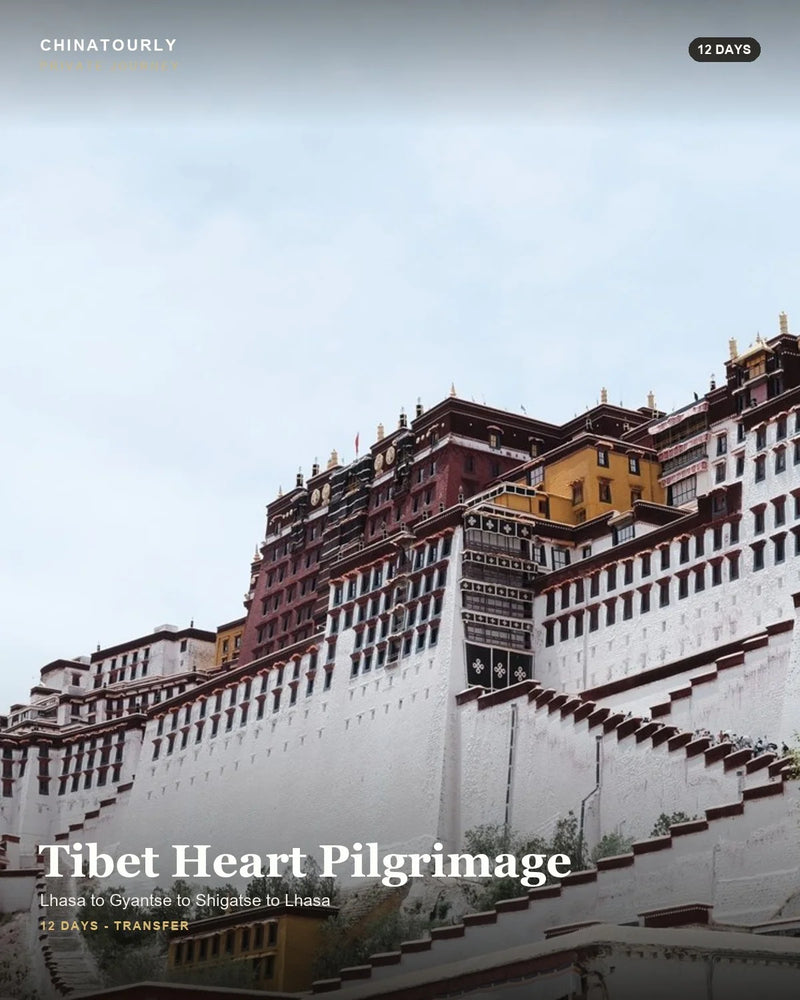
Best pick Tibet Heart Pilgrimage 12 days

Five Lhasa nights (Jokhang, Potala, Drepung, Sera), Shigatse, Gyantse, Namtso day on day 11.

Also consider: Time visits to coincide with monastery debate sessions.

Watch out: Photo restrictions inside halls; respect them.

If

You want Mount Everest

Best pick + Everest Base Camp 3-day extension

Drive from Shigatse to Rongbuk Monastery and EBC at 5,200m. Overnight Rongbuk. October typically gives clearest peak views.

Also consider: ATP requirement removed since June 2025.

Watch out: Weather/road conditions can change — buffer day recommended.

An encounter at the pilgrims' hour

An operator-arranged early-morning access.

The Jokhang at the pilgrims' hour
06:30 · Jokhang

The Jokhang at the pilgrims' hour

The most sacred site in Tibetan Buddhism, founded 647 CE under King Songtsen Gampo, housing the Jowo Shakyamuni statue brought from Nepal as a wedding gift. By 07:00 the central hall is full of prostrating pilgrims; by 09:30 the day-tour groups arrive and the temperature of the place changes entirely.

We arrange a 06:30 entry with a Tibetan-Buddhist-trained guide, so you walk the inner circuit with the same pilgrims who have walked it daily for years.

Pre-public access through operator relationship.

View Tibet Heart Pilgrimage

Six sites to know by name

The sacred core, the high lakes, the monastery clusters.

Sacred core · 647 CE

Jokhang Temple

Lhasa Old Town

Built by King Songtsen Gampo to house the Jowo Shakyamuni image. The spiritual heart of Tibetan Buddhism for nearly 1,400 years. Survived the Cultural Revolution with most iconography intact through monastic concealment.

  • 06:30 pre-public entry
  • Roof terrace at sunset
  • Barkhor pilgrimage circuit (1 km clockwise)
Winter palace · 13-storey

Potala Palace

Lhasa Red Hill

The Dalai Lama's winter palace, 13 storeys carved into Red Hill. Inner sanctum tour covers 35 of 1,000 rooms across a strict 90-minute timed window. White Palace (administrative) + Red Palace (religious) divisions.

  • 90-minute timed inner-sanctum tour
  • Booked 2 weeks in advance
  • Pre-public morning access for photography
Panchen Lama seat · 1419

Tashilhunpo Monastery, Shigatse

Shigatse Prefecture

Founded 1419 by the first Dalai Lama. 4,500 monks at historical peak; ~600 currently in residence. 26m gilded copper Maitreya Buddha (1914) is the largest in Tibet. The debate courtyard runs afternoons.

  • Maitreya Buddha hall
  • Debate courtyard afternoon session
  • Panchen Lama stupa complex
Stupa fortress · 1418

Gyantse Kumbum

Gyantse

The Pelkor Chode Monastery's Kumbum (35m, 9 storeys, 108 chapels) is the largest stupa in Tibet. Walking the spiral interior takes 90 minutes; each chapel holds distinct iconography. The Gyantse fortress on the cliff above is a separate climb.

  • Kumbum interior spiral walk
  • Gyantse fortress climb (steep)
  • Old town walking circuit
Sacred lake · 4,441m

Yamdrok Lake

Day excursion from Lhasa

The most accessible Tibetan sacred lake from Lhasa — 100km southwest via the Kamba La pass (4,800m). Manageable as a day excursion for travellers who have completed Lhasa acclimatisation. Postcard turquoise water best photographed late morning.

  • Kamba La pass overlook
  • Lakeshore at the south end
  • Day excursion from Lhasa
Sacred lake · 4,718m

Namtso Lake

Overnight or long day

The second-highest lake in the world above 4,000m. Pilgrimage circuit (kora) takes 4-5 days; most travellers do a half-day at the south shore from Nyenchen Tanglha pass. Snow can close the access road from late October.

  • South shore at first light
  • Tashi Dor Peninsula walk
  • Acclimatisation prerequisite mandatory
When & altitude

Best seasons & acclimatisation

Apr–Jun, Sept–Oct

April–June and September–October are clearest; Nyingchi peach blossom peaks late March. Build two nights in Lhasa to acclimatise — not advised for infants or anyone with heart conditions.

Specific Tibet moments we arrange

Six experiences with permits and altitude built in.

Pre-pilgrim morning access
Jokhang 06:30

Pre-pilgrim morning access

Inner circuit when the temple is still cool and the pilgrims still few.

Through our Lhasa operator.

90-minute timed inner sanctum
Potala

90-minute timed inner sanctum

35 of 1,000 rooms. White Palace administrative, Red Palace religious.

Booked 2 weeks in advance.

Debate courtyard afternoon
Tashilhunpo

Debate courtyard afternoon

Hand-clap monastic debate. Most visceral living-Buddhism encounter in Tibet.

Weekdays 14:30-17:00 typical.

Kamba La pass at 4,800m
Yamdrok

Kamba La pass at 4,800m

Postcard turquoise lake view. Best late morning when eastern sun warms colour.

Day excursion from Lhasa.

Barkhor pilgrimage kora
Lhasa

Barkhor pilgrimage kora

1 km clockwise circuit around the Jokhang. Pilgrims walk it daily; you join them.

Best 06:00-08:00 or 17:00-19:00.

Mount Everest clear view
October

Mount Everest clear view

October typically delivers the clearest Mount Everest visibility from Rongbuk Monastery.

ATP no longer required since June 2025.

Momo, yak, and sweet-tea houses
Taste of Tibet

Momo, yak, and sweet-tea houses

Steamed momo dumplings, yak-meat stew and bottomless sweet milk-tea at a Lhasa house like Guangming Gangqiong, where pilgrims share long tables.

Lhasa teahouses

The Barkhor pilgrim circuit
Living faith

The Barkhor pilgrim circuit

Join the clockwise kora around the Jokhang at dawn — prayer wheels, prostrating pilgrims, juniper smoke. The most moving hour in Lhasa.

Best at dawn

Sera & Drepung debates
Monastic life

Sera & Drepung debates

Sera’s afternoon courtyard debates — clapping monks, sharp questions — and Drepung, once the largest monastery on earth.

Sera ~3pm weekdays

Yamdrok, the turquoise lake
High-plateau scenery

Yamdrok, the turquoise lake

One of Tibet’s three sacred lakes, vivid turquoise at 4,440 m on the Lhasa–Gyantse road. We pace altitude before the drive.

Day trip from Lhasa

The Potala Palace
Must-see

The Potala Palace

A thousand rooms rising 13 storeys over Lhasa, the Dalai Lamas’ winter palace. Entry is timed and capped — we book the window weeks ahead.

Timed entry, book early

Honest answers before you commit

When can I travel to Tibet in 2026?

April-October generally. Tibet typically closes to foreign visitors late February through most of March around Tibetan New Year (Losar). Reopens early April. May-June and September-October are the strongest windows. October especially gives the clearest Mount Everest views.

How does the TTP application actually work?

Send us passport scans 25+ working days before your Tibet entry. We apply through our Lhasa operator relationship; permit processing takes 8-9 business days. We deliver the original permit to your gateway city (Chengdu or Xining) before your Tibet flight or train. You travel within Tibet with the registered guide accompanying the permit. We handle all of this.

Is altitude really a serious concern?

Yes. Lhasa at 3,656m produces some altitude symptoms in 30-40% of first-time visitors. Severe sickness is rare but possible. Our practice: two light walking days on arrival, no strenuous excursions before day 3, clear thresholds for going above 4,000m. Consult your physician before booking, especially with any cardiopulmonary considerations.

Do I need additional permits beyond the TTP?

Depends on your itinerary. As of June 2025, Nyingchi, Shigatse (including Everest Base Camp), and the Sichuan-Tibet Highway no longer require ATP. Mount Kailash and far-western Ngari still require ATP. We confirm permit needs based on your specific routes at booking.

Can I photograph inside temples?

Outdoor courtyards and exteriors: generally permitted. Indoor halls with active iconography: typically restricted, sometimes prohibited entirely. During ceremonies: prohibited. Your guide knows specific rules for each site and translates when staff direct you.

Is Tibet safe for solo or female travellers?

Tibet is among the safest tourism destinations in China for international visitors. The mandatory tour-group requirement means you always travel with a licensed guide. Female travellers report no specific safety concerns beyond standard travel awareness.

Build your own

Tell us about your altitude experience

Send us your dates, altitude history, and any physician considerations. 24-hour response.

Prefer to talk first? hello@chinatourly.com  ·  WhatsApp +1 725 303 6645  ·  A real planner replies within 24 hours.