


Key Takeaways
- Peking duck is the non-negotiable. Every first-time visitor eats Peking duck; the question is where. Dadong and Siji Minfu are the most respected current establishments; Quanjude is the most historic. Budget ¥150–450 per person depending on venue.
- Beijing's street breakfast is one of the great urban food experiences. Jianbing (savory crepes), baozi (steamed buns), and congee from cart vendors running 6–10am fuel the city's working population. ¥8–15 per item.
- The hutong neighborhood restaurants outperform the tourist-area restaurants in quality and value. Nanluogu Xiang and Wudaoying Hutong have the most accessible options without requiring advance booking.
- Beijing is a city of northern Chinese and Muslim cuisine — lamb, wheat, vinegar, and fermented sauces dominate. Southern Chinese preferences (rice, seafood, dim sum) exist here but are not the tradition.
Beijing's food culture is built on two foundations: the imperial court cuisine that evolved over 600 years of dynastic patronage, and the street food culture of its hutong neighborhoods where residents fed themselves from cart vendors for centuries. Both remain accessible and authentic in 2026 — the duck at a serious Beijing restaurant and the jianbing from a street cart at 7am represent different but equally genuine experiences of the city's food identity. The broader context of Chinese regional cuisine is in our Chinese food guide.
Prefer it handled end to end? Browse our private Beijing tours.
The Essential Beijing Dishes
Peking Roast Duck (北京烤鸭, Běijīng kǎoyā)
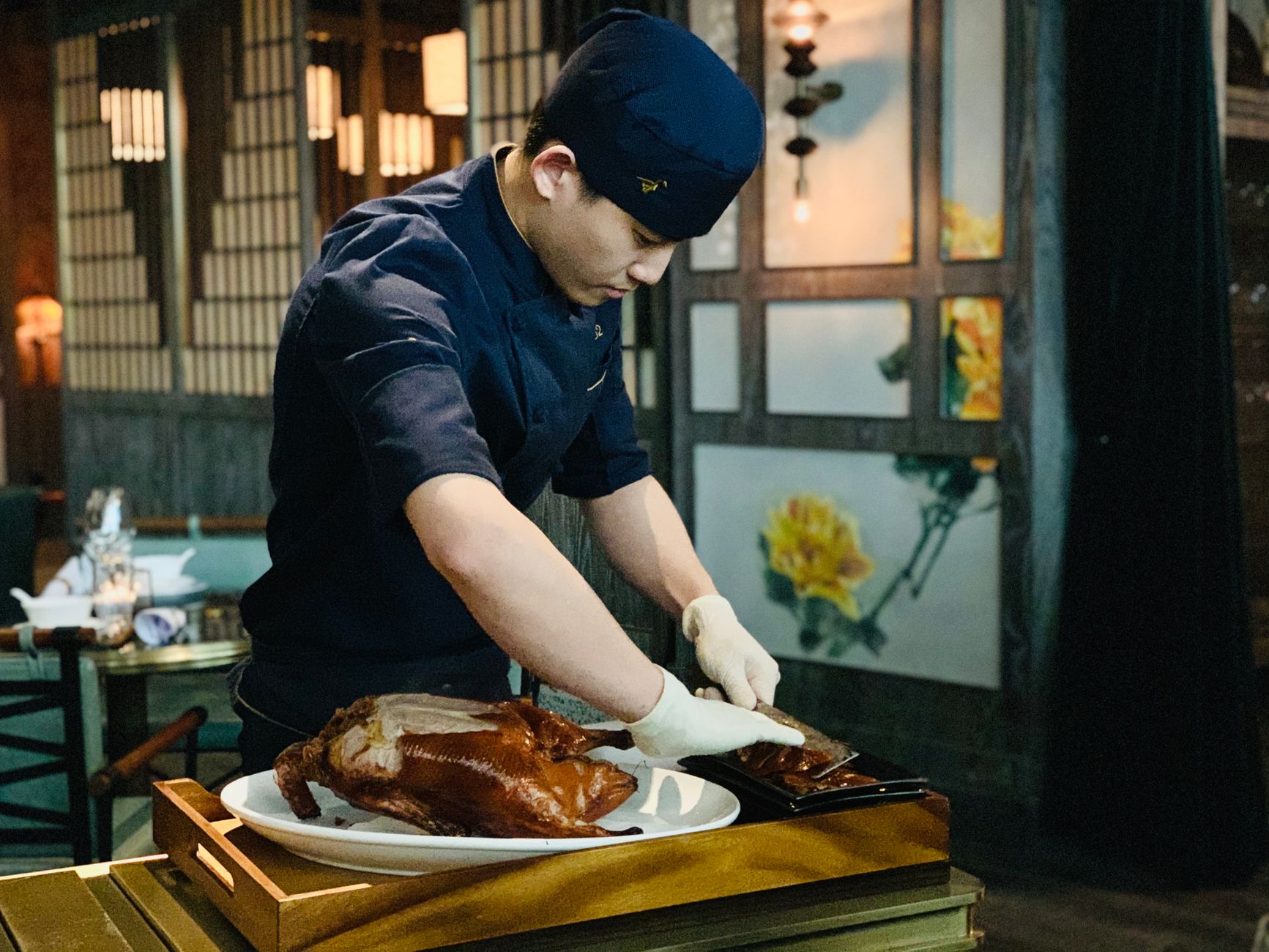
The definitive Beijing dish, roasted in a closed wood-fired oven using fruit wood (typically date, pear, or peach) that imparts a distinctive fragrance. A quality Beijing duck has crispy golden skin, glistening fat beneath it, and tender meat — three separate textures in a single bite. The correct eating sequence:
- The carver slices the duck tableside, separating skin, skin-with-fat, and meat
- Take a thin pancake (spring roll wrapper-thin), spread hoisin sauce across it with the scallion brush
- Lay a slice of crispy skin, a piece of meat, a cucumber strip, and a scallion segment
- Roll tightly and eat in one or two bites — the skin-to-sauce-to-pancake ratio is the whole point
The remaining bones are taken to the kitchen for duck bone soup, served at the end of the meal. Ordering the whole duck also includes the liver and heart, typically served stir-fried — do not skip these.
Where to go:
- Dadong (大董): The modern reference point. Dadong's low-fat roasting technique has won considerable recognition; the restaurant's contemporary design makes it accessible to international visitors. Multiple locations; book a week ahead during peak periods.
- Siji Minfu (四季民福): Consistently rated among Beijing's best by local food media. Qianmen and Guomao locations. Booking required.
- Quanjude (全聚德): Founded in 1864. The most historic name in Beijing duck; the experience is formal and the duck is excellent, but the tourist-oriented atmosphere has become part of the package.
- Da Ya Li (大鸭梨): The best value option — solid duck at approximately half the price of Dadong, targeting a local rather than tourist clientele.
Zhajiang Noodles (炸酱面, Zhájiàng miàn)
Beijing's everyday noodle — thick handmade wheat noodles topped with a sauce of ground pork or vegetable cooked in fermented yellow soybean paste (黄豆酱), served with fresh julienned cucumber, carrot, bean sprouts, and edamame on the side. Mix everything together and eat immediately; the sauce thickens as it cools. This is the dish that Beijing residents eat at home when they want something comforting. Order it at a hutong neighborhood restaurant for ¥20–35.
Lamb Hot Pot — Instant-Boiled Mutton (涮羊肉, Shuàn yángròu)
Beijing's hot pot tradition is distinct from Sichuan hot pot: the broth is clear (Chinese date, ginger, and spring onion), and the focus is on paper-thin slices of high-quality lamb cooked tableside and dipped into a sauce of sesame paste, fermented tofu (腐乳), and chili oil. The Donglaishun restaurant chain (东来顺) has served this dish since 1903. A proper hot pot meal runs 2–3 hours and represents one of Beijing's finest winter dining experiences.
Jianbing (煎饼)
The iconic Beijing breakfast crepe. A vendor spreads a thin mung bean and wheat batter on a hot circular griddle, cracks an egg onto it, adds scallion, cilantro, sesame seeds, and chili sauce, then folds it around a crispy wonton sheet. The whole assembly takes 90 seconds. ¥8–12. Find vendors near metro stations from 6–10am — by 10:30am most have sold out for the day. This is the meal that fuels Beijing's 20 million residents every morning.
Rou Jia Mo (肉夹馍) — From Xi'an but Everywhere in Beijing
The "Chinese hamburger" — slow-braised pork belly (or beef at halal vendors) stuffed into a freshly baked flatbread. The pork version is not a Xi'an Muslim Quarter preparation but a Guanzhong regional dish now found throughout northern China. Excellent from the chain Xibei (西贝) and from the dedicated roujiamo stands in food courts and pedestrian streets. ¥15–25.
Beijing Street Breakfast Beyond Jianbing
- Baozi (包子): Steamed filled buns — pork and cabbage, three-fresh (shrimp, pork, and egg), or vegetable. Goubuli baozi from Tianjin (one hour from Beijing) is the most famous brand; local variants throughout the city.
- Congee (粥, zhōu): Rice porridge with various toppings — preserved egg, pork, century egg. Thin and comforting; a genuine morning staple at noodle and congee shops across the hutongs.
- Shaobing (烧饼): Sesame-encrusted flatbread, sometimes filled with red bean paste or meat. Eaten alone or wrapped around a youtiao (油条) deep-fried dough stick.

Beijing's Muslim Quarter Food Culture
Beijing has a substantial Hui Muslim population concentrated in the Niujie area, producing a distinct halal food tradition that runs through the city's culinary identity. Lamb dominates — lamb skewers (烤羊肉串), lamb shaomai, lamb offal soup. The Niujie area is not a tourist attraction in the way Xi'an's Muslim Quarter is, but it is an excellent place to eat authentic Muslim-Chinese food that is harder to find in tourist-facing restaurants.
Where to Eat: Neighborhood Guide
Nanluogu Xiang (南锣鼓巷): The hutong street most accessible to foreign visitors — cafes, snack shops, and small restaurants alongside tourist boutiques. Best for quick eats and the atmosphere of a busy hutong; not for serious destination dining.
Wudaoying Hutong (五道营胡同): The upscale hutong food street — better restaurants, slightly quieter, more serious quality across the board. Recommended for evening meals during a hutong neighborhood experience.
Guomao / CBD area: The central business district has the widest range of international and Chinese chain restaurants, including the best Dadong duck location. Excellent for business meals and high-end food experiences.
Sanlitun: Beijing's international expat and nightlife district. Best selection of non-Chinese food if you need a break; also has strong Chinese options alongside Western restaurants.
For the full picture of eating in China — what to order in other cities, dietary restriction guidance, and street food safety — our Chinese food guide and street food guide cover the country in depth.
ChinaTourly Planning Note
We treat this topic as a practical planning issue, not a generic travel tip. Before we recommend a route, our team checks the traveler's arrival city, season, mobility level, payment setup, language needs, and whether the experience requires advance local coordination.
Official planning references
Plan this with a China-based team
If this topic affects your route, timing, payment setup, dietary needs, or family logistics, tell us what kind of China trip you are considering. ChinaTourly can turn the research into a private itinerary with English-speaking support, local transport, and practical pre-trip preparation.
Frequently Asked Questions
Is this guide enough to plan Beijing Food Guide: What to Eat and Where on my own?
It can help you understand the basics, but travel in China often depends on timing, local rules, payment setup, language support, and transport logistics. For a private trip, we turn the guide into a day-by-day plan with local support.
When should I start planning a private China trip?
For a simple city route, two to three months is usually workable. For culture-heavy routes, heritage workshops, family travel, Tibet, Yunnan, or festival timing, three to six months gives more room to secure better guides and smoother logistics.
Can ChinaTourly customize this around my budget and travel style?
Yes. ChinaTourly designs private, tailor-made journeys for English-speaking travelers. We can adjust pace, hotels, guides, transport, food requirements, and cultural access around your party instead of forcing you into a fixed group itinerary.
Walk the Great Wall and the Forbidden City with a private guide, at your own pace.
Explore our private Beijing journeys → · Beijing Wall Walk + Hutong Deep →


