


Key Takeaways
- Hot, freshly cooked street food from busy vendors is generally safe. The heat required to cook jianbing, chuanr, and baozi kills the pathogens that cause traveler's diarrhea. A vendor with a queue of Chinese locals is the strongest safety signal available.
- Street food in China is cheap, fast, and often the most memorable food of the trip. Budgets of ¥30–60 cover a full street food exploration of breakfast through evening snacks.
- The best street food is in the morning. Many of China's best street food items — jianbing, baozi, youtiao — are breakfast foods sold by vendors from around 6am to 10am, gone by mid-morning.
- Tourist-facing food streets (Wangfujing, Jinli) are convenient but not representative. The deep-fried scorpions and starfish sold in tourist night markets are novelties marketed to visitors, not local food culture.
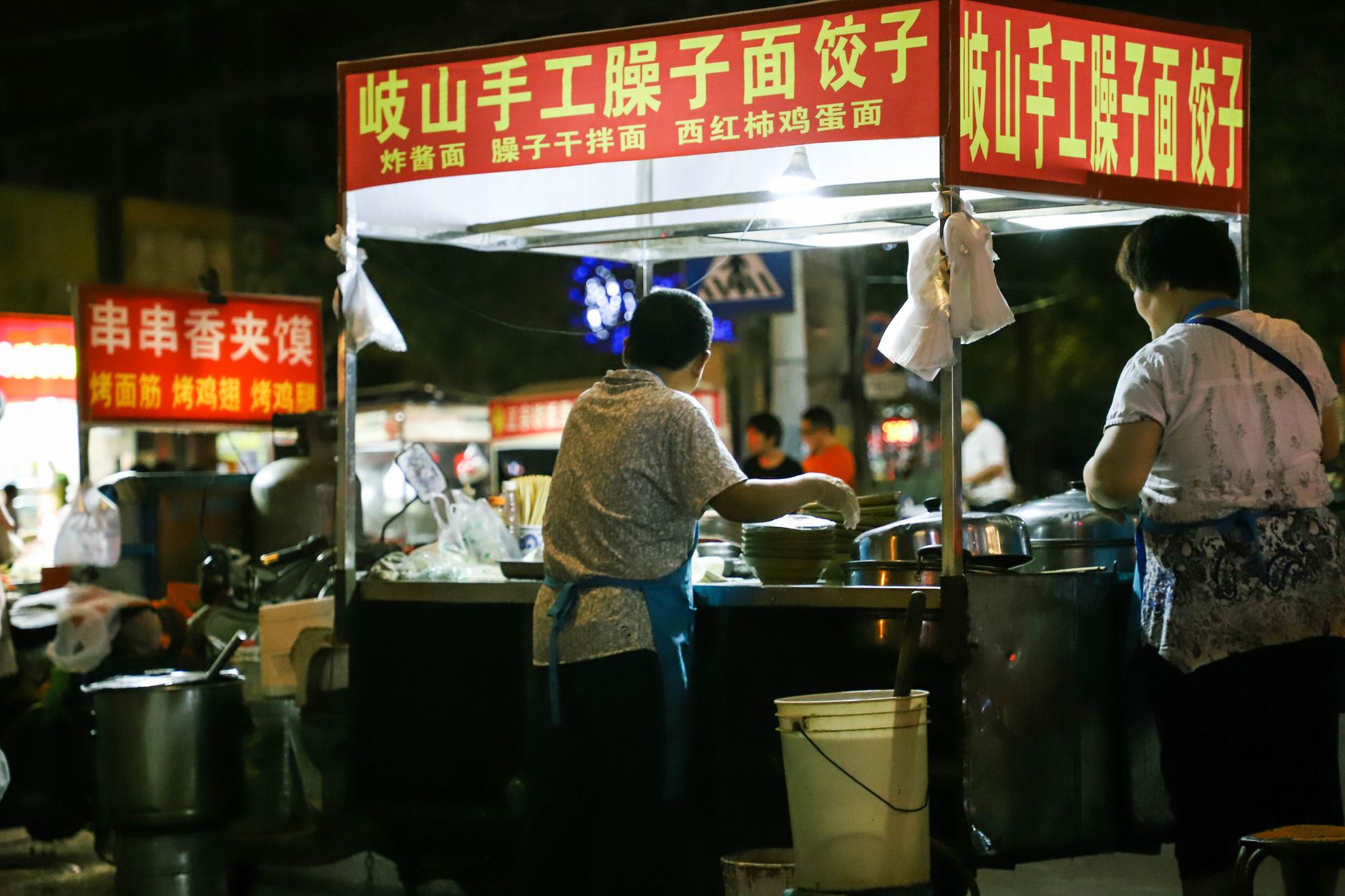
China's street food culture is one of the great pleasures of the country for travelers who engage with it rather than retreating to hotel restaurants. The morning streets of Beijing, the night food stalls of Xi'an's Muslim Quarter, the crossing-the-bridge noodle shops of Yunnan, the hot pot skewer vendors of Chengdu's residential neighborhoods — these experiences are not available in any restaurant. They require walking into the city at the right hour, following the crowds, and ordering with a pointed finger. The safety context for street food is covered in our food and water safety guide. This guide covers what to find and where.
Prefer it handled end to end? Browse our private China tours.
Beijing Street Food
Morning (6am–10am): The Best Window
Jianbing (煎饼): The definitive Beijing street breakfast. A vendor spreads mung bean batter on a round griddle, cracks an egg onto it, sprinkles scallion and sesame seeds, brushes on hoisin and chili sauce, folds it around a crispy wonton sheet, and hands it to you wrapped in paper. Eaten while walking. ¥8–12. Find vendors near metro exits, at the entrance to office buildings, and at busy intersections from 6:30–10:00am.
Baozi (包子): Steamed buns sold from bamboo basket stacks at storefront shops and carts. The best Beijing versions: pork and cabbage (猪肉白菜), three-fresh (三鲜 — shrimp, pork, egg), and vegetable and egg (蔬菜鸡蛋). ¥1.5–3 each; eat three for a full breakfast.
Youtiao (油条) with soy milk (豆浆): Deep-fried dough sticks, eaten alongside a bowl of warm sweet or savory soy milk. The combination is the classic northern Chinese breakfast. Look for the steaming fryer visible from the street at soy milk shops.
Evening and Night: Hutong Food Culture
Chuanr (串儿) — Lamb skewers: Cumin-and-chili seasoned lamb on metal skewers, cooked over charcoal by vendors who set up in hutong alleys from around 5pm. The best chuanr in Beijing comes from Xinjiang-style vendors identifiable by the long metal skewers and the dramatic chopping of lamb blocks visible from the street. ¥3–5 per skewer.
Wangfujing Night Market: The famous tourist night market near the Forbidden City. Visually dramatic (scorpions, sea horses, distinctive animals on sticks); authenticity questionable; primarily exists to photograph and occasionally taste novelties. Not representative of Beijing street food culture but worth walking through. Budget ¥50 for the experience rather than a meal.

Xi'an Street Food: The Muslim Quarter
The Huimin Street (回民街) area around the Great Mosque is one of China's greatest street food environments — a dense network of lanes where vendors have operated for generations, selling the Hui Muslim cuisine that has shaped Xi'an's food identity. Visit in the evening when it is fully active; the energy from 5pm–10pm is extraordinary.
Rou Jia Mo (肉夹馍): The original "Chinese hamburger" — slow-braised meat inside a freshly baked flatbread. The Muslim Quarter versions use beef or lamb (halal); the pork version is sold in the surrounding streets. ¥12–20.
Biang Biang Noodles (biáng biáng miàn): From specialty noodle shops rather than street carts, but ordered at the counter and eaten standing or at communal benches. Wide belt noodles with chili oil, vinegar, and your choice of toppings. ¥15–25.
Persimmon Cake (柿子饼, shìzi bǐng): A Shaanxi specialty — flat cakes made from local persimmon and wheat flour, pan-fried until golden. Sweet, slightly chewy, completely unique to this region. ¥5–8 each from street vendors.
Pomegranate Juice (石榴汁): Pressed fresh at carts throughout the Quarter. Xi'an's pomegranates are celebrated — the juice is intense and worth every glass.
Shanghai Street Food
Sheng Jian Bao (生煎包): Pan-fried pork soup dumplings — the base is crispy from the hot pan while the top is soft and steamed. Available from specialist shops (Da Hu Chun, Yang's Dumplings) and cart vendors in residential neighborhoods. The best sheng jian bao in Shanghai are eaten standing outside the shop where they were made, accompanied by a small cup of the cooking stock. ¥10–18 for 4.
Scallion Pancake (葱油饼, cōngyóu bǐng): Flaky layers of wheat dough with scallion and sesame, fried on a flat pan. The Shanghai version is thicker and more substantial than the Beijing version. ¥5–8.
Wonton Soup (馄饨, húntun): Shanghai's thin-skinned wontons in clear pork-and-ginger broth are served at tiny breakfast shops from 6:30am — the Shanghai standard is for the wonton wrapper to be almost translucent. ¥10–15 for a bowl.
Chengdu Street Snacks
Skewer Hot Pot (串串香, Chuànchuàn xiāng): Individual skewers of meat and vegetables cooked in a shared hot pot broth at a communal table, then dipped in sesame sauce. Chengdu's casual version of hot pot, eaten while standing or perched at narrow counters in food streets. ¥2–4 per skewer.
Dragon Wonton (龙抄手, Lóng Chāoshǒu): Thin-skinned wontons in a complex broth with red chili oil. The namesake restaurant on Chunxi Road is an institution; versions are also sold from street stalls throughout the city.
Iced Jelly (冰粉, bīng fěn): Cold konjac jelly with brown sugar syrup, fresh fruit, and red bean paste — the standard Chengdu summer street dessert. ¥5–10. Every park and food street has vendors in warm weather.
A Note on Authenticity
The most photographed street food in China — scorpions, starfish, and distinctive animals on sticks at Beijing's Wangfujing — is marketed to tourists and represents none of the food that Chinese people actually eat daily. The authentic street food experience is found in residential neighborhoods, near metro stations at rush hour, and in the food lanes adjacent to local wet markets. Follow the Chinese office workers at 7:30am to find the best jianbing; follow Chinese students at 9pm to find the best chuanr. The relevant safety guidance — which types of street food to be more careful about — is in our food and water safety guide. The full dining context — table service, ordering, restaurant etiquette — is in our Chinese food guide.
ChinaTourly Planning Note
We treat this topic as a practical planning issue, not a generic travel tip. Before we recommend a route, our team checks the traveler's arrival city, season, mobility level, payment setup, language needs, and whether the experience requires advance local coordination.
Official planning references
Plan this with a China-based team
If this topic affects your route, timing, payment setup, dietary needs, or family logistics, tell us what kind of China trip you are considering. ChinaTourly can turn the research into a private itinerary with English-speaking support, local transport, and practical pre-trip preparation.
Frequently Asked Questions
Is this guide enough to plan Chinese Street Food Guide: What to Eat From Stalls Across China on my own?
It can help you understand the basics, but travel in China often depends on timing, local rules, payment setup, language support, and transport logistics. For a private trip, we turn the guide into a day-by-day plan with local support.
When should I start planning a private China trip?
For a simple city route, two to three months is usually workable. For culture-heavy routes, heritage workshops, family travel, Tibet, Yunnan, or festival timing, three to six months gives more room to secure better guides and smoother logistics.
Can ChinaTourly customize this around my budget and travel style?
Yes. ChinaTourly designs private, tailor-made journeys for English-speaking travelers. We can adjust pace, hotels, guides, transport, food requirements, and cultural access around your party instead of forcing you into a fixed group itinerary.
Turn this into a real trip — we design private China journeys end to end.
Explore our signature private journeys → · Beijing Wall Walk + Hutong Deep →


