


Key Takeaways
- Chinese cuisine is eight distinct regional traditions, not one. "Chinese food" as understood in the West bears little resemblance to what you eat in Sichuan, Guangdong, Xinjiang, or Shanxi. Each region has its own flavor profiles, ingredients, and cooking techniques developed over centuries.
- The most important decision is regional context. Eating Shanghainese food in Shanghai and Sichuanese food in Chengdu will always be better than eating any cuisine outside its region of origin. Follow your geography.
- Street food and local restaurants are not synonymous with risk. Hot, freshly cooked food from busy local vendors is generally safe — covered in our food safety guide. The best meals in China are often found in unmarked local restaurants rather than tourist-oriented establishments.
- Vegetarians, halal diners, and those with dietary restrictions can eat well in China with the right knowledge. The challenge is communication, not availability.
- Ordering without Chinese language skills is solvable. Translation apps with camera function (point your phone at the menu) handle most situations. Photo menus are ubiquitous at tourist-adjacent restaurants.

The single most common regret expressed by first-time visitors to China is not spending more time eating. China has one of the world's most sophisticated and diverse food cultures — a culinary tradition developed over 5,000 years across a continent-sized country with radically different climates, agricultural systems, and ethnic communities. The version available in Chinese restaurants abroad is a narrow approximation. Eating in China itself — particularly when you understand what to order and where — is one of the most reliable pleasures the country offers.
Prefer it handled end to end? Browse our private China tours.
This guide covers the regional framework, the essential dishes by destination, how to order when you don't speak Mandarin, and how to navigate dietary restrictions. The specific regional deep-dives, Beijing street food, Sichuan cuisine, and vegetarian eating are in the linked spoke guides.
The Eight Regional Cuisine Traditions
Chinese culinary culture recognizes eight major regional traditions (八大菜系, bā dà càixì), each with distinct flavor profiles and techniques. Understanding which tradition you are eating in shapes what to order. Full detail is in our regional cuisines guide.
Sichuan Cuisine (川菜, Chuān cài) — Chengdu and Chongqing
The cuisine that has most captured international attention in recent years. Sichuan cooking is defined by two sensations that work together: the heat of dried red chilies (辣, là) and the numbing tingle of Sichuan peppercorn (麻, má). The combination is known as 麻辣 (málà) and is the signature of dishes like mapo tofu, dan dan noodles, and the communal hot pot. Sichuan food also has an underappreciated gentle side — the white-cooked and fragrant-oil preparations that appear alongside the spicy dishes in a traditional meal.
Cantonese Cuisine (粤菜, Yuè cài) — Guangdong and Hong Kong
Widely considered China's most refined culinary tradition. Cantonese cooking maximizes the natural flavor of ingredients — the wok technique (镬气, wok hei), steaming, and minimal seasoning allow freshness to dominate. Dim sum is a Cantonese institution — the tradition of yum cha (drinking tea while sharing small dishes) is a social ritual as much as a meal. Cantonese cuisine handles seafood with particular sophistication; live seafood tanks at restaurant entrances are standard.
Shanghainese Cuisine (沪菜, Hù cài) — Shanghai and Jiangnan region
Sweet, rich, and reliant on sugar, soy sauce, and Shaoxing rice wine. "Red braising" (红烧, hóngshāo) — slow-cooking meat until glossy and deeply flavored — is the technique Shanghai applies to pork, fish, and eel with outstanding results. Xiaolongbao (soup dumplings) are the most famous export of Shanghainese cuisine; the correct technique is to bite a small hole, drink the broth, add vinegar and ginger, then eat the whole dumpling.
Shandong Cuisine (鲁菜, Lǔ cài) — Northern China, Beijing's foundation
The oldest and historically most influential tradition — the cuisine of Confucius's home province and the foundation of imperial court cooking. Light, clear stocks, whole fish preparations, and wheat-based staples (handmade noodles, steamed buns) characterize northern Chinese cooking. Peking roast duck is technically a court dish from this tradition, refined over centuries at specialist restaurants in Beijing.
Huaiyang Cuisine (淮扬菜) — Jiangsu Province
Delicate, precise, and visually beautiful. Huaiyang cuisine uses knife skills that border on art — ingredients are cut into elaborate shapes as part of the cooking process, not as decoration. This is the cuisine of state banquets; when China hosts foreign leaders, Huaiyang dishes typically appear on the menu.
Fujian, Zhejiang, Hunan, Anhui
Each of the remaining four major traditions has its own character: Fujian is known for soups and seafood; Zhejiang for clean, fresh flavors similar to but distinct from Shanghainese; Hunan for a different heat from Sichuan (pure chili without the numbing peppercorn, often called "dry spicy"); Anhui for its use of mountain herbs and preserved ingredients.
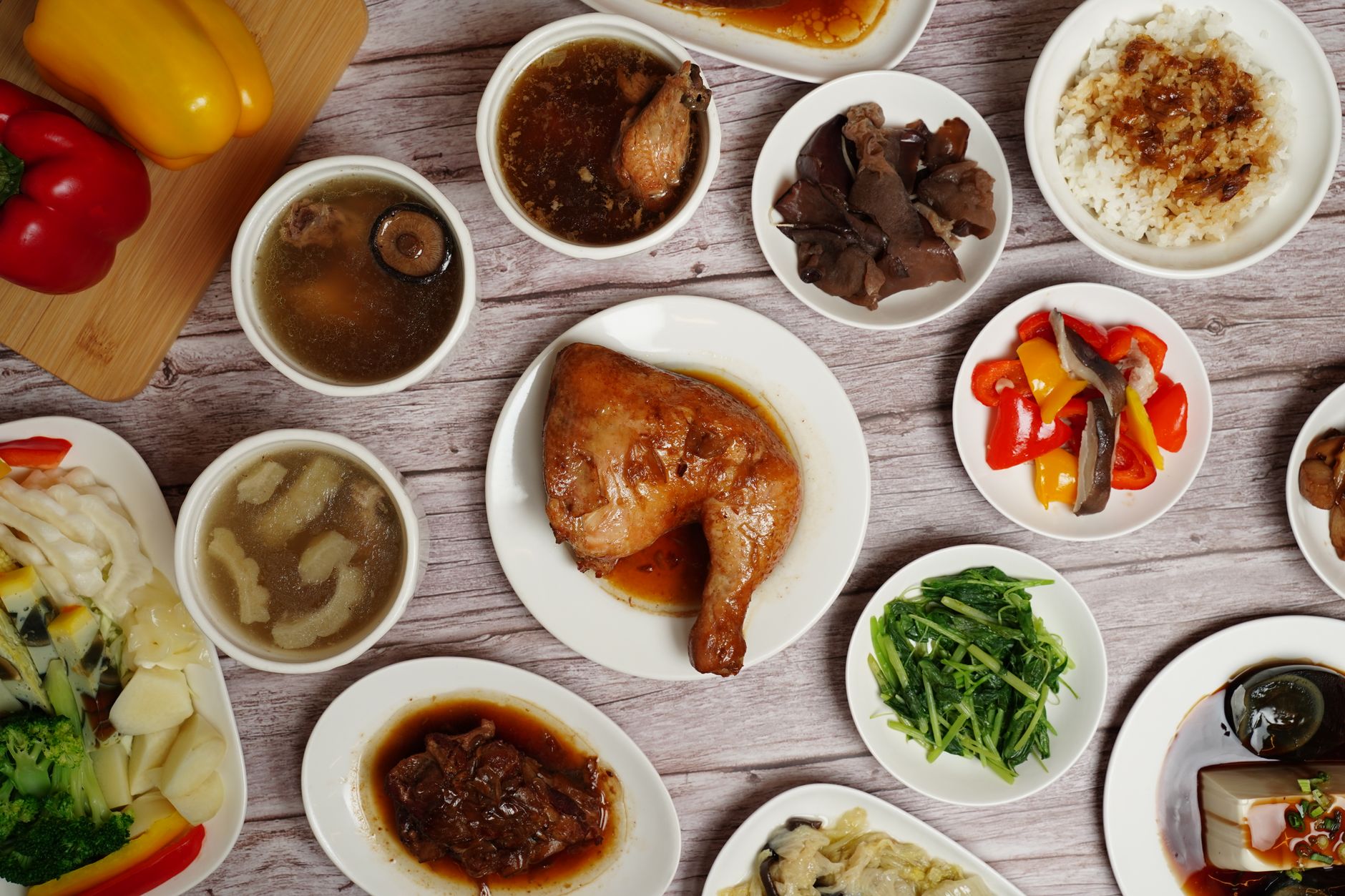
What to Eat by Destination
Beijing
Beijing's culinary identity is built on two things: imperial-era court cuisine and the street food culture of its hutong neighborhoods. The non-negotiable dishes:
- Peking Roast Duck (北京烤鸭, Běijīng kǎoyā): The definitive Beijing experience. Quanjude (founded 1864) and Dadong are the most famous establishments. The correct way to eat: spread hoisin sauce on a thin pancake, place a slice of crispy duck skin, a piece of meat, cucumber strips, and scallion, then roll and eat in one or two bites. The bones are taken away to make soup.
- Zhajiang noodles (炸酱面, Zhájiàng miàn): Beijing's everyday noodle dish — handmade noodles topped with a fermented soybean and pork sauce, fresh vegetables, and cucumber. A classic hutong restaurant dish.
- Jianbing (煎饼): The street breakfast of Beijing — a savory crepe made to order on a griddle, filled with egg, scallion, cilantro, and crispy wonton. ¥8–12 from street vendors, consumed while walking.
- Lamb hotpot (涮羊肉, Shuàn yángròu): Beijing's Muslim-influenced instant-boiled mutton hotpot — paper-thin slices of lamb dipped into a sesame and fermented tofu sauce. Different from Sichuan spicy hotpot; the broth is clear.
Xi'an
Xi'an's food is shaped by its position at the eastern end of the Silk Road and a substantial Hui Muslim population. The Muslim Quarter (回民街) is one of China's best food streets — chaotic, fragrant, and packed with vendors at any hour.
- Biang biang noodles (biáng biáng miàn): Wide, belt-width hand-pulled noodles in a chili-oil and vinegar sauce. The character for "biang" is the most complex character in Chinese writing — over 57 strokes.
- Rou jia mo (肉夹馍): Slow-braised pork or beef in a flatbread — sometimes called "Chinese hamburger." The pork version is the Xi'an original; the halal beef version dominates in the Muslim Quarter.
- Yang rou pao mo (羊肉泡馍): Lamb soup where you break the unleavened flatbread yourself into the bowl, then the kitchen pours the broth over it. The ritual of tearing the bread to the right size is taken seriously.
Chengdu
Chengdu was designated a UNESCO Creative City of Gastronomy in 2010. The Sichuan capital has more restaurants per capita than any comparable city in China. Full detail in our Sichuan food guide. To plan a trip around the food, see our complete private Sichuan travel guide.
- Mapo tofu (麻婆豆腐): Silken tofu in a deeply spiced sauce of doubanjiang (fermented broad bean paste), ground pork, chili oil, and Sichuan peppercorn. The dish should leave your lips tingling.
- Dan dan noodles (担担面): Thin noodles in a sesame-chili sauce with minced pork, preserved vegetables, and peanuts. Traditionally sold from carrying poles in the street — hence the name.
- Sichuan hot pot (四川火锅): The communal cooking experience at the center of Chengdu social life. A bubbling cauldron of chili and peppercorn broth; you cook your own ingredients. Order a split pot (鸳鸯锅, yuānyang guō) to get one side spicy and one mild.
Shanghai
Shanghai's food scene combines local Shanghainese cuisine with the best representatives of every other regional tradition — it is the city where you can eat everything. The essential local dishes:
- Xiaolongbao (小笼包): Din Tai Fung's version is famous globally, but local Shanghai specialists (Jia Jia Tang Bao, Nan Xiang) make the definitive version. The filled buns contain hot soup inside the wrapper.
- Hairy crab (大闸蟹, Dàzhá xiè): A seasonal delicacy available only in October–November, from Yangcheng Lake near Shanghai. Eaten with ginger vinegar sauce; the seasonal specificity makes it a true China experience.
- Sheng jian bao (生煎包): Pan-fried pork and soup dumplings — the base is crispy from frying while the top is steamed. A Shanghai breakfast staple.
How to Order Without Speaking Mandarin
The Photo Menu Solution
Most mid-range and tourist-adjacent restaurants in major cities use photo menus or picture cards on the table. Point at what you want. This works reliably for 80% of restaurant encounters.
Camera Translation
Google Translate's camera function (hold up your phone and point at the menu — the translation appears live on screen) handles most restaurant menus with reasonable accuracy. Download the Chinese language pack before arrival for offline use. For handwritten menus, accuracy drops — ask staff to help identify dishes with a gesture.
Ordering Strategy
A Chinese restaurant meal for two people typically orders 3–4 dishes plus rice or noodles. The structure: one meat/poultry dish, one fish/seafood dish (optional), one vegetable dish, one soup or congee. Dishes arrive when ready — not simultaneously in the Western style. This is normal and not a sign of poor service.
Dietary Restrictions
Vegetarian and Vegan
China has a deep Buddhist vegetarian cooking tradition — vegetarian restaurants attached to Buddhist temples serve some of the most sophisticated plant-based food in Asia. In mainstream restaurants, the challenge is that Chinese "vegetarian" dishes sometimes include oyster sauce, shrimp paste, or lard as cooking ingredients. The phrase "我是素食者,请不要加肉或肉汤" (Wǒ shì sùshí zhě, qǐng bú yào jiā ròu huò ròu tāng — "I am vegetarian, please no meat or meat broth") covers the basic request. Full strategies in our vegetarian food in China guide.
Halal
China has a substantial Muslim population (Hui, Uyghur, and other ethnicities), and halal restaurants (清真, qīngzhēn, marked with a crescent moon) are widespread in most cities. Xi'an's Muslim Quarter is the most famous halal food street in China. Lanzhou beef noodle restaurants (兰州拉面) are halal and present in almost every Chinese city — identifiable by the blue and white sign. In Xinjiang, the entire food culture is halal.
Gluten-Free
Genuinely difficult in China. Wheat flour and soy sauce (which contains wheat) appear in a vast proportion of Chinese cooking. Rice-based southern Chinese cuisines (Cantonese, Yunnan) offer more options than wheat-heavy northern traditions. Communicate with restaurant staff and be aware that cross-contamination is common in Chinese kitchen environments.
The Restaurant Experience: What to Expect
A few norms that surprise first-time visitors to Chinese restaurants:
- Noise level: Chinese restaurants are loud. Animated table conversation is the norm; the sound of a busy restaurant is considered lively and positive, not chaotic.
- Service style: Servers do not typically check in during the meal the way Western restaurants do. To get attention, say "服务员!" (Fúwùyuán! — "Server!") or use the call button present at most tables.
- Tea: Tea is typically brought immediately after seating and is free. At Cantonese restaurants, rinsing your cups with the first pour of hot tea is customary — pour the hot tea over your cup, bowl, and chopsticks, then pour the rinse water into the small dish provided.
- Hot water: Tap water is not served; hot water (热水, rè shuǐ) or tea is the standard beverage at meals. Cold water is available on request in most tourist-oriented restaurants.
Further Reading in This Series
- China's Eight Regional Cuisines: A Traveler's Guide
- What to Eat in Beijing: The Essential Food Guide
- Sichuan Food Guide: How to Eat in Chengdu Without Losing Your Palate
- Vegetarian Food in China: Where to Eat and What to Order
- Chinese Street Food: The Best Dishes by City
ChinaTourly Planning Note
We treat this topic as a practical planning issue, not a generic travel tip. Before we recommend a route, our team checks the traveler's arrival city, season, mobility level, payment setup, language needs, and whether the experience requires advance local coordination.
Official planning references
Plan this with a China-based team
If this topic affects your route, timing, payment setup, dietary needs, or family logistics, tell us what kind of China trip you are considering. ChinaTourly can turn the research into a private itinerary with English-speaking support, local transport, and practical pre-trip preparation.
Frequently Asked Questions
Is this guide enough to plan Chinese Food Guide: What to Eat, Where to Eat It on my own?
It can help you understand the basics, but travel in China often depends on timing, local rules, payment setup, language support, and transport logistics. For a private trip, we turn the guide into a day-by-day plan with local support.
When should I start planning a private China trip?
For a simple city route, two to three months is usually workable. For culture-heavy routes, heritage workshops, family travel, Tibet, Yunnan, or festival timing, three to six months gives more room to secure better guides and smoother logistics.
Can ChinaTourly customize this around my budget and travel style?
Yes. ChinaTourly designs private, tailor-made journeys for English-speaking travelers. We can adjust pace, hotels, guides, transport, food requirements, and cultural access around your party instead of forcing you into a fixed group itinerary.
Turn this into a real trip — we design private China journeys end to end.
Explore our signature private journeys → · Beijing Wall Walk + Hutong Deep →


