Longquan celadon is a ceramic tradition associated with Longquan in Zhejiang, in which the clay body, glaze and firing work together to produce the finished surface. Look beyond the familiar green colour: the rim, foot, profile and decoration reveal different decisions. A museum visit explains historical objects; a workshop visit can explain a living maker's process.
Begin with the object rather than a colour chart
At first glance, a group of celadon vessels can seem remarkably similar. Move your attention from their colour to their outlines and the differences become easier to describe. A bowl opens towards the viewer; a bottle concentrates attention around its neck; a dish provides a broad surface on which a pattern can unfold. Green is only the beginning of what these objects have in common.
Choose one piece and follow its edge with your eyes. Where does the wall change direction? Is the transition from neck to shoulder abrupt or gradual? Does the foot appear substantial, or does the vessel seem to hover above it? These are useful questions even if you do not yet know the date or technical vocabulary. They keep the encounter grounded in something you can actually see.
Then return to the glaze. Notice whether it looks equally dense at the rim, on a raised line and in a recess. The relationship between surface and shape is more informative than finding the nearest colour name on a screen. A photograph, especially one taken under different lighting, cannot provide a dependable colour standard for comparing an object in front of you.
This way of looking also makes a conversation with a guide or potter more productive. Instead of asking whether an entire display is authentic, point to a feature and ask how it was made. A clear answer about that particular rim or surface gives you something to examine and remember.
What the heritage recognition actually concerns
The Chinese national heritage account describes Longquan celadon as a traditional craft involving material preparation, forming, glazing and firing. It records national recognition in 2006 and inscription on UNESCO's Representative List in 2009. The subject is a body of transmitted knowledge and practice, not simply a collection of valuable old pots.
That distinction helps separate three things often mixed together in travel advertising: an ancient object, a living craft and a modern visitor activity. A museum bowl can document historical production. A contemporary potter can practise and develop the craft. A short workshop can introduce a visitor to one part of making. None is interchangeable with the others, even though all may be discussed under the same cultural heading.
For example, making a small clay shape during an introductory session does not mean you have completed the full traditional firing process. Equally, a newly made vessel need not be an imitation pretending to be old. It can be an honestly identified contemporary work. The important questions concern the work's actual origin, method and purpose.
Heritage recognition is also not a quality certificate for every item sold under the Longquan name. It does not establish the maker of an individual bowl, its suitability for food, its age or the conditions of a purchase. Those require evidence attached to the particular object rather than borrowed authority from the tradition's recognition.
Clay body and glaze are different parts of the explanation
Think of the body as the formed vessel and the glaze as its fired surface layer. In a finished piece they work together, but separating them conceptually helps you follow a demonstration. The material being shaped at a wheel is not a pot already carrying its final green surface. Nor is the final appearance simply green paint added after all the making has finished.
The official account names locally associated mineral materials and preparation knowledge. Its description is a useful introduction to the craft, not a recipe that every workshop follows in identical proportions. A maker may be able to show prepared clay, a test piece and a finished vessel side by side. Ask what each sample demonstrates instead of assuming that every grey or pale object on a shelf is at the same stage.
An unglazed area, where it is visible without handling the object, can help you recognise the distinction. You may see a contrast between the body and the glazed wall. Treat that contrast as an observation, not an instant test of age or authenticity. Similar visual effects can occur in different contexts, and a visitor cannot resolve provenance from one exposed patch.
If you are shown raw ingredients, ask how the samples relate to the work being demonstrated that day. A display may illustrate historical materials while production uses prepared batches elsewhere. Understanding that relationship is more valuable than collecting unfamiliar ingredient names without knowing what they do in the process.
Follow the sequence before focusing on the kiln
Firing attracts attention because it seems to deliver the dramatic transformation. Yet the national account describes substantial work before that moment: preparing materials, forming a vessel, drying and refining it, decorating and glazing, and arranging work for firing. The kiln is part of a sequence, not a device that can rescue every earlier decision.
During a visit, ask the demonstrator to identify the stage you are seeing. A pot that can still be adjusted by hand presents different possibilities from one already fired. A trimmed foot tells you something about finishing that a brief wheel demonstration may not show. A display of several stages can make the sequence clearer than watching one impressive operation without context.
Do not assume that a visitor session follows the production schedule of a working studio. It may be designed around an introductory activity, with later stages completed by staff. That arrangement can be worthwhile when explained clearly. Problems arise when a short hands-on exercise is described as though the visitor personally undertook every specialised stage.
Before joining, establish what you will make, what the staff will do afterwards and whether a finished object is actually included. Ask how collection or shipping works if later processing is necessary. These are practical questions about the activity you are considering, not reasons to dismiss an introduction because it differs from professional training.
Forming is a decision about the whole vessel
A wheel demonstration can be absorbing: a lump becomes an opening, a wall rises, and a shape appears. Try to follow more than the speed of the transformation. Watch the relationship between the opening and the base, the height and the width, the wall and the space it encloses. These proportions will continue to matter after the surface changes in firing.
Ask which features of the demonstration are particular to the intended vessel. A bowl, a bottle and a wide dish present different design problems. Even without touching the clay, you can notice where the maker pauses to assess the profile or changes the direction of the wall. A good explanation connects those movements with the form being made.
Not every part of a completed object must have been created in one uninterrupted performance at the wheel. Ask how the relevant work is assembled or refined rather than using a short demonstration as proof of its entire production history. If the studio shows a handle, a lid or another component, find out when it joins the rest of the piece.
Photographing the finished profile, with permission, can be more useful than recording a few seconds of fast movement. It gives you a reference when looking at the glazed version later. Keep the caption modest: it shows that demonstrator and that stage, not a universal account of every Longquan workshop.
Glaze colour is not a single fixed green
Museum descriptions use names such as powder-green and plum-green for celebrated Longquan surfaces. These names are helpful cultural vocabulary, but they are not interchangeable with precise digital colour codes. A physical glaze has thickness, reflectivity and a relationship with the body underneath. Its appearance changes with the object and the conditions in which it is viewed.
Start by comparing two areas of one vessel. A raised edge may appear different from a broader surface. A recess can draw the eye through a change in tone or depth. You are not necessarily looking at several painted colours; you may be seeing a surface responding to differences in form. Ask the maker or museum interpreter which explanation applies to the object concerned.
Avoid turning colour preferences into a simple ladder of quality. A darker shade is not automatically more valuable, and a paler one is not automatically older. The historical context, intended effect, condition and documented identity all matter. A shop's flattering light can also make comparisons harder, particularly when the reference is a photograph on your phone.
For a contemporary purchase, consider whether the piece works as a whole. Does the surface support the shape? Is the finish consistent with what the maker says they intended? You can have a clear personal preference without claiming that your preferred shade is the only legitimate expression of a broad ceramic tradition.
A small bottle teaches close looking
The Palace Museum records a Song-period Longquan bottle with a dish-shaped mouth, measuring 17 centimetres high. Its description notes a slender neck, rounded body and pale body visible where the glaze is thin on projecting features. Those few details offer a focused alternative to a general claim that celadon resembles jade.
Look at the museum's linked object photographs and ask where your eye moves first. Does the broad mouth make the neck seem more slender? How does the rounded body balance the upper section? The absence of a busy painted scene does not leave the object without visual structure. Proportion and changes in surface can supply the interest.
The recorded height is useful because isolated object photographs can mislead us about scale. Imagine the bottle beside an everyday object of known size rather than mentally enlarging it into a floor vase. Scale affects how you understand the relationship between its parts. It also reminds you that a close photograph is a way of examining an object, not a substitute for its physical dimensions.
Use the example as an exercise in attention, not a shopping authentication checklist. Finding a similar outline in a modern shop does not establish a Song date. The museum's attribution belongs to its documented object; your visual comparison remains a comparison.
Raised lines can make the glaze easier to read
Another Palace Museum Longquan bottle is described with seven raised horizontal lines and a thinner glaze over the projections. It provides a particularly clear prompt: follow a line around the vessel, then compare it with the areas above and below. The pattern belongs to the shape as well as to the appearance of the surface.
This is different from treating decoration as an image applied to a neutral container. A raised band changes the way the wall is encountered. Even a small difference can interrupt an otherwise continuous curve and establish a rhythm. You can examine that rhythm without assigning an invented symbolic meaning to each line.
Try the same exercise with a contemporary object if its owner permits close viewing. Do the bands appear evenly spaced? Does their placement emphasise the shoulder, the widest part or the transition towards the foot? Those questions concern the design in front of you. They do not require assuming that a modern potter intended to reproduce the museum piece.
Keep the source attribution precise when making notes. The museum description concerns one historical bottle, while your observations concern what you can see in the image or the current object. Distinguishing the two makes it possible to compare thoughtfully without turning resemblance into an unsupported history of influence.
A square vessel changes the conversation
The Palace Museum's Longquan cong-shaped bottle is catalogued as Song-period and described as adapting the form of a jade cong. Its square body, raised linear decoration and circular opening provide a different starting point from the rounded bottle. Celadon does not have to be understood through bowls and soft curves alone.
Consider the meeting of flat faces and corners. A viewer can approach one face directly or see two faces together, changing the apparent silhouette. The mouth then introduces a different geometry. The object asks you to think about relationships between forms rather than look for a single continuous curve.
The reference to an older material and form is also instructive. Ceramics can reinterpret shapes associated with other objects. That does not mean a ceramic version performs the same function in every context or that its owner used it in an ancient ritual. The source establishes a formal association; claims about use need their own evidence.
For a visitor, this is a good reason to read the object label before inventing a story from appearance. An unfamiliar vessel can invite speculation, but the catalogue may supply a much more interesting question. What happens when a shape associated with one material is remade in another, with different possibilities for surface, scale and decoration?
A large dish invites a different pace of viewing
A Yuan-period dragon-pattern Longquan dish in the Palace Museum has a recorded mouth diameter of 42.9 centimetres. The museum identifies a moulded dragon-and-cloud design in the centre and incised decoration on the inner wall. This example counters the impression that celadon must always be visually undecorated or modest in scale.
Look first at how the broad centre and surrounding wall divide the available space. Then follow the pattern rather than trying to absorb everything at once. Does the decoration encourage movement around the dish, or draw attention towards the middle? The answer may become clearer when you stop treating the entire object as one green circle.
The dimensions again matter. A picture viewed on a phone can make a large dish seem no bigger than a tea saucer. Read the measurement and imagine the space it would occupy. This is not simply a larger version of every small bowl; the relationship between the pattern and the field around it deserves its own attention.
Do not use this one object to assign a fixed character to an entire dynasty. It is a documented example that helps broaden your view. A collection contains individual objects, and an enjoyable museum visit can be built around comparing a few of them carefully rather than memorising a sweeping description of a period.
The stem bowl illustrated on this page
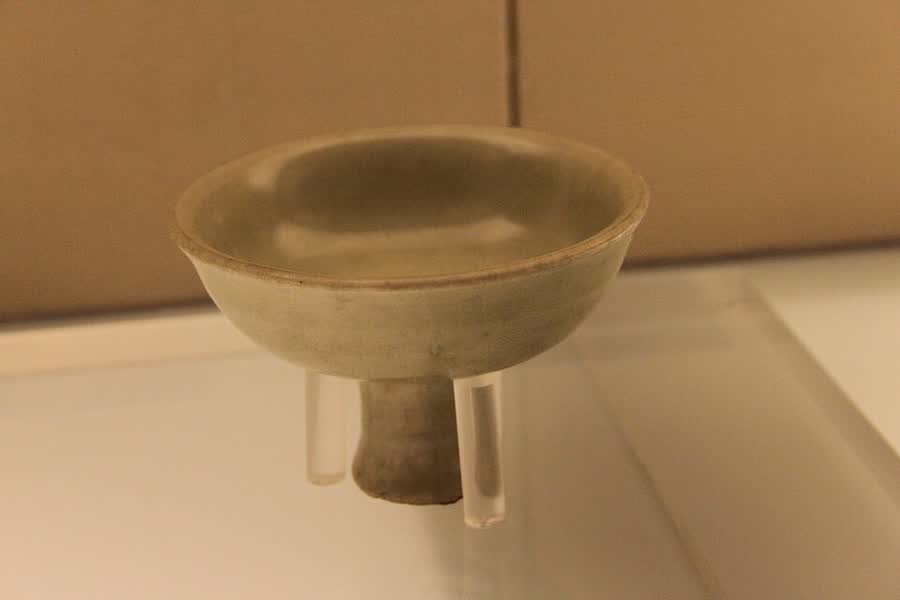
The retained photograph shows a Longquan stem bowl identified with the Shifang hoard and photographed in the Sichuan Provincial Museum collection. It is a historical object photographed away from Longquan, not a scene of a present-day Zhejiang workshop. The image credit and collection context remain attached to it so that the illustration does not quietly acquire a different identity.
Start with the transition from the bowl to its support. How does raising the bowl change your sense of its weight and balance? Follow the outer profile downwards, then look back towards the opening. You may notice relationships that would be less prominent in a shallow bowl placed directly on a low foot.
A single photograph cannot show every surface or settle questions about condition. Nor does the collection identification prove that a visitor can see the object on a particular date. A museum owns many things that may not be in a current display. The image is useful as a looking example without being converted into an advertised guaranteed encounter.
If this vessel catches your interest, take the object information rather than an unsupported promise into your planning. Ask the institution about current displays through its official channels. You can still enjoy comparing the photograph with other documented ceramics even if the exact object is not on view during your trip.
Fire involves judgement, not just reaching a number
The official heritage account places knowledge of firing alongside material selection and forming. A number on a temperature display can be useful information, but it cannot by itself explain a finished glaze. Ask how the maker assesses the firing and what the displayed information means within their process. The answer should connect the equipment with the work rather than turn the visit into a recital of impressive temperatures.
A kiln demonstration is not necessarily a live firing. You might see an inactive kiln, a model, an explanation of loading or finished pieces from an earlier cycle. Each can teach something different. Find out which you are being shown before describing the experience afterwards as watching a vessel transform in the fire.
A working kiln also imposes practical boundaries. Follow staff instructions about where you may stand and what may be approached. Do not treat a barrier as an obstacle to a better photograph or assume that a process is safe to touch because part of it looks still. An informative visit does not require entering every production area.
For a requested workshop appointment, describe your interest specifically. Someone interested in forming may need a different arrangement from someone hoping to understand firing practice. Availability should be checked against the actual work schedule, rather than presumed from an attraction's name or from an old video of an event.
Read a museum label as several separate statements
A ceramic label may contain an object name, a period, a kiln attribution, a material description and a collection number. These are not all the same kind of information. The collection number identifies a particular museum record. A period attribution concerns dating. A descriptive name helps distinguish the object's form or decoration. Keeping these functions separate makes the label more useful.
Suppose two objects have similar English names. Their collection records may still distinguish important differences in date, size or technique. Read the details rather than assuming that the shorter label tells the complete story. Conversely, differences in English terminology need not automatically mean that one institution has made an error; translation and classification can vary.
Note what the label does not say. A vessel identified with a kiln region does not necessarily come with the name of an individual maker. A collection entry does not automatically provide a complete history of every owner. Where information is absent, leave the gap rather than filling it with a plausible anecdote about an emperor, merchant or family.
This approach makes a guided visit more conversational. You can ask why a feature supports an attribution, how the form relates to another object, or which parts of the record are uncertain. Those are richer questions than asking a guide to confirm a story drawn from an unrelated shop label.
Museum, studio and shop offer different kinds of encounter
Choose according to what you hope to understand. A museum can place objects beside other periods and forms. A studio may connect a maker's explanations with materials and work in progress. A shop can let you compare contemporary pieces available for purchase. One place may combine these functions, but it helps to know which activity is actually being offered.
If your priority is historical comparison, ask about the collection and current exhibition. If you want to see a technique, ask what can be demonstrated and who will explain it. If you want to buy a usable bowl, request information about that product and its intended use. A famous location does not answer these different questions on its own.
Be open about language needs. A skilled maker need not also be an English-speaking guide, and an interpreter may need advance notice of your interests to prepare useful terminology. Photographs of the type of object you want to discuss can help, provided you do not assume the maker is responsible for the pictured work.
Allow space for a visit that is mainly about looking. Buying something or completing a hands-on task is not the only evidence that the encounter was worthwhile. You might leave understanding the difference between two surfaces, or noticing a form you previously passed over. That is a meaningful result without turning the craft into a souvenir transaction.
Bringing a contemporary piece home
If you decide to buy, establish what is being sold in ordinary language. Is it contemporary? Who made it, where, and what information supports that account? Is the signature attributed to an individual or associated with a studio? Ask for the relevant details in writing rather than relying on a hurried conversation that becomes difficult to reconstruct after leaving.
Separate a claim about artistic tradition from a claim about practical use. A piece marketed as decorative should not be assumed suitable for food or drink. For intended tableware, ask the seller for applicable product information and care instructions. The colour of the glaze, an attractive story or the word traditional cannot supply that information.
Inspect the actual object you will receive and clarify any variation from a display sample. Discuss packing, shipping responsibility and what happens if an item arrives damaged before agreeing to a purchase. This guide does not set a price, recommend an investment or certify a seller. Those decisions depend on the particular object and terms.
Treat an antique claim as a separate, more demanding matter. A visual resemblance to a museum piece is not adequate provenance. Do not assume that a tourist purchase may automatically be exported or imported without restrictions. Obtain current official guidance relevant to the object and your destination before committing to a transaction that depends on taking it across a border.
Put Longquan in the right travel geography
Longquan is not a neighbourhood of Hangzhou, and a general Zhejiang itinerary does not automatically include a celadon visit. Begin with the location of the particular museum or studio you want to see. Then plan how it fits with the rest of the journey, including the time available for the visit itself rather than merely reaching the area.
Our Hangzhou tea visit planning guide offers a separate introduction to a cultural interest in Hangzhou. The Longjing guide develops the tea subject further. Their connection here is a possible interest in material culture, not a claim that a tea visit includes a Longquan kiln or that the two crafts are demonstrated in the same place.
The Shanghai journeys collection and Shanghai, Hangzhou and Suzhou Triangle route provide eastern-China planning context. They are not presented as confirmed Longquan itineraries. Do not add a distant craft stop simply because several places share a provincial or regional association; examine the actual route and available time.
For a bespoke journey, state the experience you want: historical ceramics, a forming demonstration, an explanation of glazes or a contemporary studio visit. Mention access and interpretation requirements. The response should identify what can genuinely be arranged, rather than substitute a generic shopping stop and call it the same experience.
Questions about Longquan celadon
Is celadon just green pottery?
Colour alone is an incomplete description. For Longquan celadon, the relationship among the body, glaze, forming and firing is central. Begin by examining the object's profile and surface, then read its documented identity. A green ceramic made elsewhere is not automatically Longquan ware, and a photograph's colour cannot establish origin or date.
What did UNESCO recognise in 2009?
The recognised element is the traditional firing technology of Longquan celadon, understood as transmitted craft knowledge and practice. Recognition does not authenticate every bowl in a shop or certify a visitor package. The national heritage account records the inscription and describes the craft; an individual product or activity requires its own accurate information.
Should every piece have exactly the same colour?
No single colour sample describes the whole tradition. Shape, surface and viewing conditions also affect what you see. Historical names for glazes can help a discussion, but a phone image is not a dependable matching chart. Compare the actual objects and ask how the maker describes the intended result instead of assuming that variation alone proves a defect.
Is a plain vessel less skilful than a decorated one?
A surface without a painted scene can still demand close attention to proportion, transitions and finish. The Palace Museum bottle examples offer useful exercises in seeing those relationships. Elaborate decoration and visual restraint create different viewing experiences. Neither the number of motifs nor their absence is enough to establish the quality of an individual work.
Does crackle prove that a bowl is old?
No. A visible surface pattern is not sufficient evidence of age or provenance. Do not turn an attractive characteristic into a shortcut for authenticating ceramics. If an antique attribution matters to a purchase, seek appropriate documented expertise and clarify the legal and practical implications. A travel introduction cannot replace an object-specific assessment.
Can I finish my own celadon bowl during one short session?
Ask exactly which stages the session includes. An introductory forming activity is not the complete preparation, glazing and firing sequence. Staff may undertake later work, and collection or shipping may be necessary. Confirm the arrangement and the intended finished result before booking rather than expecting to leave with a professionally fired vessel immediately.
Will a kiln be firing when I visit?
That depends on the actual production schedule and access arrangements. A venue may show an inactive kiln, a display or a demonstration of another stage. These can be informative, but they are different experiences. Describe your interest when enquiring and respect working-area restrictions rather than assuming a live firing is continuously available to visitors.
Is the pictured stem bowl in Longquan?
The retained photograph identifies a historical Longquan bowl in the Sichuan Provincial Museum collection, associated with the Shifang hoard. It is not a photograph of a Zhejiang studio or a product offered by ChinaTourly. Collection ownership does not establish current public display; check official exhibition information if seeing that exact object is important to you.
Can I use any celadon object for tea?
Ask for the product's intended use and relevant food-contact and care information. A decorative vessel should not be assumed suitable for drinking simply because its shape resembles a cup. Heritage recognition and a pleasing glaze are not substitutes for product documentation. Follow the maker's specific instructions rather than a general rule applied to every ceramic object.
Is Longquan a quick addition to a Hangzhou tea visit?
They are separate destinations. A shared Zhejiang connection does not establish a convenient transfer or a confirmed activity. Identify the actual venue, then check transport and the time needed for a useful visit. The linked Hangzhou tea material provides context for a different interest, not evidence that a Longquan stop is already included.
Are the museum objects linked here guaranteed to be on display?
No. Online collection records support the discussion of identified objects, but they do not promise current gallery availability. An object may be stored, loaned or shown under different arrangements. Check the museum's current information before planning around one piece. The records remain useful for preparation and comparison regardless of the display schedule.
Why is there no firing video embedded here yet?
No matching licensed Longquan craft clip has been verified for this page. Generic pottery footage could misidentify a process, and unrelated scenery would not show celadon making. A useful future film needs a clear subject, production stage and source. The existing historical-object photograph remains accurately credited instead of implying evidence it does not contain.
Sources and further reading
- China's official heritage account: traditional firing technology of Longquan celadon. Craft sequence and recognition; historical safeguarding narrative is not a current venue schedule.
- Palace Museum: Song dish-mouth Longquan bottle. Identified object and dimensions, with views of the vessel and base.
- Palace Museum: Longquan bottle with raised horizontal bands. Catalogue description used for a specific looking exercise; no universal authentication test.
- Palace Museum: Longquan cong-shaped bottle. Formal association with jade cong and the recorded object identity.
- Palace Museum: Yuan dragon-pattern Longquan dish. Object scale, moulded centre and incised decoration.
Reviewed 2 November 2026. Looking exercises are editorial interpretation. Collection records, living production and bookable activities are kept distinct.