Longjing is a Chinese green tea closely associated with Hangzhou. West Lake Longjing refers to a particular local origin, while its heritage tradition concerns the knowledge of growing, picking and processing the leaf. To understand it on a visit, separate three questions: where the tea grew, how it was made, and how you enjoy drinking it.
A photograph of green hills answers none of those questions on its own. Nor does a beautiful packet, a high price or a host's confident description. The most rewarding tea visit gives you time to examine something specific: a maker changing the pressure of a hand, the difference between dry and infused leaves, or two cups prepared in a way that lets you compare them fairly.
This guide is for travellers who want more than a shopping stop but do not arrive with a specialist vocabulary. It explains what the cultural designation covers, how to watch a demonstration, how to ask useful questions at a tasting and how to choose between a museum, a village walk and a booked activity. It does not certify a seller, promise a harvest session or turn a cultural tradition into a medical recommendation.
What the heritage record actually recognises
The national record for West Lake Longjing green-tea processing lists the tradition in the traditional craftsmanship category, with project number VIII-148 and a 2008 inscription. Its focus is practical knowledge: cultivation, selective picking and skilled pan-processing, including a repertoire of ten named hand techniques. That is more specific than saying that all tea sold in Hangzhou is a heritage product.
Think of the recognition as a reason to pay attention to work rather than as a badge on a souvenir. A packet can carry a cultural illustration without telling you who processed its contents. A demonstration can explain an important technique without proving that the entire batch offered in the shop was made in front of you. These are separate questions and deserve separate answers.
The broader international context is China's traditional tea processing and associated social practices, inscribed on UNESCO's Representative List in 2022. The UNESCO committee decision concerns knowledge surrounding tea cultivation, processing, drinking and sharing. It is not a commercial endorsement of a particular farm visit or a guarantee that a business offers access to a recognised practitioner.
For a visitor, the useful distinction is between a living practice and a purchasable product. You can learn something substantial without buying tea, and buying tea does not by itself mean that you have seen the craft. If a programme promises both a workshop and a tasting, ask what you will observe or do during each part. A clear description is more useful than repeated references to prestige.
Longjing, West Lake and the problem of place names
The name on a tea packet can describe more than one thing. Longjing identifies a tea associated with a recognisable style, while West Lake Longjing makes a more particular claim about origin. Hangzhou is a city, not a substitute for the exact growing area of every tea sold there. Keep those levels separate when reading labels or discussing a sample.
A Hangzhou government explanation published in January 2022 describes the West Lake Longjing protection system and its specialised labelling, including information about the leaves' origin and production. This is useful background for asking a seller about traceability. It is not a live verification of any individual package, and this guide does not reproduce historical enforcement figures as current buying advice.
At the table, ask the host to identify the tea you are actually drinking before discussing reputation. Is the sample described as West Lake Longjing, or simply Longjing? Can the seller connect that description to the package you would receive? If several grades are offered, have each sample labelled while you taste rather than trying to remember a sequence of similar cups.
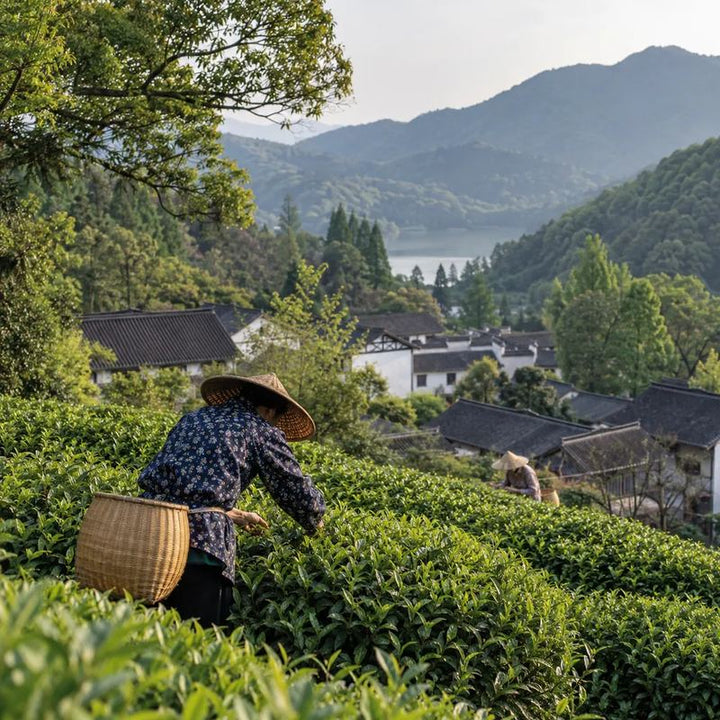
The scenery around a shop may be genuine and still tell you little about a specific packet. Visitors often make a reasonable but unreliable leap: there are tea bushes outside, therefore everything inside must come from those bushes. Ask about the batch instead. A precise answer may be modest, such as a named producer and harvest year, but it gives you more to work with than a sweeping story.
For the same reason, do not treat a village name as a quality score. Geography matters to a claim of origin; it does not replace your preference for one cup over another. You might favour a less expensive sample after a fair comparison. That is not a failure to appreciate the tradition. It is a good reason to separate provenance, craftsmanship and personal taste.
How to watch pan-processing without needing to be an expert
Watching tea being made becomes more interesting when you follow a change rather than a performance. Ask what stage the maker is showing, where the leaves were in the process before you arrived, and what will happen to them next. A short demonstration is rarely the same thing as following a complete batch from picking to finished tea.
The national heritage record describes a repertoire of hand movements in Longjing pan-processing. Do not expect the maker to perform ten isolated gestures in a neat sequence for the audience. The better question is what each movement is intended to achieve at that point. You are looking for decisions about the leaf, not collecting the names of tricks.
Watch how the material occupies the pan. Is it being moved loosely, gathered, pressed or shaped? Then ask the maker which change in the leaf prompts a different movement. This invites an explanation of judgment. It also makes room for an honest answer that the current demonstration shows only one stage or uses material prepared earlier.
It is tempting to judge skill by speed. Fast hands are visually impressive, but speed alone tells a newcomer very little about the intended result. Look for the relationship between the action and the leaves instead. If the host can show examples from different stages, compare their appearance and handling qualities without touching a hot surface or taking material from the work area.
Do not turn an observation guide into a do-it-yourself production recipe. A working pan can be hot, and food preparation has its own handling requirements. If participation is offered, let the host define what is safe, supervised and appropriate. Standing beside a maker and following a thoughtful explanation may teach you more than a brief photo opportunity with your hands in the wrong place.
Finally, ask which parts of production are manual and which use equipment. The answer need not fit a simple opposition between authentic hands and inauthentic machinery. What matters for your visit is that the programme describes its practice accurately. A partly mechanised operation should not be presented as wholly hand-made, while an honest explanation of equipment can be informative in its own right.
Read the dry leaf, then return to it after brewing
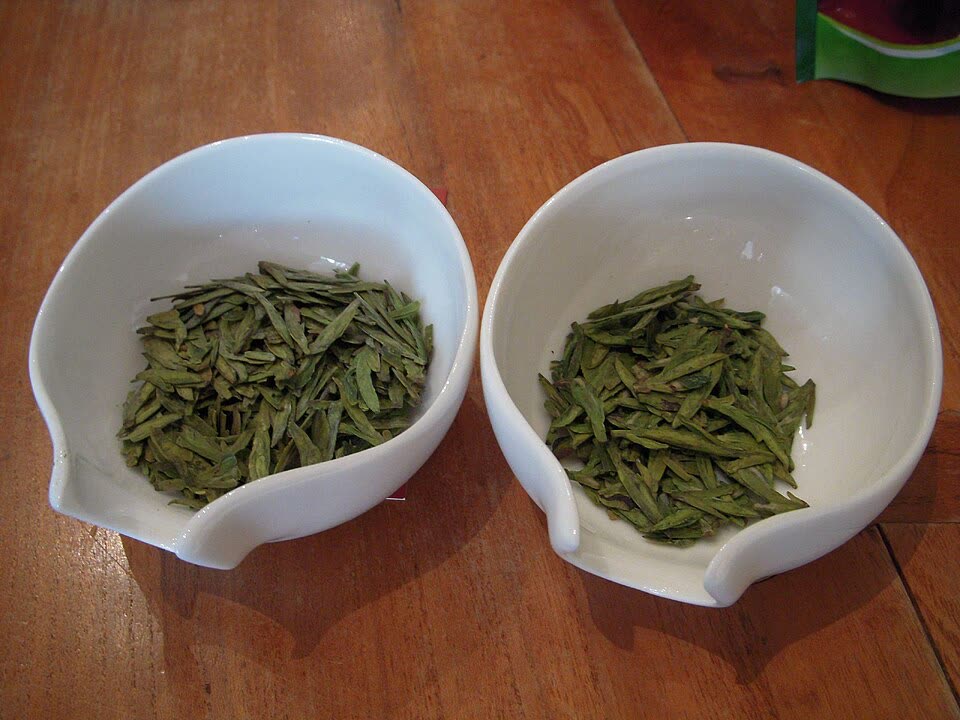
Begin with a small amount of dry tea on a clean surface chosen by the host. Notice shape, variation and the proportion of broken material without declaring a verdict immediately. Ask whether what you see is typical of the batch. A display sample selected for appearance may not represent the package you are considering, so establish that connection before comparing prices.
The existing photograph on this page shows Longjing leaves in two cups. Use it as an aid to observation, not a reference specimen that authenticates other tea. Photography changes colour, scale and texture, and it cannot convey aroma or the conditions under which the leaf was stored. A leaf that looks similar in a photograph does not acquire the same origin.
After brewing, return to the leaves. Observe how they have opened and how their appearance differs from the dry sample. Ask the host to explain what can reasonably be inferred and what cannot. A useful tasting makes those limits visible rather than encouraging you to believe that a glance can replace provenance information.
Keep the dry sample, cup and infused leaf connected in your notes. Otherwise, a succession of tastings can become a collection of disconnected impressions. A simple record might identify sample A, its stated origin, how it was prepared and what you noticed. You do not need a scoring system or a photograph of every cup to remember what mattered.
Avoid treating a single imperfection as proof of fraud, or a single attractive feature as proof of excellence. Different observations answer different questions. What you enjoy drinking is your judgment; what a label claims is a matter for supporting information. Keeping the two separate makes conversations with knowledgeable hosts more productive and sales pressure easier to recognise.
A tasting method that leaves room for your own preference
Ask to taste before hearing a long ranking of grades. It is difficult to form an independent impression after being told that one cup is prestigious and another is ordinary. You can still hear the explanation afterwards. First, notice what you like, what you find unfamiliar and whether you would want another cup prepared the same way.
If comparing two samples, ask whether they can be prepared under comparable conditions. Differences in leaf quantity, water or time can affect the comparison, so changing everything at once makes the result harder to interpret. This is not a demand that every casual host conduct a laboratory test. It is a way to understand what you are comparing.
Take notes in ordinary language. You might describe one cup as lighter, another as more drying, or one aroma as easier to notice. Do not borrow elaborate tasting terms simply because they appear on a display. A useful vocabulary helps you communicate a preference; it should not become a test that you can fail.
Allow the cup to become comfortable to drink, and keep your attention on the experience rather than on matching someone else's reaction. You can decline another sample. You can also explain that you are interested in the craft but do not wish to drink much tea. A visit should not require repeated consumption to demonstrate respect or enthusiasm.
When something tastes unpleasant to you, ask whether a different preparation would change it. That is a practical question, not an insult. If the next cup is different, record what changed. If you still dislike it, there is no need to invent admiration. The point is to understand your response well enough to choose a tea you will actually use.
The same principle applies to buying. A tea that makes sense during an elaborate tasting may not suit the way you prepare drinks at home. Ask for a preparation method using equipment you already own. A clear answer using an ordinary cup may be more valuable than a display of specialised vessels you do not intend to buy.
Choose a museum, a village walk or a practical session
These formats are not interchangeable. A museum is useful when you want context and a way to compare objects, techniques and historical accounts. A village walk foregrounds the landscape and the relationship between growing areas and settlement. A practical session should specify the activity, supervision and material involved. Decide which question you want answered before booking a format.
The China National Tea Museum's own introduction identifies two sites: Shuangfeng at 88 Longjing Road and Longjing at 268 Wengjiashan. Do not assume that a reference to the tea museum identifies a single meeting point. Confirm the site when arranging transport or a guided visit, especially if someone uses only an English shorthand.
For a museum-led visit, begin with the interpretation rather than rushing towards a shop or tasting. Choose a few objects or displays that help answer your own question. You might focus on how tea is prepared, how utensils differ, or how a local tea tradition fits into a wider history. You do not have to read every panel to have a worthwhile visit.
A village visit asks different questions. Which paths are open to visitors? Where are you allowed to stop? Is there a planned explanation of cultivation, or are you mainly walking through a landscape? A path passing tea plants is not automatically permission to enter a working plot. Keep photographs and movement within the access the host or site actually permits.
For a practical session, ask for the verbs. Will you observe, pick, sort, process, brew or taste? Those words describe different experiences, and a vague promise to experience tea culture does not tell you which is included. If the answer changes with season or weather, request the alternative format in advance.
Combining formats can work well, but more stops do not necessarily mean more understanding. One museum visit followed by an unhurried conversation may be more satisfying than several hurried tastings. Leave space for questions and for the ordinary details of the day, including food, rest and getting back to your accommodation.
Season matters, but a calendar is not a booking confirmation
Harvest photographs often make a destination appear to offer the same scene throughout the year. They do not. A Hangzhou report from March 2025 documented the start of spring picking in a particular location. That is evidence of an event in that year, not a fixed annual opening date or a promise for your travel dates.
If watching active production is the main purpose of your trip, make that requirement explicit. Ask whether fresh leaves are expected to be processed during your visit, whether access is arranged and how a change in conditions would affect the session. A truthful answer may be uncertain until closer to the date. That is more useful than a guarantee unsupported by the growing season.
Outside an active harvest period, a museum, discussion or tasting may still be worthwhile. The important thing is to name the experience accurately. A demonstration using prepared material should be described as a demonstration, not presented as an encounter with that day's harvest. You can enjoy it while understanding what it does and does not show.
Do not build a tightly timed day around an unconfirmed production moment. Leave flexibility between the tea visit and an onward departure. Rather than relying on a generic journey time, check the actual starting point, meeting place and transport plan. The two museum sites, a village and your hotel may be described under the same broad destination name while requiring different arrangements.
For wet weather, ask what interpretation can take place indoors and what becomes impractical. A landscape walk and a seated tasting have different needs. For anyone who finds slopes or long periods standing difficult, request route-specific information: steps, surfaces, distances and seating. The label easy visit is not a substitute for those details.
Buy a small amount you understand rather than a story you cannot check
If you want to take tea home, start by connecting the sample to the product. Ask which package contains the tea you tasted, what quantity it holds and what the stated origin and harvest year are. Request a clear price for that specific quantity before agreeing to a purchase. An attractive gift box can distract from the basic information you need.
Separate claims that can be documented from impressions that belong to the tasting. A seller may show origin information, identify a producer or explain a batch. Your preference for the flavour is a different kind of evidence. Neither should be used to replace the other: enjoyment does not prove origin, and a prestigious origin does not mean you must enjoy the cup.
Be wary of an explanation that becomes less specific as the purchase becomes more expensive. You should not have to accept an unverifiable story about exclusivity in place of a label or a receipt. Equally, avoid assuming that every unfamiliar practice is dishonest. Ask straightforward questions and give the seller a chance to answer them plainly.
Consider how much you will realistically use. A modest purchase that you can finish and prepare comfortably may be better than a large quantity chosen under pressure. Ask the seller for storage and preparation instructions for the actual tea, and keep those instructions with the package. Do not transfer a recommendation from another tea simply because the packets look similar.
If the tea is a gift, think about the recipient's habits. Someone who uses a large mug at work may appreciate clear brewing guidance more than elaborate presentation. Someone who avoids caffeine may not want tea at all. Do not describe Longjing as a treatment or a health product to make the gift sound more valuable.
For travel across borders, check the destination's current official rules before carrying food or plant products. Rules depend on the destination and can change; a shop's assurance is not the receiving authority's decision. Keep the original packaging and purchase details where useful, but do not assume that packaging alone establishes permission to import something.
Hospitality, photography and the people doing the work
A tea encounter involves people as well as objects. Ask before photographing a maker closely, filming a sustained demonstration or recording a conversation. Permission to enter a shop is not automatically permission to turn the people inside into promotional content. If someone declines, continue the visit without making the refusal the subject of another photograph.
At a working area, avoid arranging the scene for your camera. Moving tools, asking someone to repeat a hot process or stepping into a planted area can interfere with work. A photograph taken from the permitted viewing space may tell the story better than a staged image that obscures what was happening.
If interpretation is provided through a guide, leave time for both the question and the answer. Short, concrete questions translate more easily than a speech about authenticity. Ask what stage is being shown, what the maker is checking, or how the sample differs from the previous one. Follow the answer rather than reading through a list regardless of what is happening.
Do not assume that a photographed person is a nationally recognised inheritor, a member of a tour company's staff or a customer. Those are factual identities that require evidence. The same care applies when sharing your own images afterwards. A caption describing what is visible is usually more accurate than one assigning a status you did not confirm.
Buying something can be a way to support a business, but it should not be treated as the admission price to a conversation unless that arrangement was made clear. Clarify any tasting or session charge before it begins. This protects both sides from an awkward ending and allows you to decide whether the format suits your interests.
A useful Hangzhou day without turning tea into a checklist
Plan around a question rather than a collection of place names. If your main interest is the craft, give the explanation and demonstration the largest share of attention. If it is the landscape, prioritise an appropriate walk and a place to sit. If you are travelling with people whose interests differ, agree on one shared tea stop rather than assuming everyone wants repeated tastings.
The Hangzhou tea visit planning guide helps frame those choices within a wider stay. This heritage page explains the subject; the planning guide addresses how the visit fits into travel. Neither means that a particular activity is included in a route merely because the route visits Hangzhou.
For another way to read the city's cultural landscape, explore the White Snake tradition. Keep story and geography distinct: a literary association is not a historical record of an event. Pairing a tea visit with a story you have read can make a walk more interesting without adding another commercial activity to the day.
If your interest extends to the vessels used for drinking, Longquan celadon offers a different craft to investigate. Longquan is a separate destination, not a neighbourhood tea stop in Hangzhou. Treat it as an onward-travel idea only if the journey genuinely fits your schedule.
You can also read the tea ceremony introduction for the serving side of the subject. Processing and serving are related but not identical skills. A polished presentation at the table should not be described as a demonstration of leaf production, just as watching pan-processing does not teach every approach to brewing.
For ChinaTourly planning, the useful starting point is the experience you want to understand. Use the bespoke travel enquiry page to describe that interest, your dates and any access needs. A cultural guide is not confirmation of supply: a specific maker visit, supervised activity or language arrangement must be checked before it becomes part of a proposed itinerary.
Questions travellers ask about Longjing
Is Longjing the same as West Lake Longjing?
Do not use the names interchangeably when discussing a purchase. West Lake Longjing makes a more specific origin claim. Ask which designation applies to the sample and how it is connected to the package on offer. The answer should concern the tea itself, not merely the location of the shop or the landscape in its advertising.
Can I pick tea whenever I visit Hangzhou?
No picking activity is confirmed by this guide. Availability depends on the actual operation, season, conditions and permission. Ask whether the proposed visit includes picking, observing a harvest or simply walking near growing areas. If picking is unavailable, decide whether the alternative interpretation or tasting still meets the reason you wanted to visit.
Is a tea tasting the same as seeing the heritage craft?
A tasting introduces the finished tea and the way it is prepared for drinking. A processing demonstration introduces work on the leaf. A visit can include both, but neither should be silently substituted for the other. Ask the organiser to describe the sequence and identify which part involves observing a maker rather than listening to a sales presentation.
Must I buy tea after a tasting?
Clarify the arrangement before accepting a session. There may be a stated tasting fee, an included service or a retail demonstration, and those formats carry different expectations. Ask directly whether a purchase is expected and what any separate charge covers. Do not rely on an assumption that a friendly invitation necessarily means everything is free.
Can I identify authentic West Lake Longjing from a photograph?
A photograph cannot establish the origin of the leaves in a package. It can help illustrate appearance, but lighting, selection and presentation limit what you can infer. Use provenance information for an origin claim and your own tasting for preference. Neither a photograph nor an attractive hillside should replace a connection between the sample, producer and labelled product.
Which China National Tea Museum site should I choose?
First confirm whether your plan refers to Shuangfeng or Longjing; the museum identifies them as separate sites. Then match the visit to your interests and the current programme. Check official visitor information before travelling rather than copying an old schedule from a guide. If you book interpretation, confirm the exact meeting point and what it will cover.
Do I need specialist brewing equipment at home?
Before buying anything, ask how the tea can be prepared with the equipment you already use. Request an explanation suitable for that vessel and adjust according to your preference. Buying an unfamiliar set during a tasting can add cost without solving your actual problem. The most useful purchase is one that fits your routine after the trip.
Is the earliest spring tea always the right choice?
An early-harvest description is not a command to buy. Ask what it means for the specific sample, compare it fairly with another option and consider whether you enjoy the difference. Your budget and intended use matter. A story about scarcity should not replace the chance to understand the product or a clear statement of quantity and price.
Can a non-tea-drinker enjoy the visit?
Yes, if the format suits their interests. Museum interpretation, tools, landscape and observation of work can be engaging without repeated tastings. Explain that preference when arranging a visit so the programme does not depend on drinking several cups. If tea consumption raises a personal health concern, seek appropriate individual advice rather than relying on a tourism page.
Where can I watch official background on Chinese tea traditions?
The UNESCO tea heritage film page provides an official audiovisual resource about Chinese tea practices. Its subject is wider than Longjing alone. Read the accompanying description before using it to prepare for a specific visit, and distinguish general cultural background from the activity a local organiser has actually offered. A documentary helps frame questions; it does not confirm a venue, practitioner or itinerary inclusion.
What should I ask before confirming a guided visit?
Ask for the location, activity, language of interpretation, expected walking conditions, any tasting or participation charge, and the plan if production is not taking place. State whether your priority is craft, landscape or buying tea. A clear answer to those points is more useful than a long list of attractions with no explanation of what happens at each one.
Does cultural recognition guarantee a premium product or experience?
No. Recognition concerns a tradition and its safeguarding; it does not independently review every product or visitor programme using the name. Evaluate the particular offer on its own information. A modest, accurately described encounter can be valuable, while an expensive one can still leave basic questions unanswered. Choose the learning experience you want, then verify the practical arrangement.
Sources and further reading
- National heritage record: West Lake Longjing green-tea processing, consulted for the project identity, category and description of hand-processing knowledge.
- UNESCO decision 17.COM 7.b.2, for the wider tea heritage inscription, not endorsement of an individual business.
- China National Tea Museum: introduction, for the two sites; check its current visitor notices separately.
- Hangzhou government: West Lake Longjing protection regulations, January 2022, historical background to provenance labelling, not a live package authentication service.
- Hangzhou government: spring picking report, March 2025, an example of a dated harvest report, not a recurring booking calendar.
- UNESCO multimedia resource on Chinese tea practices, broader audiovisual context rather than Longjing-specific visit evidence.