Suzhou kesi is silk tapestry weaving that builds coloured shapes through local sections of weft rather than stitching onto finished cloth. Continuous warp threads support the image while coloured wefts turn within particular areas. To understand a work, examine its boundaries, colour transitions and construction, then distinguish weaving from any added painting or embroidery.
Follow a colour to its boundary
The easiest way into kesi is to choose one coloured area and ask where its thread goes. In an ordinary mental picture of weaving, a thread travels across the width of a cloth and returns. In kesi, the coloured weft can work within a smaller part of the design. A flower, a letter or an area of background therefore involves local decisions about where a thread turns.
This is what makes a border more than an outline. It is also a meeting between areas of construction. Look at the edge of a motif and then at a nearby transition within it. One may be distinctly separated while the other seems gradual. The finished picture conceals a great deal of organisation: colours have to occupy their places, connect appropriately and contribute to a coherent textile.
Do not begin by trying to count every thread. A first visit is more rewarding when you understand one relationship clearly. Trace the edge of a leaf, a character or a small figure, then ask how the maker dealt with the adjacent ground. That question leads directly to the structure of the work instead of treating the textile as a painting that happens to have an interesting texture.
Kesi is often translated as silk tapestry, and that is a useful starting description. It does not mean that every decorative silk hanging is kesi. Nor does a surface that looks finely textured in a photograph identify the technique on its own. The object's label, a reliable catalogue and a clearly explained working sample provide stronger evidence than an attractive pattern or a seller's evocative name.
Warp, weft and the role of the small shuttle
The warp is the set of threads extending through the working structure; the weft interlaces with it to build the cloth. The Palace Museum's technical entry describes kesi in terms of a continuous warp and coloured wefts worked in sections. Its account of small shuttles helps explain why a design with several colour areas can require repeated local changes during weaving.
Imagine a simple exercise with a coloured square against a plain background. The square's colour does not need to travel visibly through the background as an uninterrupted band. It can turn within its own area. The adjacent background has to be constructed too, and the border between them becomes a practical problem rather than a line drawn afterwards. This simplified example explains the principle without pretending to reproduce a complete professional technique.
At a demonstration, watch the destination of the shuttle as much as the motion of the hand. Which part of the picture is being worked? Does the weaver stay within that passage or move to another colour? A loom can contain the beginnings of a large image while the maker's attention is concentrated on a small section. That difference between the whole design and the current working area is central to understanding the pace.
Ask before moving close to the loom or photographing the design. Threads and tools are not props arranged solely for visitors. A well-positioned view can reveal plenty without requiring the maker to stop, change technique or let someone handle an unfinished work. If a teaching sample is offered, clarify which parts may be touched and which remain part of the active production.
Why the surface can appear cut
The national record and Palace Museum account connect the name kesi with the appearance of boundaries between areas. Because the weft turns locally, certain transitions can leave small separations or an engraved-looking effect. The English phrase "cut silk" sometimes used in discussion of the name can therefore be misleading if it suggests that the finished picture is simply cut out with a blade.
Think of the difference between a visible boundary and actual damage. A construction feature belongs to the way the areas meet; a tear involves a different question about condition. A visitor should not assume that every opening is evidence of damage, but should equally avoid declaring every separation intentional. In a valuable or historical object, that assessment belongs to someone with appropriate textile expertise and access to the object.
The museum's explanations also show that joining is an active technical concern. Long vertical boundaries create different demands from short changes of colour. The maker has ways to manage the relationship between adjoining areas. For a first encounter, you do not need to memorise every translated term. It is enough to understand that a design's shape has consequences for the textile's construction.
This is a useful question to take into a studio: "How does this particular border stay connected?" It points to a real feature and gives the maker room to explain at an appropriate level. It is more informative than asking whether kesi is fragile in general. The answer may vary with the object, the scale, the method and the condition of the work being discussed.
Kesi, embroidery and brocade: three different questions
Embroidery begins with a ground textile and adds stitches to it. Kesi builds the patterned textile through weaving. This distinction does not disappear when both produce pictorial effects or use silk. Our Su embroidery guide examines the needlework side of the comparison; here, the primary question is how coloured woven areas are constructed.
Brocade is also a woven textile, but calling something woven does not make it kesi. If a shop or museum displays several types of silk work, ask for the specific technique of each object rather than treating weaving as one uniform process. A demonstration using a large loom may illustrate a different cloth structure from the local coloured wefts described in a kesi explanation.
The most useful comparison is a construction comparison. Ask what existed before the image was made. In an embroidered work, a supporting fabric was already there to receive stitches. In a woven picture, the making of the cloth and the making of the image are closely connected. A printed image introduces colour in yet another way. These differences matter even when the finished subjects look similar.
There is an important complication: an object may combine techniques. A textile can include kesi alongside embroidery or applied colour. That does not undo the distinctions, but it does mean that one simple label may not explain the whole surface. Read the complete catalogue description before deciding that every mark must have been made by the same process. Mixed construction deserves accurate explanation, not automatic suspicion or automatic praise.
Turning a painted image into woven decisions
The Palace Museum's kesi feature presents works related to painting and calligraphy as well as other uses. This relationship is one reason kesi can be interesting even to a traveller who initially thinks of textiles mainly as clothing. It makes the movement of an image between materials visible.
A painted line can change width through pressure and the movement of a brush. A woven version has to resolve that changing form through the structure and placement of threads. A wash that seems continuous on paper presents a different problem again: how will a sequence of coloured threads create a transition without simply dividing the passage into obvious stripes?
These are interpretive decisions, not only tests of patience. A weaver working from a model needs to decide which aspects of it matter most at the intended scale. Is the emphasis on the silhouette, the tone, the rhythm of a brush mark or the distribution of empty space? A successful textile may invite comparison with its model while also revealing effects that belong specifically to thread.
If a display includes a reproduction of the source painting, resist the urge to use it only as an answer sheet. Compare what changes. A small line may become more pronounced, a subtle boundary may acquire texture, or the reflective surface may alter how a dark passage is read. This comparison can help explain artistic choices without assuming that any difference must be a mistake or a failure of copying.
Colour transitions are designed, not accidental blur
A smooth-looking change from dark to light can hide a sequence of decisions about thread and structure. The Palace Museum's technical feature explains several ways colour can be graded or interleaved. Rather than memorising a list of names, choose a transition in an illustrated work and ask what makes it appear gradual from normal viewing distance.
Move closer, if the display allows, and compare the lengths or arrangements of the coloured passages. Then step back again. At one distance, you may notice the construction; at another, the eye reads a more unified tone. Both views belong to the object. A detail photograph that makes every transition look coarse can be as incomplete as a distant photograph that suppresses all evidence of weaving.
It is also worth noticing when a transition is intentionally clear. A stylised cloud, a decorative border or a character may depend on distinct colours rather than an illusion of continuous shading. Judging all kesi by how closely it imitates a softly painted surface would overlook those purposes. Ask what the design needs before deciding whether the colour treatment has succeeded.
The most precise discussion stays attached to an actual area. "How did the colour change across this leaf?" allows a knowledgeable guide to distinguish the method, the materials and any supplementary work. "How many colours make kesi valuable?" asks for a numerical rule that cannot reasonably determine quality. A limited palette can pose demanding problems of its own, especially when fine differences carry much of the image.
Calligraphy when a stroke is made slowly
Calligraphy offers a particularly striking comparison because the apparent movement of a written stroke can be recreated through a much slower process. A line that looks quick may have required sustained construction. That contrast is part of the fascination: speed in the image is not the same thing as speed in making it.
The Palace Museum feature includes woven texts among its historical examples. When looking at such a work, follow the change in width within one character, then consider the spaces around it. The textile has to preserve relationships between marks, not merely fill a recognisable outline. A character's position within a larger arrangement can matter as much as the detail of one stroke.
This comparison does not require you to read Chinese fluently. You can notice rhythm, density, alignment and changes of scale while using a reliable translation to understand the text. If a label supplies a translation, keep it separate from your interpretation of the visual arrangement. A decorative character may carry meaning, but its presence does not authenticate a place of manufacture or a maker.
The Chinese calligraphy page provides background on that separate art. A calligraphy activity and a kesi demonstration do not teach the same skill, even when they relate to the same image. Pairing them conceptually can be useful; assuming one activity is included with the other is not. Any practical arrangement needs its own named provider, activity and confirmed conditions.
The longevity panel illustrated here
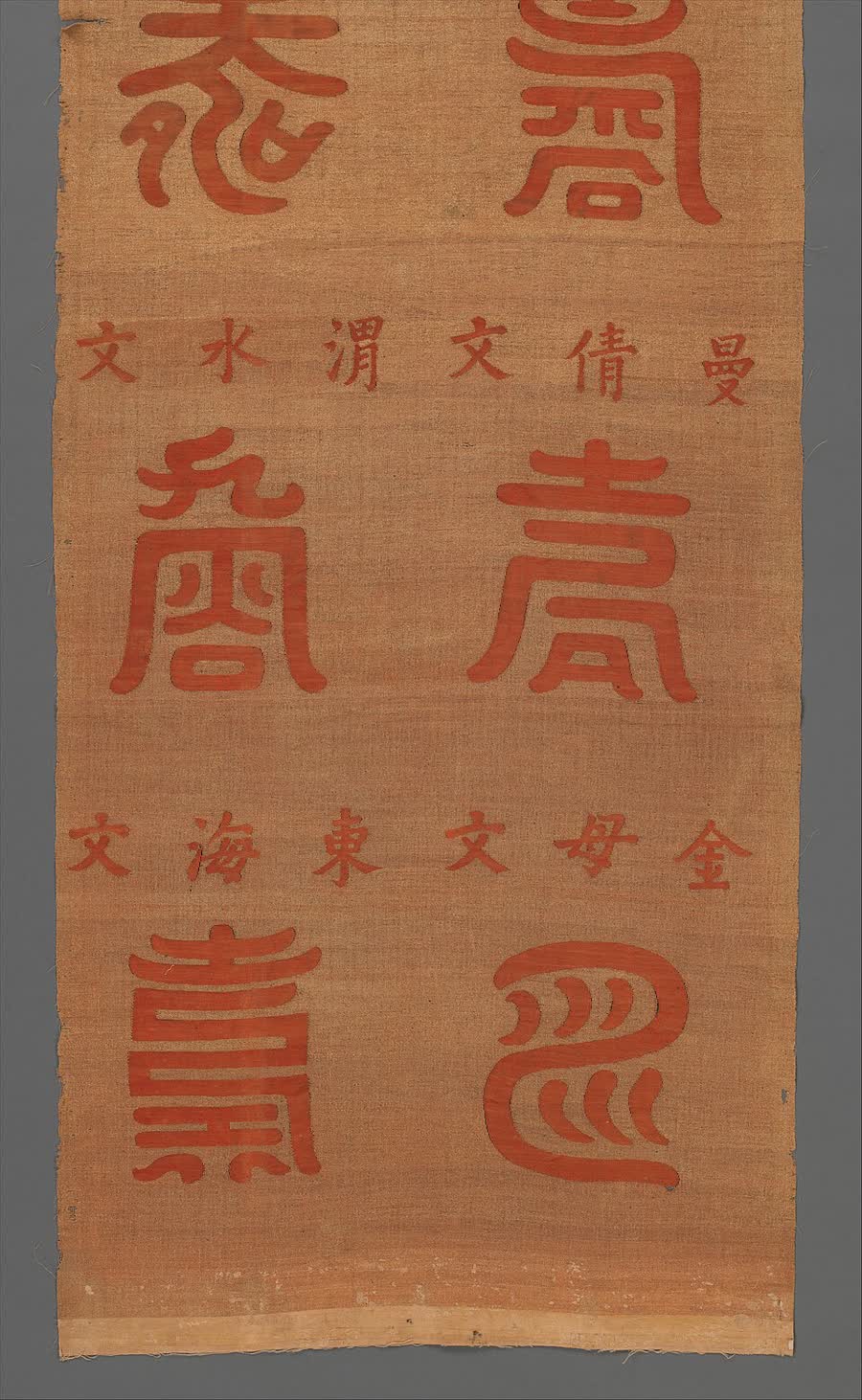
The retained image on this page shows a Chinese kesi panel with longevity characters from The Metropolitan Museum of Art's collection. Its existing credit records a CC0 image. We use it as an example of a textile carrying written forms, not as proof that a particular Suzhou workshop produced the object or that it can currently be seen during a local visit.
Look at how repeated characters or related forms create an overall arrangement. Repetition in a design does not necessarily mean that the maker repeated an identical unit without adjustment. Differences in shape, placement and surrounding space can organise the surface. Viewing the whole panel before selecting a detail helps preserve that relationship between individual forms and the larger composition.
The term longevity explains an aspect of the subject. It does not promise any effect for an owner, and it should not be converted into a claim that the object provides health or protection. Cultural meaning, material construction and commercial claims are different subjects. A well-captioned image can illuminate the first two without being used to justify the third.
The illustration also has limits as technical evidence. A digital reproduction cannot supply every detail of weave, condition or mounting. Its purpose here is to support a discussion of the image, not to replace the institution's object documentation or a textile specialist's examination. When looking at any museum image, keep the institution's description alongside it so that visual impressions do not quietly become unsupported claims about the object.
Painting and embroidery can be part of the same object
The Palace Museum's historical examples are a useful corrective to an overly simple rule sometimes applied to craft: that any use of paint must make a woven object fraudulent. Its feature explicitly describes combinations of kesi, embroidery and painting. The question is whether the object is accurately described, not whether it conforms to a visitor's imagined rule that a textile must contain only one technique.
When a label identifies supplementary painting, ask where it appears and what it contributes. Does it develop a fine facial feature, a background tone or a small detail? When embroidery is also identified, compare the added stitches with the woven structure. These observations make the combination understandable instead of treating the extra processes as invisible finishing.
Accurate disclosure matters in a sale as well. A contemporary mixed-technique object can be a legitimate work, but a seller should not describe every part as woven if that is not how it was made. Conversely, a buyer should not accuse a work of being fake solely because a knowledgeable label acknowledges another technique. The explanation must match the particular object.
Historical precedent is not a blanket guarantee for every present-day product. A museum's account of one documented object cannot authenticate an unrelated item in a shop. It can help you ask better questions: what is woven, what is stitched, what is painted, and who supplies that description? These questions are much more productive than treating a general claim of "pure handwork" as a complete technical account.
Suzhou history without turning old records into current bookings
The national Suzhou kesi record identifies the craft under project code VIII-15 in the first national batch of 2006. It places the practice in Suzhou and surrounding areas, and describes changes in production and transmission over time. The local designation should not be mistaken for the entire geographical history of kesi.
The Palace Museum's wider historical account discusses other places and periods. Together, the sources help distinguish a regional living tradition from the larger history of the textile technique. You can value Suzhou's role without claiming that every surviving kesi object was made there or that the craft's full history can be reduced to one city.
Historical copying also appears in accounts of transmission. Reconstructing or studying an earlier work can demand close attention to structure, materials and pictorial decisions. A copy should be labelled as such, but the word need not imply that no knowledge or skill is involved. The more important questions are what is being copied, how the interpretation is made and what claim is attached to the result.
Dates are particularly important when an official record discusses factories, the number of practitioners or concerns about the industry's survival. Such descriptions establish the context of that account, not today's business statistics. This page does not infer which named studios are accepting visitors or whether a specific artisan is available. Current access has to be verified independently of a historical or heritage listing.
What to watch during a demonstration
A demonstration becomes easier to follow when you identify its scale. Is the maker working on an entire picture, a small sample or one area of a larger textile? Ask to see the relationship between the design and the current weaving, where the setup permits. That prevents a small working passage from being mistaken for the whole product.
Watch one colour through a short sequence. Notice where the shuttle goes, where the thread turns and how the new work relates to what is already there. You may not see enough to understand every technical step, and that is fine. A focused observation can still make the principle of local weft work clear without turning the encounter into an unrealistic crash course.
The pauses matter too. A weaver may assess a passage, change a thread or explain a decision before continuing. A video edited to show only continuous hand movement can conceal those intervals. If you film with permission, an accurate caption should identify it as a selected passage rather than imply that the complete object emerged at the speed of the edited sequence.
Stand where the host asks you to stand and keep bags, drinks and camera equipment away from the working surface. A visitor's curiosity does not justify reaching across threads or turning an object to inspect its reverse. If you would like to handle a sample, ask for one specifically prepared for that purpose. Historical textiles and active work are not interchangeable with teaching materials.
Learning a principle is different from completing a picture
An introductory activity can help a visitor understand a structure that was previously abstract. Moving a coloured thread within a limited area may make the idea of discontinuous weft easier to grasp. That achievement does not require the participant to produce a finished pictorial textile, and it should not be advertised as mastery of the craft.
Before booking a session, establish what participants actually do. Some activities are demonstrations with questions; others involve a prepared loom or a simple sample. Ask whether setup, materials and explanation are included, and how any unfinished work is handled. A photograph of an accomplished display piece should not be allowed to imply that a beginner will make an equivalent object during a brief visit.
Learning conditions also matter. Close visual work, seating, working height and the ability to follow instructions can affect participation. For children or people with particular access requirements, ask the provider about the actual equipment and task. Do not assume universal suitability from the quiet appearance of weaving or infer accessible facilities from a cultural venue's name.
There is no obligation to participate physically. Someone interested in textile history might gain more from an extended explanation of one sample than from a rushed attempt to finish a souvenir. Decide whether your purpose is to see, understand, practise or purchase. Those are all different reasons to visit, and matching the activity to the purpose is more useful than choosing the option with the most impressive promotional photograph.
Making room for textiles in a Suzhou itinerary
If kesi is a serious interest, give the visit a distinct place in your planning. A textile collection or demonstration can require a different pace from a garden, a water-town walk or a transfer day. It is not necessarily a convenient extra simply because it belongs to the same broad region. Start with the activity you want and then confirm where it can actually take place.
Our Suzhou Garden and Tongli day tour from Shanghai offers a regional route to compare, not an implicit kesi booking. Its named destinations describe a different focus. Adding specialist craft access would need a separate assessment of availability, time and the confirmed itinerary; it should not be assumed from a cultural theme shared by the article and the tour.
For a longer stay, the Shanghai and Suzhou Gardens journey gives another starting point for discussion. Read the daily route and overnight locations rather than using the total day count alone. A longer trip can still be tightly scheduled, while a more focused plan may leave better room for a specialist visit.
When discussing a bespoke journey, describe the interest precisely: seeing historic textiles, watching local-weft construction, comparing kesi with embroidery, or trying an introductory sample. A clear brief is easier to evaluate than a request for an unspecified "authentic silk experience." Keep confirmed access separate from a preference or a request until the actual activity and arrangements have been agreed.
Value, care and claims that need a closer look
Traditional praise comparing kesi with gold expresses esteem, not a current price formula. It cannot tell you what a contemporary object should cost, whether a seller's attribution is correct or whether a purchase will gain value. Consider the individual piece, its documentation and your reason for buying it rather than allowing a familiar saying to settle the decision.
Ask what the seller means by handwoven, original design or master's work. A designer, a weaver and a selling studio can be different parties. A reproduction can be accurately described and worthwhile, while a vague claim of uniqueness may tell you very little. If an attribution, material or technique is important to your choice, request a clear written description of that particular object.
Do not use historical praise of durability as care advice. Old descriptions sometimes celebrate the strength or longevity of a craft in language that would be unsafe to apply literally to an individual textile. Its present condition, materials, colourants and mounting matter. Do not rub, wash or fold a work to test a claim. Ask for object-specific care guidance and consult a qualified conservator where appropriate.
Finally, consider transport and display before committing. A mounted panel and an unmounted textile create different packing questions. Get the agreed terms for framing, shipping and responsibility in writing, and seek current guidance for any item described as an antique. A cultural visit can end successfully without a purchase; the ability to explain how one woven boundary was made is already a meaningful thing to take home.
Questions about Suzhou kesi
Is kesi a kind of embroidery?
No. Kesi is weaving: coloured wefts interlace with warp threads to create the textile and its design. Embroidery adds stitches to an existing ground fabric. Some historical objects combine both processes, so the complete description matters. The presence of supplementary embroidery does not make the woven component disappear, but it should not be left out of the object's technical account.
Does the name mean the image is cut out of silk?
Not in that simple sense. The name is associated with the cut-like appearance of certain boundaries created by local weft work. It is not a general instruction to cut a finished image from cloth. A photograph of a gap also cannot determine whether it is an intentional structural feature or damage; that requires appropriate examination of the particular object.
Must every weft thread cross the whole width?
No. Local coloured wefts turn within sections of the design, which is central to the technique discussed here. The continuous warp provides the underlying structure. A small working sample can make this relationship easier to understand than a finished framed picture. Ask the demonstrator to identify one colour area and follow what happens at its edge.
Does added paint prove that a kesi work is fake?
No. The Palace Museum documents historical combinations of weaving, painting and embroidery. The important issue is truthful description of the particular object. A mixed-technique work should not be sold as entirely woven if it is not, and a historical example cannot authenticate an unrelated product. Ask which parts use which process and what evidence supports the explanation.
Is the illustrated longevity panel from a Suzhou workshop?
This page does not make that attribution. The existing credited image identifies a Chinese kesi panel in The Metropolitan Museum of Art collection. It illustrates written forms in a textile, but does not establish a specific Suzhou workshop or maker. The caption preserves that boundary rather than attaching the object to a travel destination merely because the article discusses it.
Are all kesi pieces identical on both sides?
Do not assume that every object offers the same relationship between its faces. Sources describe particular structures and later developments, while mounting and supplementary techniques can affect what is visible. Read the individual description and inspect both sides only when the display or owner permits it. One demonstration cannot establish how every other piece was made.
How long does it take to make a work?
There is no reliable universal answer based only on size. Design, construction, colour changes, finishing and the maker's approach all affect the work involved. Ask what an estimate includes and whether it refers to the specific object or a general example. A large time claim is not by itself proof of quality, authorship or a fair selling price.
Can a beginner complete a picture in one visit?
A short activity may introduce a principle or a prepared sample, but it should not imply that a participant will reproduce a substantial professional picture. Confirm the task, equipment, materials and treatment of unfinished work. Observation may be more appropriate if your main interest is the construction or history rather than making a take-home object.
Can I wash a piece because historical accounts praise its durability?
Do not use that praise as an instruction. The correct care depends on the object's materials, age, condition, dyes and mounting. Ask for guidance specific to the piece and seek professional textile-conservation advice when needed. Testing a claim by rubbing, washing or folding could cause damage that a general description of the tradition cannot predict.
Is a kesi visit included in the linked journeys?
Only if it appears in the confirmed itinerary. The routes linked here provide real regional planning options; they do not promise a particular studio, artisan or workshop. Raise the interest explicitly and establish the activity, location, timing and conditions. A related cultural subject on a website is not itself evidence of a reserved service.
May I record a weaving demonstration?
Ask the maker or venue for permission, including the intended use of the recording. Keep equipment away from the working area and respect restrictions on designs and identifiable people. If you edit the clip, describe it as an excerpt rather than a full production record. Do not label a demonstrator as your guide, employee or customer without a factual basis.
Why has no demonstration video been added here?
No licensed clip has yet been confirmed to show this specific technique for the page. Generic silk footage could show a different weaving process, and embroidery footage would illustrate a different craft. The gap is left open rather than filled with an attractive but misleading sequence. Any future addition needs a verified subject, source and accurate explanatory caption.
Sources and further reading
- National heritage record: Suzhou kesi weaving, VIII-15. Regional designation, construction and historical transmission; not current business or visitor-access data.
- Palace Museum technical entry: kesi. Warp/weft construction, tools and the relationship between boundaries and the craft's name.
- Palace Museum kesi feature. Historical objects, pictorial uses, colour treatments and documented mixed techniques. Online examples do not guarantee that a work is currently on physical display.
Reviewed 2 November 2026. Technical and historical claims are distinguished from original viewing prompts. No appraisal, health effect, current admission, workshop availability or tour inclusion is guaranteed by this guide.