Su embroidery is the needlework tradition centred on Suzhou and the wider Jiangsu region. Its images are stitched onto a prepared textile, not woven as part of the cloth. To understand it, compare how different makers translate a drawing, a painted surface or an observed subject into directions, layers and intervals of thread.
A cat that changes when you move
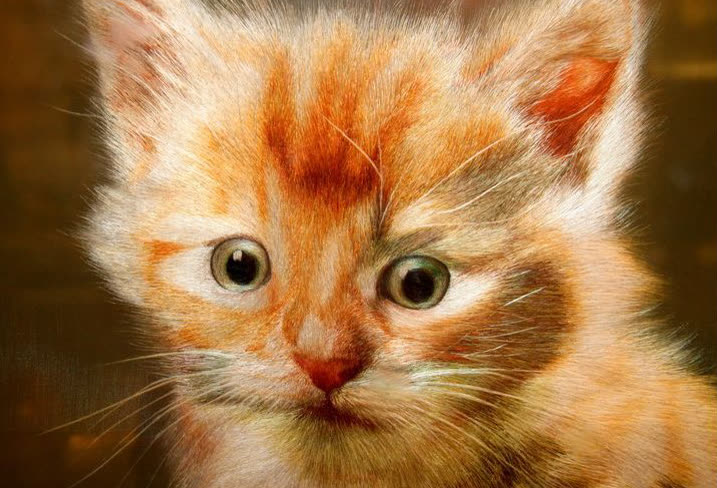
The cat illustrated on this page is an embroidered image, not a photograph of a living animal. That distinction is a useful place to start. At a distance, the subject is easy to recognise. Closer viewing changes the question from "What is it?" to "How has this been made?" The answer lies in the working surface rather than simply in the outline of the animal.
Choose a small passage near an edge and follow it with your eyes. How does the stitched area meet its background? Does a line remain sharply defined, or does it disappear among finer marks? An animal picture invites attention to fur, but the same questions work with a flower, a landscape or a portrait. The maker has to decide not only what to show but which information the eye can supply for itself.
Now change your position slightly, without touching the display. Some passages may seem more prominent as the threads catch the light. A reproduction on a phone fixes one viewing angle and one lighting condition; the textile in front of you can offer a different experience. Looking at both helps explain why a convincing photograph is not a complete account of an embroidered work.
The image here has a documented public-domain credit. It does not identify a particular workshop, prove the material of every thread or establish the work's date. Those questions need separate records. Keeping the photograph's role modest lets it do something more useful: give you a visible starting point for understanding how a stitched picture asks to be examined.
What belongs under the name Su embroidery?
Su is the shortened regional name in Suzhou embroidery. The Suzhou heritage authority's account describes a Jiangsu tradition centred on Suzhou, with related activity in places including Wuxi, Changzhou, Zhenjiang, Yangzhou and Nantong. It is therefore broader than the output of one shop, one institute or one contemporary artist.
The national representative heritage record identifies Su embroidery as a traditional-fine-arts project in the first national batch of 2006, under code VII-18. The record also connects related local forms within that project framework. These administrative relationships help organise the history, but they are not a reason to assume that every regional practitioner uses identical methods or pursues the same visual result.
A visitor can use the regional term as an introduction, then move towards the individual object. Who designed it? Who stitched it? What does the label say about its technique and intended use? Those questions become especially important in a mixed textile display, where woven silk, embroidery and printed fabric may appear close together. A shared material or subject does not erase the difference between their processes.
For this guide, Su embroidery means the cultural and technical tradition, not a guarantee attached to anything sold in Suzhou. The national designation recognises that tradition. A current maker's attribution, a seller's material statement and an object's provenance each require their own evidence. The strongest visit gives you room to appreciate the work while keeping these different kinds of information separate.
History through surviving work, not a single origin date
The national record is unusually useful because it does not pretend to know the exact origin of Su embroidery. It instead discusses surviving textiles and the changing practices they reveal. That is a sound approach to a craft whose domestic work, professional production and teaching have not all left the same kinds of records.
The Suzhou local-history office's account, published in 2018, discusses textiles recovered from local historical contexts and traces later developments in production. For a traveller, the lesson is not to memorise a continuous list of dynasties. It is to distinguish evidence for a particular surviving object from a much larger story about the origins of the whole tradition.
Imagine reading a gallery label that identifies a fragment rather than a complete garment. The fragment can still reveal choices about stitches, colour and repeated pattern. What it cannot necessarily reveal is the complete original design, the maker's name or the everyday circumstances in which it was worn. Missing information is part of the historical object, not something a fluent explanation should quietly invent.
The relationship between embroidery and painting also changed over time. A design based on a painted model asks the embroiderer to make decisions about line, tone and space. That relationship should not reduce the needleworker to someone who merely copies. Translation between materials creates its own problems: a brush mark spreads pigment, while a stitch places thread of a particular length and direction. Their visual effects may correspond without being identical.
Ding Pei and the value of writing about skilled work
The national heritage account names Ding Pei in connection with an early specialised embroidery treatise, the Xiupu. It also mentions the later Xuehuan Xiupu associated with Shen Shou's dictated experience. These references matter because craft knowledge is not preserved only inside finished objects. It can also be discussed, organised, taught and argued over in writing.
A written account cannot make a reader's hand instantly skilled. It can, however, tell us what practitioners considered worth noticing. Think of the difference between watching a stitch and hearing why that stitch was chosen. One gives you an action; the other begins to expose a decision. Historical technical writing offers another route towards those decisions, even when translation and terminology require care.
In a museum or a book display, ask whether the text shown is an original edition, a later reproduction or a modern explanatory extract. A photographed page may be historically interesting without being a complete instruction manual. It is also worth asking who is speaking in the text: the maker, an editor, a compiler or a later historian. Their roles affect how the material should be read.
This is a different kind of heritage encounter from watching a demonstration. It gives attention to the intellectual labour of describing techniques and passing them on. If your interests include design, education or women's history, a well-labelled discussion of technical writing may be as rewarding as a spectacular display panel. The visit becomes a question about knowledge as well as dexterity.
Shen Shou and the problem of realism
Both the national record and the Suzhou authority's account identify Shen Shou with a lineage of realistic embroidery, often translated as imitation-real or lifelike embroidery. The local-history account connects this development with attention to light and perspective in Western painting. It is an example of adaptation within a tradition, not evidence that meaningful heritage must remain unchanged.
Realism is easy to praise and harder to explain. A face can be recognisable because of a strong outline, yet feel flat. A shadow may suggest depth even when its boundary is almost imperceptible. In a stitched picture, these effects have to be negotiated through threads rather than wet pigment. Ask where the image relies on a firm edge and where it relies on a gradual transition.
Portraits are particularly helpful for this comparison because viewers are sensitive to small differences in expression. Instead of asking only whether the portrait looks like its model, look at the relationship between the eyes, the surrounding tone and the head's position. Which passages carry the likeness? Which areas can remain quieter? These are viewing questions, not a reconstruction of Shen Shou's private working method.
A contemporary work described as realistic embroidery is not automatically by Shen Shou or a direct copy of one of her works. A lineage, a technique and an attribution are different things. If a label names a historical artist, read whether it identifies authorship, inspiration, reproduction or teaching tradition. That small distinction prevents a general history of innovation from becoming a mistaken claim about the object in the room.
Yang Shouyu and why random stitch is not random effort
The national record associates Yang Shouyu with the development of random-stitch embroidery in the twentieth century. The name can mislead an English-speaking visitor. "Random" sounds as though control has been abandoned, but a named artistic approach is not the same as careless placement. The finished picture still has to establish relationships between marks, colour and the subject being represented.
Try comparing a passage of crossing threads with one whose threads appear more orderly or parallel. What happens to the surface when directions intersect? Does it feel more active? Does the underlying subject emerge immediately, or only when you step back? These observations can help you discuss an example without pretending that every intersecting thread belongs to the same technical school.
The comparison also changes how you judge neatness. A smooth, uniform passage and a deliberately varied one may pursue different ends. Evaluating both solely by whether every visible mark points in the same direction misses that difference. Ask the guide or maker which effect the work is aiming for, and then consider how the surface contributes to it.
Do not learn a technique's entire history from an isolated translated label. The official accounts give an entry point, while a detailed technical explanation would require closer study and a qualified teacher. For a first visit, understanding that Su embroidery contains more than one approach already improves the experience. You can stop looking for a single appearance that every legitimate work must share.
The journey from design to stitched surface
The Suzhou heritage description lists stages that include preparing the design, working with threads, setting up the support, stitching and mounting. In a short demonstration, most of these may already have happened before you arrive. The visible movement of the needle is only one part of the work's production.
Begin with the design if it is available for viewing. Ask whether it is the stitcher's own composition, a commissioned drawing or an adaptation of an identified source. Then compare its scale with the textile. An image that reads clearly on paper may need adjustment when made smaller, placed on a different ground or interpreted through thread. Design decisions can therefore continue beyond the first sketch.
Next consider the preparation of the working surface. A supporting frame makes the cloth available for stitching, but the setup is not merely background equipment. It affects how the maker can reach and assess the work. A visitor need not understand every practical adjustment to recognise that the finished image depends on preparation that a retail photograph usually leaves out.
The sequence is also useful when discussing time. A production estimate might refer to stitching alone, or include planning, material preparation and finishing. Ask which it means rather than treating a large number of hours as a universal measure of artistic quality. Two works of similar size may involve different designs, working methods and purposes. Understanding those differences is more informative than comparing time claims in isolation.
Ground, thread and the space between marks
The ground is the textile that receives the stitching. It is not necessarily an invisible support. In some works, its colour and texture contribute substantially to the image; in others, dense stitching covers much of it. Look for a place where the ground remains exposed and compare that area with a more heavily worked passage.
Unstitched space can help a form stand apart from its surroundings. It can also affect how light travels across the whole surface. A picture with open areas should not automatically be described as less finished than one with continuous coverage. The question is whether those areas participate in the design. Compare their placement and proportions before judging them as omissions.
Thread has its own behaviour as a material. Its apparent brightness can change with direction, and several neighbouring colours can produce an impression that differs from any one colour seen alone. When a demonstration includes prepared threads, ask how the selection relates to a specific passage in the picture. A general display of many colours is less revealing than one explanation of why two close tones are used together.
Keep material identification separate from visual guesswork. Fine-looking thread is not sufficient evidence that every component is silk. The official tradition includes a range of forms, and the current object's label should establish its materials. If the label is vague, the accurate response is to ask or leave the detail unspecified, not to let the prestige of the regional name supply the missing information.
Two faces of a textile
Double-sided embroidery changes the viewing situation. Instead of treating the reverse as a surface that can remain unseen, the work offers another face for inspection. The Suzhou authority distinguishes ordinary double-sided work from more differentiated forms. A visitor should therefore ask what the term means for the particular piece rather than assume that all two-sided displays work in the same way.
If you can walk around a mounted object, use the same small passage for comparison on both sides. Consider the relationship between outline, colour and the surrounding cloth. Are the images corresponding, or does the label describe a deliberate difference? It is better to make this comparison slowly than to rely on the impressive fact that both sides are visible.
The mount shapes the encounter too. A tabletop screen invites a different kind of viewing from a textile fixed against a wall. The frame can make a work accessible from both sides, but it is not proof of a particular embroidery method. Nor does a photograph of a revolving display tell you enough about the construction of another piece offered elsewhere.
Two-sided work is not the only interesting destination for a visit. A single-sided hanging may offer a more complex composition or a more engaging treatment of a subject. The technical category describes an aspect of construction, not a final verdict on the work. Let the actual surface, design and documented purpose guide your attention rather than assuming that an extra visible face must mean an automatically better object.
Display work and objects made to be used
The local heritage source divides Su embroidery into display pieces and practical-use textiles. That distinction is worth carrying into a gallery or shop. A large hanging can be designed for sustained viewing at a distance. A garment moves with its wearer. A small accessory may be seen briefly and closely. Each situation changes what the image needs to do.
On a display piece, ask how the composition behaves at two distances. From across the room, does the main form remain legible? Up close, does the stitching introduce further detail? A work can offer different information at each distance. That is not necessarily inconsistency; it may be part of how the maker has balanced overall effect with close inspection.
On a wearable textile, consider where the decoration sits in relation to seams, folds and movement. The purpose is not to conduct a technical appraisal without expertise, but to notice that embroidery is part of an object rather than a picture floating independently of use. A motif placed on a sleeve is encountered differently from the same motif in a frame.
Buying for use also raises different questions from buying for display. Ask for care guidance that matches the specific materials and construction. An item's beauty does not answer whether it can be washed, folded, exposed to strong light or regularly handled. If the seller cannot explain those matters clearly, that uncertainty should be part of your decision rather than hidden behind a general promise that silk is delicate or durable.
Suzhou's institutions and living places of work
The official descriptions connect Su embroidery with research institutions, teaching and local working communities. The Suzhou account names contexts including Zhenhu, Mudu and Guangfu. These references show that the craft is not confined to a historical display case. They also explain why different kinds of visit can reveal different aspects of the tradition.
An institute may emphasise research, collections or the development of techniques. A studio may make the relationship between an individual maker and a current work more visible. A retail area may offer a range of objects but little sustained explanation. None of those descriptions can be assumed from a map pin alone. Before planning around a place, establish what it actually admits visitors to see.
Historical institutional photographs can be especially engaging, but their dates matter. The 2018 local-history article includes earlier images of demonstrations, teaching and visitors. They document moments in the development of the craft's public life. They are not today's appointment calendar, and the names of organisations in a historical narrative should not be converted automatically into current tour stops.
For practical planning, seek a current venue name, address and description of the activity. Ask whether viewing requires an appointment, whether a demonstration is scheduled and what language support is available. A cultural guide should help you formulate those questions, not manufacture an appointment with a named master. This article does not certify current opening hours or offer a private meeting that has not been confirmed.
Plan a textile visit alongside gardens, not underneath them
Suzhou is often approached through its gardens. Embroidery can add another way of thinking about composition, space and close observation, but it deserves more than whatever minutes remain after a crowded sightseeing list. If textiles are a serious interest, make them a distinct purpose of the day rather than an assumed shop stop on the route home.
A useful pairing is conceptual rather than literal: notice how a garden view changes as you move, then consider how a textile's surface changes with distance and light. The comparison can sharpen attention without claiming that a particular embroidered image depicts the garden you visited. A thematic connection is an interpretation, not evidence of a historical commission or direct influence.
The Suzhou Garden and Tongli day tour from Shanghai is an existing route to examine if your main priority is a garden-and-water-town outing. Its title does not promise a Su embroidery workshop. If you want to add a textile visit, treat that as a separate request that needs a realistic time allocation and confirmed arrangements rather than an inclusion inferred from this article.
For a longer regional stay, compare Shanghai and Suzhou Gardens with other Shanghai and Jiangnan journeys. Look at overnight locations and transfer days before adding specialist activities. The best choice is the route that leaves room for your actual interests, not necessarily the one whose title contains the largest number of places.
A conversation that reveals the maker's choices
Start with something you can point to. "Why does this edge become softer here?" gives a maker a clear subject. "Tell me everything about Su embroidery" is much harder to answer well, especially through translation and during a working demonstration. A small, precise question can lead naturally into the larger story.
Ask about a decision rather than demand a secret. The maker might explain why a particular ground was chosen, how the scale affected the design, or which part of the image required reconsideration. Those answers can reveal artistic judgement without requiring a complete technical lesson. It is reasonable for someone to protect a design, a client's unfinished work or a method they teach only in a formal setting.
Listen for changes of subject in translated explanations. An answer about the tradition as a whole may not describe the object in front of you. A statement about what a famous historical artist did may not identify what the current demonstrator is doing. Checking the reference politely helps everyone: "Is that how this piece was made, or another example?"
If photography is permitted, record the label as well as the attractive detail. Later, the label helps distinguish the maker's name, the technique and the date. Ask separately about filming people and publishing the result. A personal visitor image should not be presented as proof that the people shown work for a travel company or that the activity is included in its standard tours.
Collecting information before collecting an object
It is possible to leave an embroidery visit with something valuable without buying a textile: a clearer understanding of the process and a record of one work that interested you. Make a few notes about the object, not a list of sales superlatives. What was its subject? What did the label identify? Which passage changed your understanding of how thread could form a picture?
If you do consider a purchase, ask the seller to distinguish the designer, the stitcher and the selling organisation. Those roles may overlap, but they need not. A studio's name can be a legitimate attribution at one level while leaving the individual contributors unspecified. The written description should reflect what is actually known rather than quietly turn a studio product into a named master's personal work.
Separate evidence of production from evidence of value. A demonstration of hand stitching can show a real process without proving that every object in the room was produced that way. A statement about the number of working hours does not establish a resale price. A heritage designation does not provide investment advice. The object needs its own material description, provenance and terms of sale.
Finally, think about the object after the journey. Mounting, delivery and display conditions may influence what is practical to buy. Ask for written care instructions and retain the receipt and agreed terms. A considered purchase is not made less meaningful by taking time. The cultural encounter should remain worthwhile even when you decide that the best thing to bring home is a better way of looking.
Questions about Su embroidery
Is Su embroidery the same as all silk work in Suzhou?
No. Silk is a material, while embroidery describes a process of stitching onto a ground. Weaving, embroidery and printing can produce related-looking objects through different methods. Read the technique stated on the individual label. A silk-related shop or museum can contain several processes, and a general regional description should not replace identification of the object you are looking at.
What is the difference between Su embroidery and kesi?
Kesi is a woven textile technique; Su embroidery adds needlework to an existing cloth. The distinction concerns how the image is constructed, not whether it contains silk or depicts a recognisable subject. Our Suzhou kesi guide introduces that separate craft. Confirm which process a proposed demonstration actually shows before arranging a visit around one of them.
Why does the guide discuss both Shen Shou and Yang Shouyu?
The official records identify them with different developments within the tradition: realistic embroidery and random-stitch embroidery. Their inclusion helps explain why Su embroidery should not be reduced to one fixed appearance. It does not attribute an illustrated contemporary work to either historical maker. A specific work's authorship or lineage needs its own documentation and should be stated separately from general history.
Does random-stitch embroidery mean an untidy result?
The name refers to a recognised approach, not a judgement that the work lacks care. Instead of judging solely by parallel or regular-looking marks, ask how directions and layers contribute to the image. Use a qualified explanation of the actual piece. Crossing threads seen in a photograph are not enough on their own to classify a work's complete technical method.
Can the cat photograph prove a particular workshop made it?
No. The photograph illustrates an embroidered subject and retains its recorded credit. It does not establish the identity of a workshop, a named stitcher, the production date or every material used. Those claims require additional evidence. Treat the image as an opportunity to look closely at needlework, not as a substitute for a catalogue entry or maker's record.
Is every two-sided display a different image on each side?
No. Two-sided construction can involve different relationships between the visible faces. Ask what the maker or label means for that object, and compare the same passage on both sides where access allows. A rotating frame may make viewing easier but does not define the technique. Avoid transferring a dramatic demonstration's claims to other pieces that have not been explained.
Should I book a museum visit or a studio demonstration?
Choose according to the question you want answered. A collection may offer historical comparisons and labels; a demonstration may make a specific working process easier to follow. A commercial studio can combine explanation and selling. Verify the actual activity, language support and appointment requirements, because the venue's name alone does not establish which of these experiences is currently available.
Can children take part in an embroidery activity?
Ask the provider about the specific task, tools, supervision and age requirements. Fine visual work and needles are not suitable for every participant in the same way. Observation or a different teaching sample may be an option, but it must be confirmed with the provider. This guide does not infer family suitability or accessible facilities from the quiet appearance of the craft.
How can I compare Su embroidery with Shu embroidery?
Use clearly identified individual works and compare their materials, surface, composition and explanations. Regional names alone do not establish a universal ranking or one appearance shared by every maker. The Shu embroidery guide gives Sichuan context. A comparison becomes more useful when you can say which object and which decision you mean, rather than asking which entire tradition is better.
Are embroidery visits included in the linked tours?
Only if the confirmed itinerary says so. The linked routes offer real regional planning options, not an implied promise of studio access, a named artisan meeting or a workshop. Raise a textile interest explicitly when discussing the trip. The final arrangements should distinguish confirmed activities from requests and preserve enough time for the visit you actually want.
What should a purchase record include?
Ask for an accurate description of the object, its stated materials and production method, its attribution where known, and the agreed terms of sale and delivery. Keep the receipt and any relevant care guidance. A general certificate about Su embroidery's cultural status cannot authenticate a different object. Claims that materially affect your choice should be clear in writing rather than dependent on an ambiguous translation.
Why is there no matching demonstration video here yet?
A suitable clip needs both a verified subject and usable rights. Unidentified silk production, a loom demonstration or another embroidery tradition would not accurately illustrate this page. No confirmed Su-embroidery clip has been added. The existing image remains labelled for what it actually shows, and a future video must be checked independently rather than included merely to make the page look fuller.
Sources and further reading
- Suzhou Intangible Cultural Heritage Information Network: Su embroidery. Regional scope, process, forms and teaching contexts; not a current booking calendar.
- National representative heritage record: Su embroidery, VII-18. Designation, historical evidence and the named technical lineages. Undated descriptions of industry conditions are not treated as live business statistics.
- Suzhou local-history office: Suzhou's cultural arts, Su embroidery, 3 December 2018. Dated historical and institutional context; historical photographs and venues do not establish current visitor arrangements.
Reviewed 2 November 2026. Looking prompts and route comparisons are editorial guidance, separate from sourced historical claims and from confirmed travel inclusions.