Shu embroidery is a regional needlework tradition associated with Sichuan and Chongqing. Its pictures are stitched into an existing textile, unlike the woven patterns of Shu brocade. In Chengdu, look for a clearly identified embroidery collection or demonstration, then examine the thread direction, surface, shading and maker's account of the work.
Start with the object, not the souvenir label
A framed textile can look almost like a painting from across a room. Up close, a flower's edge may resolve into individual threads, while a patch that seemed uniformly green becomes several differently angled passages. That change in scale is a useful way into embroidery. You do not need to recognise every stitch before you can begin looking carefully, and you do not need to buy anything to make the encounter worthwhile.
The first question is simple: what has actually been made? A woven silk, a printed scarf, a machine-embroidered accessory and a hand-stitched picture can all carry similar imagery. A panda or a flower does not identify a technique. Nor does a shop's location in Chengdu establish that everything on its shelves is locally made Shu embroidery. Read the object label, ask for the material and process, and distinguish the seller's description from evidence about the particular piece.
This guide treats looking, learning and purchasing as different activities. A museum display might give excellent historical context without offering a working demonstration. A studio visit might reveal a small part of the process without presenting a full history. A retail stop might be useful for comparing objects but cannot substitute for either. Knowing which kind of encounter you want helps you ask a more precise question than whether a place is simply "authentic."
What the national listing establishes
The national heritage record for Chengdu's Shu embroidery identifies the tradition as a first-batch entry from 2006, under traditional fine arts, with project code VII-21. It also links a related entry in Chongqing's Yuzhong district. These are useful distinctions: the craft has a regional history, and Chengdu is not the only administrative place associated with its recognition.
Listing describes a tradition and its safeguarding context. It does not certify every textile sold under its name, and it does not turn a shop assistant or a temporary demonstrator into an officially recognised representative bearer. Those are separate claims. If a venue advertises a particular status, ask whose status it is, which organisation granted it, and how that person is connected to the work being shown. A clear answer is more useful than a wall of unexplained certificates.
The traditional craft revitalisation directory also names Chengdu and Chongqing's Yuzhong district. That directory is not a second, interchangeable proof of an individual object's origin. It belongs to a different policy context. Likewise, a national listing should not be casually relabelled a UNESCO inscription. This guide uses the national designation actually documented for Shu embroidery rather than borrowing the international status of another Chinese textile tradition.
A regional history without an invented ancient purchase story
Shu is a historical regional name closely associated with Sichuan. The national record connects the development of its embroidery with the area's silk production and describes both domestic needlework and more organised production. The important point for a visitor is continuity through changing forms of work, not the idea that every object in a modern shop reproduces an unchanged ancient design.
Clothing, domestic textiles and display pieces answer different needs. A decorative panel can devote much of its surface to an image; a wearable object must also tolerate movement and use. A contemporary maker might draw on older techniques while changing scale, colour or subject. That does not automatically make the work less meaningful. The useful distinction is between a stated contemporary interpretation and an unsupported claim that an object, design or workshop is centuries old.
Historical sources also need dates. A 2009 article on the national heritage website describes concerns about production, employment and transmission at that time. It can help explain why safeguarding mattered, but it cannot establish how many studios operate today or whether a particular factory, school or shop is still open. We do not turn its old commercial observations into current visiting advice.
When a guide tells a long origin story, ask what evidence supports the specific part that interests you. An archaeological textile, a written reference, an inherited technique and a modern reconstruction are different kinds of evidence. None needs to be dismissed, but each deserves its own label. A careful explanation can leave some questions unresolved without diminishing the pleasure of seeing a well-made piece.
Embroidery, Shu brocade and kesi are different processes
In embroidery, stitches are worked onto an already existing ground fabric. That ground might remain visible around an image or be largely covered by it. The needle and thread add the decoration. This construction gives you a practical viewing question: where can you see the supporting cloth, and where has the stitched image begun to take over its surface?
Brocade belongs to weaving. Its pattern is built through the arrangement of threads during production of the cloth, rather than being added afterwards in the same way as embroidery. Shu brocade and Shu embroidery share a regional association, but their similar English names are a frequent source of confusion. A venue that demonstrates a loom may be offering a valuable textile encounter without demonstrating needle embroidery at all.
Kesi is also a woven textile technique, not a synonym for silk embroidery. If you are comparing cultural visits across Chengdu and Suzhou, separate the process before comparing the visual effect. A dense picture made with threads may look similar at a distance while asking very different things of its maker. Labels that distinguish weaving, embroidery and printing make a mixed display easier to understand.
For a straightforward conversation, ask the demonstrator to identify the ground, the working thread and the tool used to build the image. Then ask which part of the work you are currently watching. You do not need to demand a complete technical lesson. One clear example of a thread crossing, a needle entering cloth or a prepared design can settle the basic distinction more effectively than a long list of translated craft names.
How to look at thread direction and light
Begin by standing where you can see the whole composition. Notice the balance between the central subject and its surrounding space. Then choose one small area: the curve of a petal, an animal's face, or a transition between foreground and background. Concentrating on a small passage prevents the common experience of looking at a complex object for a minute and remembering only its subject.
Move slightly sideways if the gallery permits it. Thread can reflect light differently as your viewing angle changes, so the same patch may seem brighter or darker without any change in its actual colour. That optical behaviour is part of what distinguishes a textile surface from a flat reproduction. Avoid assuming that every change in brightness represents a separate dye colour or an error in the stitching.
Compare directions within the passage. Do threads follow a contour, cross it, or create a different visual rhythm? Where does an edge remain crisp, and where does it soften? These are observation prompts, not a rigid scoring system. Different makers and different subjects call for different effects. A deliberately open area should not be judged as unfinished merely because it is less densely covered than its neighbour.
Do not touch the textile to test its smoothness. Reflected light, visible stitching and a staff explanation can tell you much without putting skin oils or pressure onto the object. If a teaching sample is available, ask which sample may be handled. An object displayed behind glass and a piece prepared for a supervised activity have different handling conditions, even when both illustrate the same technique.
Shading, stitches and the limits of a quick demonstration
The national record describes a large repertoire of Shu embroidery stitches, grouped into twelve main categories. Treat that as evidence of technical range, not a checklist you must complete during a visit. The existence of a named technique does not mean it appears in every piece. A small finished object might depend on restraint and consistency rather than a visibly large assortment of stitches.
For shading, look for the transition rather than only the endpoints. How does a dark area become light? Are neighbouring threads close in colour but different in direction? Does a boundary dissolve gradually, or is it deliberately distinct? Asking about one transition gives a maker something specific to explain. It is usually a better conversation than asking how many colours the entire picture contains.
A demonstration shows a moment within a longer process. It may begin with the design already prepared, the frame set up and the thread selected. The fact that a visitor sees one appealing passage stitched does not reveal the time required for planning, preparation, corrections and finishing. Conversely, a long claimed production time is not a quality guarantee. Ask what the time estimate includes and whether it refers to this object or a general example.
Do not press for speed. A demonstrator may pause because speaking, translating and stitching compete for attention. The slower interval can be useful: watch how the thread is managed, where the maker looks before placing the next stitch, and how they assess the existing surface. Those decisions reveal skilled judgement without requiring the person to disclose every specialised method or reproduce a difficult effect on demand.
Single-sided and double-sided work
Some display pieces are intended to be seen from one side, while others invite inspection from both. The historical heritage article discusses double-sided work among the forms associated with Shu embroidery. That does not make every framed picture double-sided, nor does a transparent-looking mount establish the claim. Ask which surfaces are intended for viewing and whether staff can explain the construction without disturbing the mounting.
If both sides are visible, compare them deliberately. Are you seeing a corresponding image, different colours, or a more substantially different arrangement? Use the maker's own description rather than assuming that one term covers all possible relationships between the two faces. A visitor's photograph of one side cannot document the other, and a general video about the technique cannot authenticate a different object offered for sale.
Single-sided work should not be treated as an inferior version by default. Its purpose may be different, and its artistic interest may lie in composition, surface or scale. A complex mounting system and a spectacular technical demonstration can attract attention, but they do not remove the need to look at the actual image. Decide what you value in the object rather than letting a category name make the decision for you.
For a purchase, request a written description that matches what you were shown. If double-sided construction, hand stitching, silk content or a named maker influenced your choice, those details belong in the documentation. Do not rely on a conversational translation alone, especially when a term has been used loosely. An ordinary, precise description is more helpful later than a grand but ambiguous certificate.
Subjects, motifs and interpretation
Flowers, birds, fish, animals and landscapes appear in the official account of Shu embroidery's subject range. They give a visitor recognisable starting points, but a familiar subject does not make the meaning of every image self-evident. A floral composition may draw on a particular model or belong to a named series. Ask about the work in front of you before applying a universal symbolic explanation.
The same caution applies to pandas. Their association with Sichuan makes them an understandable subject for contemporary souvenirs and display pieces, but a panda image alone cannot establish where an object was made or how it was produced. Look at how the form is built: the treatment of fur, the edge between dark and pale areas, and the relationship between the animal and the background.
When a piece resembles a painting, ask whether the design comes from an identified artwork, a studio drawing or a contemporary commission. The relationship can be interesting in itself. Translating a painted brush mark into thread raises questions about texture, light and scale. A reproduction need not be dismissed, but it should not be described as an original design by the stitcher unless that authorship is documented.
Interpretation can remain personal without pretending to be historical fact. You may find a sparse composition calmer than a densely filled one, or prefer the visible movement of thread to a highly illusionistic image. Those are valid responses. Separating them from claims about age, status and provenance makes the conversation more honest, especially when a retail setting encourages every aesthetic preference to become a reason to buy.
Chengdu and Chongqing: choose a specific encounter
The regional name is broader than a single attraction. The Chengdu national listing and its related Chongqing entry establish a cultural connection, not an itinerary joining all relevant places. Travel planning still requires a named venue, a current address and a clear account of what visitors can do there. A museum, a teaching studio and a commercial showroom may each use the word embroidery while offering quite different experiences.
Before allocating time, ask whether the visit centres on a permanent collection, a temporary exhibition, a working demonstration or a participatory session. Confirm which language support is actually available. A person who can welcome international visitors may not be able to translate technical questions, and an English label does not imply an English-led workshop. It is better to discover that difference before arranging the rest of the day around it.
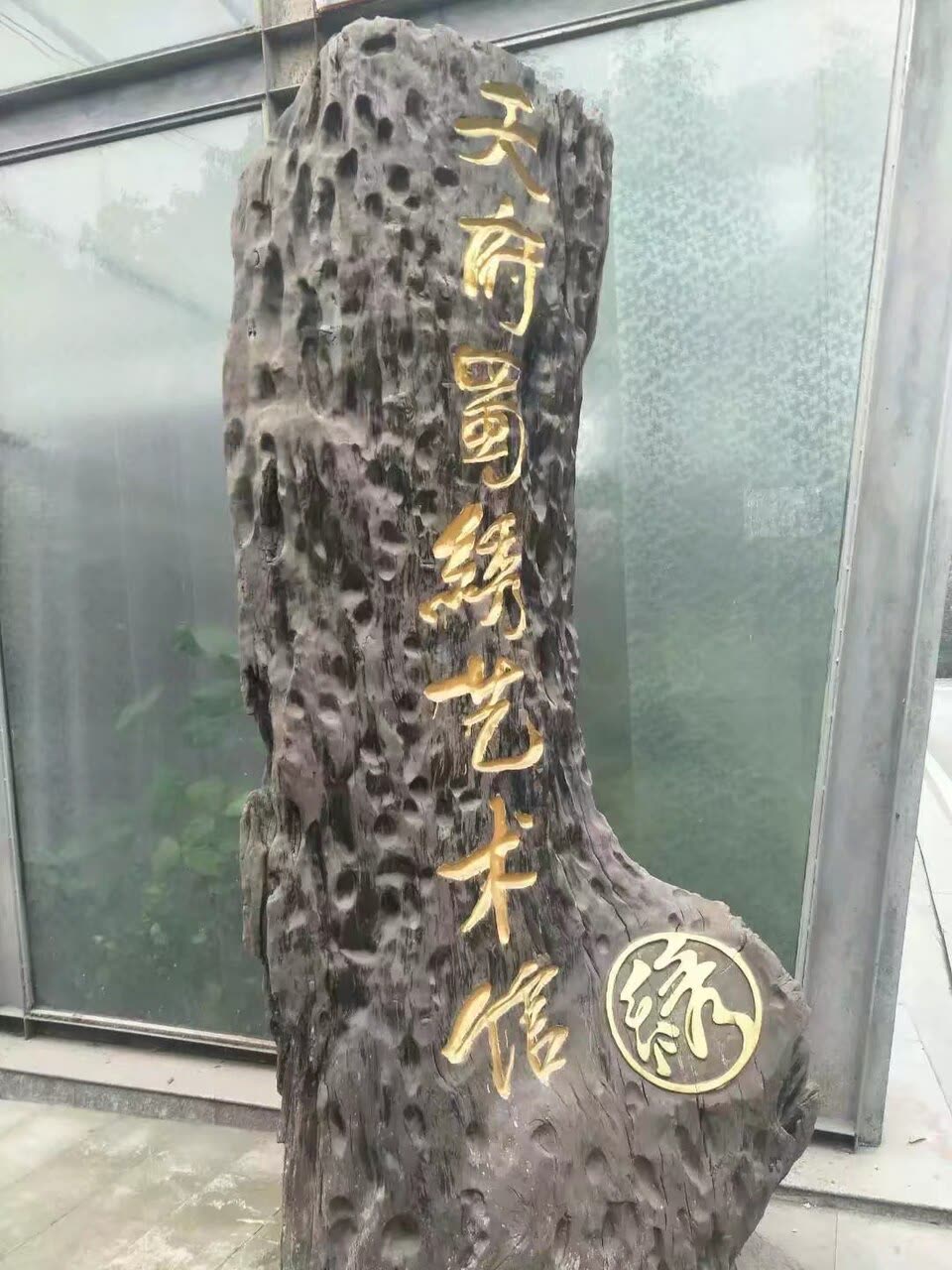
The photograph retained on this page shows the identifying stone outside Chengdu Tianfu Shu Embroidery Art Museum. It documents that photographed subject, not the current contents of the galleries, today's opening status or a reserved meeting with an artisan. We label it as a venue photograph rather than using it as if it were a close-up of a finished textile.
If your trip is already based in Chengdu, compare the cultural stop with the rest of your schedule before adding a second city. Our Sichuan and Chengdu journeys provide broader route context, but their presence beside this guide does not establish that a Shu embroidery visit is included. A particular venue, activity and date would need separate confirmation in the actual itinerary.
Build a useful museum or studio visit
A good visit can have a modest aim. You might want to distinguish embroidery from weaving, understand one shading passage, or learn how a maker adapts a design to a small object. Choosing one aim gives structure without turning the encounter into an examination. Leave time to look quietly before asking questions; your first question will often become more specific once you have seen the work.
In a gallery, read a complete label for one object. Note its maker if identified, its date, materials, technique and whether the object is an original, reproduction or teaching sample. Then compare it with a second object that differs in one clear respect, such as scale or intended use. This method is more manageable than trying to absorb an entire room's chronology at once.
In a working studio, ask where visitors should stand and whether photography is allowed. A close-up camera can obscure the work or distract the person using a needle. Request permission before filming hands, faces, unfinished designs or other visitors. Permission to take a personal photograph is not automatically permission to publish a commercial video, and a public demonstration is not a reason to identify its participants as customers or employees of a travel company.
For translation, prepare a few short questions instead of a long technical speech. "Which part is the ground fabric?" and "Why do these threads change direction here?" are easier to answer accurately than a broad request for all the secrets of the craft. Give the maker time to respond, and check that the translated answer still refers to the same object or passage.
What a beginner activity can and cannot offer
Trying a supervised stitch can change how you look at a finished textile. Holding a needle, keeping the fabric supported and placing a thread where intended may make the work's precision easier to appreciate. That does not mean a brief activity can confer professional competence, reproduce an advanced piece or make the participant a bearer of the tradition.
Ask what the activity actually includes: materials, tools, the design, instructor attention and the handling of an unfinished piece. Check whether the advertised time includes explanation and setup. A session described only as "embroidery experience" might involve observing, stitching a simple sample or decorating a prepared accessory. Those are different offers and should not be inferred from a photograph of a professional work.
For children or anyone with visual, mobility or dexterity requirements, ask the provider about the specific task and environment. Do not infer suitability from the quiet appearance of the craft. Needles, lighting, seating, working height and the need to see fine detail can matter. A venue may be able to suggest an alternative way to participate, but that is a question to confirm, not a service promised by this guide.
It is also reasonable to choose observation rather than participation. Watching a skilled maker explain a small area can be more rewarding than hurrying to finish a souvenir. A cultural visit does not need a take-home object to justify its time. Decide whether your interest is in learning a process, hearing a person's account or making something, and look for an activity that actually serves that interest.
Buying with a record rather than a story alone
Begin a buying conversation with the object, then move to its documentation. Ask whether the embroidery is hand worked, machine produced or a combination, and whether the ground and working threads have been identified. Materials can vary, so do not assume that every textile sold in a silk-related venue is entirely silk. A clear material description helps both comparison and later care.
Ask who made the piece and what the seller means by that answer. A named designer, an individual stitcher, a studio and a workshop brand can all participate in production. Their roles need not be interchangeable. If a seller attributes an object to a particular recognised maker, request evidence connecting that person to the object rather than merely showing that the person exists or has an impressive biography.
Price is not a shortcut to authenticity. A low price may reflect scale, materials, production method or an ordinary retail choice; a high price can reflect many factors as well. Compare like with like, ask for written terms, and avoid buying because you are told that the opportunity will disappear before you can think. This guide does not appraise objects, endorse a seller or promise investment returns.
Before paying, clarify framing, packaging, delivery, insurance responsibility, returns and any proposed export arrangements with the relevant parties. If an object is represented as an antique, separate that issue from a purchase of contemporary craft and seek appropriate documentation and current legal advice. Do not assume that a shop's informal assurance settles customs rules or the transport of a fragile textile.
Bringing a textile home and keeping its record
Ask for care guidance specific to the materials and mounting. A framed display, an unmounted panel and a wearable accessory should not all be treated alike. Avoid testing colourfastness, washing a decorative piece or applying a cleaning product based on a general internet suggestion. When the construction is uncertain or the object is valuable, consult someone qualified to assess that textile.
Keep the receipt, written material description, maker information and any agreed delivery terms together. Photographs of the front, permitted views of the reverse and identifying labels can help document what you actually bought. Store the images with the purchase date rather than relying on a social-media caption that may lose its context. Documentation is especially useful when the English translation of a name varies between records.
For packing, ask how the seller recommends protecting the particular piece, then confirm the carrier's restrictions. Do not force a framed object into luggage or tightly fold a panel simply because it appears flexible. Packaging should protect against movement and pressure as well as visible dirt. Specific transport arrangements depend on the dimensions, mount and materials, so a universal packing instruction would be misleading.
At home, think about where the work will be displayed before choosing it. Prolonged strong light, damp conditions and accidental handling are sensible concerns to discuss with the maker or a conservator. A photograph can preserve a record of appearance, but it does not replace care. If damage occurs, resist an improvised repair that may make later professional treatment more difficult.
Connect needlework with the rest of a Chengdu trip
Shu embroidery and Sichuan opera offer different ways of looking at skilled work: one can reward close attention to a nearly still surface, while the other unfolds through movement, sound and performance. They can be interesting subjects within the same holiday, but a thematic connection is not a practical booking. Confirm locations, performance times and the day's travel demands independently.
Food offers another route into regional life. Our Chengdu food-planning guide helps frame that separate decision. An embroidery studio need not be turned into a rushed stop between meals, and a food itinerary does not automatically include craft access. Keeping the purposes distinct often produces a more satisfying day than assuming every cultural subject can be fitted into a single package.
If you are comparing regions, the already-published Su embroidery introduction gives a starting point for a Suzhou comparison. Compare individual objects and the explanations their makers provide rather than treating regional names as a competition with one winner. Both a small sample and a major display piece can be informative if you know what question you are asking.
For a proposed cultural itinerary, describe your interest concretely: a museum collection, a working demonstration, textile history or a beginner activity. Use the bespoke planning page to discuss possibilities without assuming a particular artisan, private meeting or workshop is available. The final plan should identify what is confirmed, what remains a request and what practical conditions apply.
Questions about Shu embroidery
Is Shu embroidery the same as Shu brocade?
No. Embroidery adds stitches to a ground fabric; brocade builds its pattern through weaving. Their shared regional name can make shop signs and translations confusing. Ask to see which process is being demonstrated. A loom-based visit can be worthwhile, but it should not be described as a needle-embroidery lesson unless that separate activity is actually offered.
Is Shu embroidery only associated with Chengdu?
No. The national Chengdu record links a related entry in Chongqing's Yuzhong district, and the craft revitalisation directory names both places. Chengdu is an important context for this guide, not an exclusive claim over every object or practitioner. A seller's address still needs to be distinguished from the place where a particular textile was made.
Does national heritage status authenticate a souvenir?
It does not. Recognition of the tradition and authentication of an individual product are different matters. For a purchase, ask about materials, production method, maker and provenance. A certificate should be read for what it actually certifies. A general account of the tradition cannot prove that a particular framed image was hand stitched by the person named in a sales conversation.
What should I look at first in a gallery?
Look at the whole composition, then choose one small area and examine its thread direction, edges and changes in brightness. Read the label for materials and technique before drawing conclusions. This approach gives you a concrete starting point even without technical vocabulary. Do not touch the object; ask whether a separate handling sample is available if that would help.
Is double-sided embroidery always better?
Not necessarily. Double-sided construction can be technically interesting, but quality and suitability also involve the design, execution, condition and intended use. A single-sided work may be exactly right for its purpose. If a seller makes a double-sided claim, ask what appears on each face and request documentation that describes the particular piece accurately rather than relying on a general demonstration.
Can I learn the craft in one short session?
A short, properly described session may introduce a stitch or a small sample. It is not equivalent to learning a professional repertoire. Confirm the task, materials, language support and expectations before booking. Observation may be the better choice if your main interest is the maker's judgement rather than completing an object. This page does not promise a currently available class.
Are panda pictures proof of local handwork?
No. The subject of an image does not identify its production method or origin. A panda can appear in a print, a woven textile or an embroidered work. Ask about the construction and the maker, then look closely at the object. Regional imagery is a useful cultural association, but it should not be used as a substitute for product information.
Can visitors film an artisan working?
Ask permission for the specific filming you intend to do, including whether you plan to publish it. Respect restrictions on unfinished designs, close-ups and identifiable people. A personal photography allowance is not automatically a commercial-use licence. Keep the caption accurate: a demonstrator is not your travel company's employee, and other visitors should not be presented as its customers without appropriate evidence and permission.
Does this guide confirm the museum's current opening hours?
No. The retained photograph identifies a photographed museum entrance feature, not a current timetable or admission offer. Confirm the venue's present address, opening arrangements and actual exhibition or demonstration before travelling. Do not rely on an old image, a cached listing or an unrelated studio's schedule to plan a visit around a particular maker.
How should I compare Shu and Su embroidery?
Start with clearly labelled objects and their processes, then compare the treatment of thread, surface, composition and subject. Avoid reducing either regional tradition to one souvenir motif or claiming every maker follows an identical style. If you are planning visits in both Chengdu and Suzhou, ask what each venue actually displays so the comparison is based on work you can see.
Is an embroidery visit included in the linked journeys?
Not simply because the route is linked here. The links provide relevant regional planning context. A particular craft venue, artisan meeting or participatory activity would need to appear in the confirmed itinerary with its actual conditions. Read the selected route and raise the interest explicitly rather than assuming that "cultural" in a tour name guarantees every activity discussed in this guide.
Why is there no demonstration video on this page yet?
We have not verified a licensed clip that clearly depicts this specific craft for this page. A video of a different weaving technique or an unidentified needlework demonstration would risk confusing the explanation. The absence is left visible rather than filled with unrelated footage. A future addition needs a confirmed subject, accurate caption and a clear source, not merely a visually attractive sequence.
Sources and further reading
- National representative heritage record: Shu embroidery, Chengdu, VII-21. Used for designation, regional context and the documented technical repertoire; not a current venue timetable.
- First national traditional craft revitalisation directory: Shu embroidery. Names Chengdu and Chongqing Yuzhong; a distinct directory from the representative-project record.
- Historical article on Shu embroidery, 7 July 2009. Used with its historical date for discussion of techniques and transmission; its commercial and employment observations are not presented as current conditions.
Reviewed 2 November 2026. Practical questions in this guide are editorial planning advice, not guarantees of access, opening, instruction, supply or purchase value.