Sichuan opera is a regional Chinese theatre tradition that combines several vocal styles with acting, movement and dramatic storytelling. Face-changing is one stage technique, not a complete description of the art. For a first visit, choose between a full play, opera excerpts and a mixed show, then check the programme and interpretation available.

Start with the performance you actually want to see
A search for Sichuan opera can lead to quite different evenings. One programme may develop a story through several scenes. Another may bring together short passages from different works. A third may combine an opera-related act with other entertainment. The useful first question is not which venue has the most dramatic promotional photograph. It is what you want to understand or enjoy during the time you have.
If your interest is dramatic storytelling, start with the play title and a synopsis. If you want an introduction to movement, costume and stagecraft, selected scenes with explanation may be more useful than a long performance you cannot follow. If you mainly want to see face-changing, say that clearly, while recognising that the act will give you a narrower encounter with the tradition. These are different interests, not a hierarchy of acceptable visitors.
Read the programme description before comparing seats or packages. A listing that names only the city and the phrase Chinese opera leaves too much unresolved. Ask for the genre, format and title where applicable. Those details make it possible to compare two offers without assuming that they contain the same performance.
What the national heritage record recognises
China's national heritage directory records Sichuan opera as traditional theatre, project IV-12, serial 156, in the first national batch announced in 2006. Its Sichuan entry identifies five vocal components: Gaoqiang, Huqin, Tanxi, Kunqu and Dengdiao. A separate related entry covers Chongqing. The recognition concerns the continuing theatrical tradition, rather than certifying every commercial show that uses its name. National heritage directory
That distinction matters when reading travel descriptions. A heritage designation can explain why a cultural practice is important. It cannot tell you whether tonight's cast, venue, seating arrangement or advertised extras will suit your visit. Those practical questions belong to the current programme and the organisation providing it.
Use the directory as a starting point for understanding the subject. Then use a current programme to decide what you will actually attend. Keeping those two kinds of information separate avoids a common mistake: treating the prestige of a tradition as a guarantee about a particular ticket. It also leaves room to appreciate contemporary interpretations without insisting that every performance reproduce a single fixed historical form.
Five vocal components, not five acts on a timetable
The list of five vocal components describes the breadth of the tradition. It does not mean that a visitor will hear five clearly labelled sections in every programme. A short excerpt may draw your attention to only part of that musical range. Nor should the word Kunqu in this list make you assume that a Sichuan opera performance is the same event as a dedicated Kunqu programme in another region.
For a first listening, you do not need to identify every musical category by ear. Follow a simpler question: what changes when the performer begins to sing, when the accompaniment responds, and when the pace shifts? Notice whether a passage seems to move the action forward or hold attention on a character's reaction. A translated synopsis can establish the situation, leaving you free to listen rather than continually checking a screen.
Afterwards, ask a guide or programme provider which musical forms appeared in the scenes you saw. That question is more productive than trying to attach an unfamiliar label to every sound during the performance. Learning one passage accurately will give you a firmer reference point for a future visit than memorising a list without hearing its context.
Listen beyond the performer at the centre
Gaoqiang offers a useful reason to listen to the whole performance rather than only the person drawing your eye. An account from the Sichuan Provincial Academy of Arts describes the relationship between supporting voices, percussion and singing. The supporting sound is part of the dramatic construction, not simply background added to an otherwise complete solo. Sichuan Provincial Academy of Arts publication
Try dividing your attention gently. During one passage, follow the visible performer. During another, listen for a response around that voice. You may hear an exchange without yet understanding all the words. Treat that as a prompt to learn more, not as permission to invent a translation or an explanation of the scene.
If interpretation is available, ask how the supporting sound relates to the action: does it establish atmosphere, accompany movement or comment on a situation? The answer will depend on the passage. A silent promotional video cannot answer that musical question. This is one reason the short clip on this page is presented as a visual excerpt, not as a demonstration of the entire tradition.
Read movement as part of the scene
The Sichuan Provincial Academy of Arts describes stylisation, suggestion and exaggeration among the theatrical principles discussed in its teaching. Its examples include representing actions such as opening a door, riding a horse and travelling by boat through performance. The stage does not need to reproduce every physical object literally for an action to become intelligible. Academy teaching account
For a newcomer, this suggests a practical way to watch. Instead of asking only whether the scenery looks realistic, follow what a performer is doing with their attention, posture and direction of travel. Notice how an action begins and ends. Look at the response of another character before deciding what the movement means.
You do not have to decode every gesture. It is better to recognise a gap in your understanding than to confidently assign the wrong meaning. Make a mental note of one clear moment and ask about it after the scene. Over time, that approach builds a vocabulary from observed examples. It is less distracting than treating the performance as a puzzle that must be solved while it is still unfolding.
Characters, roles and the value of a short synopsis
A report from Sichuan University describes a lecture-demonstration by Sichuan opera practitioner Xiao Demei that introduced role categories and demonstrated contrasting forms of posture and movement. The report is evidence of an educational event in 2021, not a current public class or an appointment available to visitors. Its value here is the emphasis on seeing a technique demonstrated alongside an explanation. Sichuan University report
Before attending, a short synopsis can do similar preparatory work. Find out who the central characters are, what each wants and what has just happened at the start of the selected scene. Those three pieces of information are often more useful than a long biography of every person associated with the production.
Keep names manageable. Write down the few that recur in the scene rather than attempting to memorise an entire cast. If the programme uses Chinese and translated titles, retain both so that a guide can identify the work accurately. An English title may vary between publications; the original title provides a useful point of reference when comparing descriptions.
Face-changing belongs in a wider theatrical conversation
Face-changing attracts attention because the visual transformation is immediate. The national directory includes it among a wider range of performance techniques. That is a reason to look at how a technique serves the moment, rather than reducing an entire evening to whether you caught the mechanism. A performance is not necessarily more informative because a spectator thinks they have worked out a trick.
Watch the preparation and the aftermath as well as the instant of change. What draws your attention before it happens? How does the performer hold the audience afterwards? If the act appears within a dramatic scene, ask what the change means for the character or situation. If it appears as a standalone entertainment item, recognise that different framing.
Respect the performer's working space. A close interaction with the audience is not an invitation to touch a costume or interfere with an act. Recording rules should come from the venue. You can enjoy the surprise without turning the encounter into an attempt to expose a technique, and you can discuss what you saw without claiming knowledge you do not have.
Compare three programme formats carefully
A complete play gives characters and conflicts time to develop. It suits visitors who want to follow a dramatic arc and are willing to prepare with a synopsis. The practical question is whether you will receive enough interpretation to sustain that interest throughout the work. Check the actual running time and interval arrangements rather than assuming a standard duration.
Selected opera scenes can introduce contrasting passages without committing to an entire work. Ask whether the excerpts come from one play or several. A change of characters may be obvious to a regular audience but confusing to a visitor who expects a continuous story. A simple programme note can prevent that misunderstanding.
A mixed entertainment show may include an opera-related act alongside other items. It can still be enjoyable, but its advertising should be read literally. Check which parts are Sichuan opera and which belong to other forms. Do not describe every item as a heritage performance simply because the evening uses a cultural theme.
Choose on the basis of your interest, not a claim that one format is universally best. The right comparison is between the experience you want and the programme actually offered.
A useful sequence for watching your first scene
Begin with the situation. Before the performance, read enough to know who is present and what problem brings them together. Once the scene starts, choose one character to follow. Notice their entrance, their first interaction and the moment when their behaviour changes. This gives you an organising thread without demanding that you understand every line.
Then widen your attention. Listen to the accompaniment and observe how other performers respond. If you spend the entire scene concentrating on a subtitle screen, try alternating between reading a short passage and watching the stage. If no translation is available, concentrate on the relationships you can observe and leave uncertain details open.
After the scene, recall one movement, one sound and one question. Discuss those with your companion or guide before reaching for a general verdict about whether the whole tradition was easy or difficult to understand. A specific question can lead to a useful explanation. A rushed judgement often closes that conversation.
On a later visit, repeat the approach with another scene or another format. The point is not to become an expert in one evening, but to leave with something more substantial than a photograph of a costume.
Choosing interpretation without overloading the evening
Interpretation can take several forms: a written synopsis, spoken introduction, translated programme note, surtitles or a guide's explanation before and after the performance. They do different jobs. A synopsis establishes the plot, while a spoken introduction may help you notice a particular technique. Surtitles can support line-by-line understanding, but only if they are visible from your seat and in a language you can read comfortably.
Ask what is actually provided. The statement that a show is popular with international visitors does not establish that it has English surtitles. Likewise, a guide accompanying your trip is not automatically permitted to talk throughout a performance. Arrange the explanation around the venue's rules and the needs of other audience members.
Keep the preparation proportionate. A page of background is often easier to use than an extensive reading pack immediately before the curtain. Save deeper questions for afterwards, when you have a scene to discuss. The aim is to improve your attention to the performance, not to fill every quiet moment with commentary. For someone who enjoys theatre, uncertainty can be part of the encounter rather than a failure of the visit.
Seats, sightlines and practical access
Choose a seat by what you need to see and how you will follow the programme. Being closer is not automatically better for reading surtitles, taking in a wide stage or seeing several performers together. Ask for a seating plan and the location of any translation screen. A general photograph of the room may not show a particular obstruction or the view from the category you are considering.
If you have mobility or other access requirements, describe them specifically. Ask about the route from the entrance to the seat, steps, accessible facilities and any arrangements that matter to you. Do not infer access from the age or appearance of a building. This guide has not verified the facilities of a named venue.
For a companion who may need to leave briefly, ask how re-entry works and whether an aisle position is available. For someone sensitive to sound, ask the organiser to describe the programme and seating options rather than assuming all opera evenings have the same sound level. Practical information should be attached to the actual venue and date, not to a general description of Sichuan culture.
Planning a Chengdu evening around the performance
Treat the start time as the fixed point in the evening. Work backwards through travel, collecting tickets if necessary, finding the entrance and settling into your seat. Avoid building a schedule in which a meal must finish at precisely the last possible minute. A leisurely food experience and a performance each deserve enough time to be enjoyed rather than turning into competing appointments.
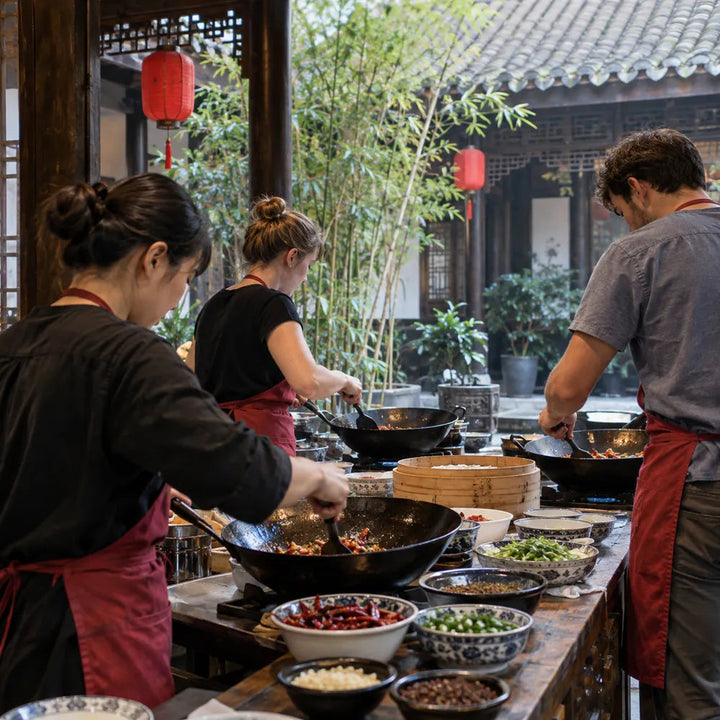
Our Chengdu food planning guide compares different meal formats. Use it to decide whether food is the main event or part of a broader evening. Then check the performance separately. A restaurant visit, transport, theatre admission and any backstage activity are distinct arrangements unless your written itinerary explicitly combines them.
Keep the address and the programme confirmation accessible before travelling. If the venue has more than one entrance or performance space, ask which one applies to your ticket. Decide how you will return afterwards without assuming that the outbound arrangement automatically includes the return journey. None of these steps requires a complicated itinerary; they simply prevent logistics from taking attention away from the work you came to see.
Chengdu and Chongqing are not interchangeable booking locations
Sichuan opera has cultural connections with both Sichuan and Chongqing. That does not make a performance advertised in one city a practical option for an evening based in the other. Search results, photographs and translated descriptions can circulate without making the location prominent, so retain the city name throughout your planning.
When comparing a programme, write down the complete venue name and address. If an organiser offers a replacement performance, check whether the proposed change preserves the city, date, format and interpretation that mattered to you. A replacement may be reasonable, but a similar label does not demonstrate that the experience is equivalent.
Use a regional journey to explore differences, not to accumulate interchangeable cultural stops. If you plan time in more than one city, you might choose one substantial theatre encounter and use another day for a different interest. Shu embroidery, for example, introduces a separate textile practice. Combining interests can make a journey varied, but the cultural relationship does not by itself confirm a workshop appointment, performance ticket or supplier arrangement.
Visiting with children or a mixed-interest group
Start with the interests and attention of the people travelling, rather than a generic claim that every cultural show is suitable for every family. Some companions want a complete story, others want a short introduction, and others may be uncomfortable sitting through an unfamiliar performance without knowing when they can take a break. Discuss those differences before booking.
Ask the organiser about the actual programme, duration, entry rules and any content relevant to your group. Do not assume that a dramatic visual act tells you everything about the rest of the evening. If a child needs an explanation, prepare a simple account of the characters and agree how questions will be handled without disturbing the performance.
A group does not have to make identical choices throughout a trip. Where practical and agreed, people with a strong theatre interest may choose a different evening from those who would prefer another activity. If everyone attends together, select a format for reasons you can explain: a particular story, accessible interpretation or a shared curiosity. Avoid promising that a spectacle will automatically overcome every difference in interest or comfort.
Photography, recording and respectful attention
Ask about photography before the performance rather than testing the rules after it begins. Permission to take a photograph does not necessarily include flash, video recording, standing up or photographing another audience member at close range. Follow the venue's instructions and any announcements made for that particular programme.
Think about the people behind and beside you. A phone held above eye level can block a view even when the screen appears small. If recording is permitted, a short, unobtrusive clip may be less disruptive than trying to document the entire show. Put the device away for part of the performance so that your own attention is not confined to its screen.
When sharing an image later, describe only what you know. Name the genre and venue if they were confirmed, and avoid identifying a performer from resemblance alone. A photograph of someone on stage is not evidence that they are your guide, a member of a travel company's team or a participant in your booked itinerary. Accurate captions are a small but useful part of treating the work and its practitioners with respect.
What the image and video on this page can show
The accompanying stage material comes from commercially authorised creator footage supplied in the owner's media library. The five-second silent montage excludes tourist interview segments. The exact venue, performance date and performers' identities have not been verified. It is therefore used to illustrate visible stage movement and costume, not to recommend a current programme or claim a ChinaTourly customer experience.
Watch the short passage for the relationship between body position, costume and movement. Pause if you want to examine a visible detail. Do not use the absence of sound to draw conclusions about the original singing or accompaniment: the clip is intentionally silent. A still image drawn from the same material is not an independent second record of another performance.
This limitation is useful when comparing travel media generally. A visually impressive clip may help you decide that a subject interests you, but a booking still requires current information. Ask whether the advertised programme is the one shown, and which details are illustrative. A clear answer is more valuable than an unqualified claim that your visit will reproduce a promotional scene exactly.
Compare related theatre traditions without flattening them
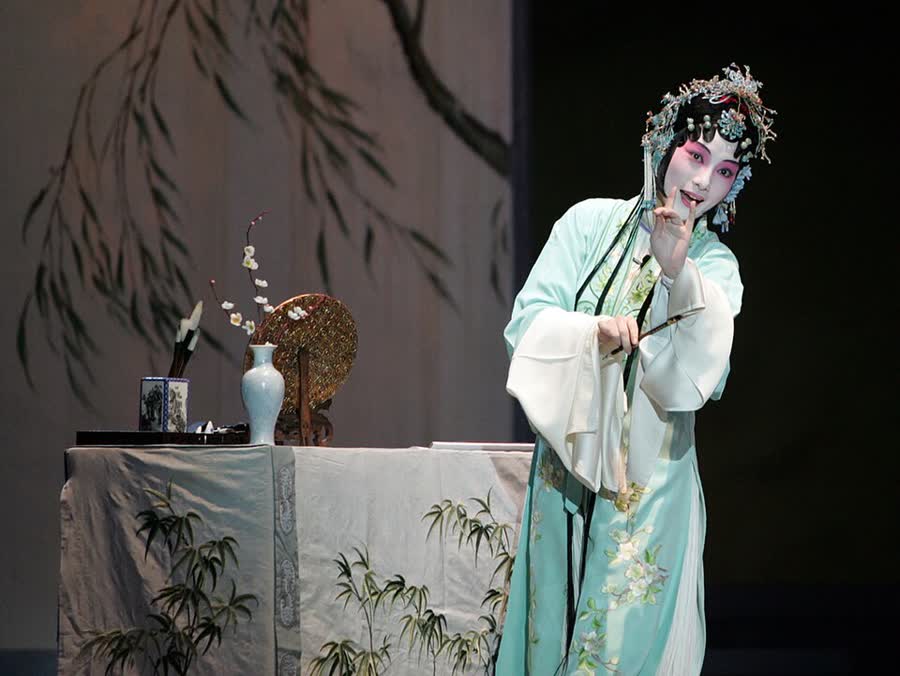
Peking opera, Kunqu and Yue opera are not alternative English names for Sichuan opera. UNESCO's Peking opera description identifies singing, recitation, acting and martial performance among its elements. Shared theatrical features do not erase the distinctions between traditions, repertoire and ways of presenting a work. UNESCO Peking opera reference
For travel planning, compare the actual programmes rather than ranking entire genres from a few images. Which work will you see? How is it introduced? Does the format match your interest in music, dramatic narrative or movement? Those questions can help you choose meaningfully without needing to claim that one tradition is more authentic or easier for every visitor.
If the same legend appears in different theatrical forms, use that as a point of comparison. Notice which characters or scenes receive attention, while remembering that you are comparing particular adaptations. The White Snake story guide offers background for one narrative that has travelled across forms. Familiarity with a plot is a helpful bridge, not proof that the performance styles are interchangeable.
A compact vocabulary for reading programme descriptions
Genre identifies the theatrical tradition. Play title identifies the dramatic work. Excerpt means a selected passage rather than a promise of the complete story. Programme is the sequence offered at a particular event. Keeping these terms separate prevents a venue name or a famous technique from standing in for the information you actually need.
Synopsis provides a summary of the story or scene. Surtitles are displayed text intended to help an audience follow a performance; ask which language is available and where it can be seen. Demonstration suggests that a technique is being shown, but the word alone does not establish whether visitors can participate. Workshop needs an explanation of what a participant will do, not just what a professional can perform.
When a description is translated loosely, ask for the original title or a current programme image. That gives both you and the organiser something concrete to discuss. There is no need to challenge every unfamiliar phrase. Concentrate on the distinctions that affect your choice: the work, format, language support, place and time.
Questions worth asking before confirming a visit
Send a short, specific enquiry rather than a long list of general questions. State your city and date, the number of people and your main interest. Then ask for the programme format, the venue address, the running time and the interpretation offered. If a practical requirement could change your decision, include it at the start rather than after a booking is nearly complete.
For example: you may be interested in a complete dramatic work with a synopsis, rather than a mixed entertainment show. Another visitor may want a shorter introduction to stage techniques. These are preferences, not demands that an organiser redesign a performance. Stating them clearly helps the organiser say whether an available option is a reasonable match.
Keep the final written description. If several options were discussed, make sure the confirmed version identifies which one was chosen. The bespoke enquiry page can be used to describe cultural interests within a wider China journey. A discussion is not a guarantee of a named artist, a backstage visit or a particular seat until those details are explicitly confirmed.
Frequently asked questions
Is Sichuan opera the same thing as face-changing?
No. Face-changing is one technique associated with the tradition, while Sichuan opera includes singing, dramatic performance, movement and a wider repertoire. A short act can be an enjoyable introduction to one aspect without representing everything the tradition contains. Read the programme to find out whether you are choosing an opera scene, a complete work or a standalone act within a mixed show. The distinction helps align your expectations with the event rather than judging the entire art from a single visual effect.
Can I enjoy a performance without speaking Chinese?
You can approach movement, costume, musical change and relationships on stage without understanding every line, but following the plot requires more support. Ask about a synopsis, translated programme or surtitles. Choose according to what you want from the evening: observing a scene and understanding every dramatic detail are different goals. Do not assume that an event offers English interpretation because its booking page is in English. Preparation should help you look at the stage, not leave you reading a phone throughout the performance.
Does national heritage status mean every show is officially certified?
No. The directory identifies a cultural tradition and its listed entries. It is not a universal endorsement of every venue, ticket seller or entertainment package using the words Sichuan opera. Use the heritage record for cultural context, then evaluate a current programme on its own details. If a seller makes a particular institutional or certification claim, ask for the relevant evidence rather than extending the tradition's designation to that business automatically.
Is a full play always better than excerpts?
Not for every purpose. A full work offers sustained dramatic development, while carefully introduced excerpts can make a useful first encounter. The important question is whether the format matches your interest and the interpretation available. If you choose excerpts, establish whether they come from one work or several. If you choose a complete play, prepare enough to follow the central situation. Neither option should be marketed as the other simply because both use the same genre name.
Should I book the seat closest to the stage?
Not automatically. The best position depends on the room, the width of the stage, any obstructions and where translated text appears. A close seat can emphasise detail while making it harder to take in a broad scene or a screen positioned elsewhere. Ask for the seating plan and explain what matters to you. This guide has not inspected a named venue or ranked its seating categories, so it cannot identify a universally best row or promise a particular sightline.
Is an evening performance included in a Chengdu city tour?
Only when the confirmed itinerary explicitly includes it. A tour's cultural theme, a theatre photograph or a general reference to Sichuan traditions does not establish admission to a specific show. Check the date, programme, transport and any meal arrangements separately. If the performance is optional, ask how that option is confirmed and whether it changes other parts of the day. Keep pricing and payment details within the actual booking process rather than inferring them from an editorial guide.
Can I meet a performer or go backstage?
Do not assume so. A public performance ticket and access to a working backstage area are different arrangements. If an organiser offers a meeting, ask what is included, who is expected to participate and how any changes are handled. Respect a refusal or a change required by the production. This page does not promise access to a named practitioner, and a performer appearing in supplied footage has not been identified as someone available to meet ChinaTourly travellers.
Will I be allowed to photograph the performance?
The answer comes from the venue and the specific event. Ask before the show and follow announcements on flash, video and the use of phones. A rule permitting still photographs does not necessarily permit continuous recording. Be considerate of sightlines and avoid photographing other audience members closely without consent. If you cannot record, programme details and a short written note afterwards can preserve what you learned without interfering with anyone's view or the performers' work.
Can children attend?
Check the organiser's current rules and consider the particular child's interests, comfort and attention. Do not assume that every show has the same length, sound level or subject matter. Ask about breaks, re-entry and any relevant age conditions. A short explanation of the story may help, but it does not guarantee that a child will enjoy an unfamiliar performance. The appropriate choice is specific to the programme and your family; no blanket suitability or facility claim is made here.
Does the video show the programme I can book?
No such connection has been verified. The clip is an illustrative, silent excerpt from authorised supplied footage. Its venue and recording date are unconfirmed, and it is not a recording of a complete work. Use it to observe visible performance details, not to infer current availability, a cast identity or an included itinerary experience. Before booking any event, request its current programme and treat promotional media separately from the written service description.
Can I combine opera with a craft visit?
It may be possible to build a trip around both interests, but the arrangements need separate confirmation. Shu embroidery and Sichuan opera introduce different forms of cultural practice; one is not automatically included with the other. Consider travel between locations, opening arrangements and the time needed to appreciate each activity. A quieter craft explanation can complement a theatre evening, but a named workshop, practitioner or performance should only appear as an inclusion once actually confirmed.
What should I remember after the performance?
Keep the confirmed play title, genre and venue, then add a few specific observations. A movement that puzzled you, a musical response you noticed or a change in a character's behaviour provides a better starting point for further reading than a broad judgement about Chinese opera. Separate what you saw from what you were told and from what you are still unsure about. That habit makes a second encounter more rewarding and helps you describe the first one accurately to someone else.
Sources and further reading
This guide separates documented cultural background from practical questions for planning a visit. Historical educational reports are not current event listings. No venue timetable, price, supplier availability or identified customer experience is established by these references.
- National heritage directory: Sichuan opera, Sichuan entry.
- Ministry of Culture and Tourism: first national heritage list.
- Sichuan Provincial Academy of Arts: teaching account on performance principles.
- Sichuan University: 2021 lecture-demonstration report.
- Sichuan Provincial Academy of Arts: publication discussing Gaoqiang.
- UNESCO: Peking opera, for comparison rather than a Sichuan opera designation.