Kunqu is a Chinese theatre tradition associated with Kunshan in the Suzhou region, combining sung text, spoken passages and carefully shaped movement. For a first performance, learn who is on stage and what the scene asks of them. Then follow the relationship between voice, gesture and dramatic time rather than expecting rapid plot delivery.
Begin with a scene, not an entire history
The most useful preparation for a first Kunqu performance may fit on a small programme note: the scene's title, the characters present and the situation at its beginning. Without those bearings, an unfamiliar language and performance style can make every detail seem equally difficult. With them, you can give attention to what the performers actually do.
You do not need to decode every word to notice an exchange of attention. One character may speak while another listens; a change in stance may alter the relationship before the next line arrives. The scene is not carried only by information in the lyrics. The timing of a look, an approach or a pause can change how you understand a familiar piece of dialogue.
Try choosing a question before the performance begins. What does this character want from the other person? What changes between the start and end of the excerpt? The question gives you something to follow without requiring a complete vocabulary of gestures. It also helps prevent the experience from becoming a sequence of attractive costumes photographed without attention to the drama.
A short programme is not automatically simple, and a long production is not automatically inaccessible. The difference often lies in how clearly the context is supplied and what you want from the evening. A first visit might be about hearing a particular voice, understanding a scene or encountering the form at all. Choose a performance format that supports that purpose rather than assuming that the longest option is the most authentic.
Kunshan origins and a tradition that travelled
The Suzhou heritage authority's account places Kunqu's development in the Suzhou and Kunshan area. It describes a transformation from regional vocal practice towards a theatrical form, rather than the sudden invention of an already complete stage tradition. That distinction makes the history more intelligible: music, language and performance developed through the work of different people over time.
The national heritage record names Kunqu, Kunshan qiang and Kunju in its account. These related terms can appear differently in English programmes and translations. A title containing one spelling does not by itself tell you whether the event is a full production, an excerpt programme, a concert or an educational demonstration. The actual programme description matters.
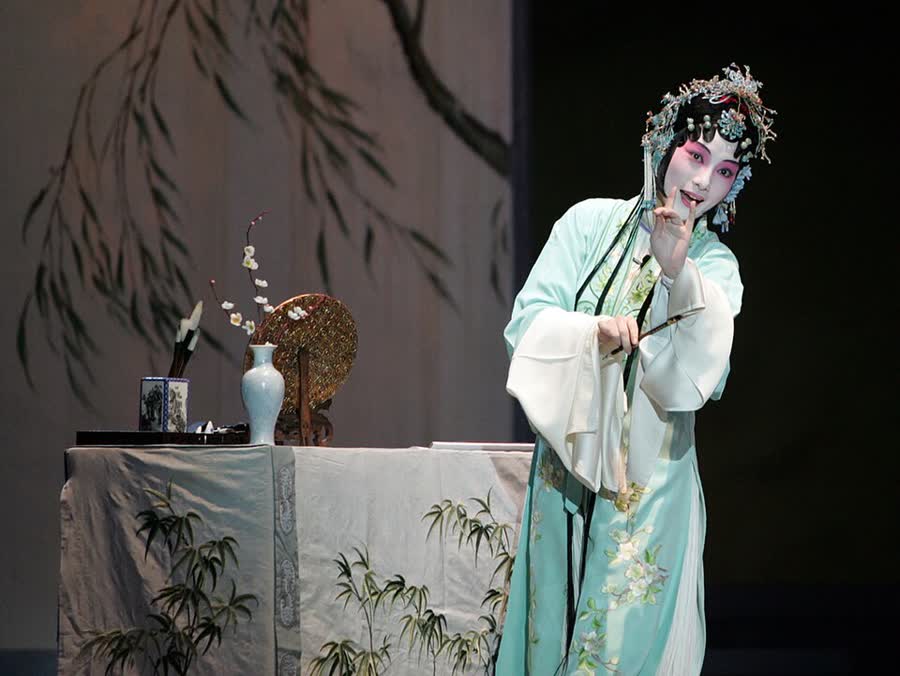
Kunqu's association with Kunshan should not be turned into a rule that a performance elsewhere is less legitimate. The official records describe its spread and regional development beyond that origin. The photograph on this page shows a performance at Peking University in Beijing; its location is identified precisely rather than relabelled as a scene in a Suzhou garden.
For a traveller, the practical consequence is straightforward. You may find a relevant performance in a city other than the one you first associate with the genre, but you still need to verify the troupe, repertoire, date and venue. A historical connection between a city and an art form is not the same as a current ticket offer. It helps orient the search; it does not complete the booking.
Wei Liangfu and the sound called shuimo
Both official accounts discuss Wei Liangfu's role in refining Kunshan vocal practice during the Ming period. The term shuimo, often translated through images of water-polishing, is associated with that refined style. It is better understood as a historical and aesthetic description than as a literal sound effect that every listener should be able to identify immediately.
On a first hearing, give attention to the shape of a phrase. Where does the voice linger? How does it move from one syllable to the next? Does the line gather intensity gradually or turn sharply? These questions let you listen actively without requiring you to decide whether a singer has met a technical standard you have not studied.
The national account pays particular attention to the treatment of pronunciation within singing. That helps explain why sung language can unfold differently from ordinary speech. A syllable is not merely a unit of plot information to be delivered as quickly as possible. Its sound can become part of the expressive structure of the line.
A translation may therefore move at a different pace from the voice. The surtitle can state a meaning in a few words while the performer continues to develop the musical phrase. Rather than assuming the singing is repeating information unnecessarily, consider what changes in the delivery. The meaning has reached you through the text; the performance may still be shaping its emphasis, emotional direction or relationship to the other character.
From vocal practice to dramatic action
The official history connects Liang Chenyu's Huansha Ji with the development of Kunqu as theatre. This matters because it reminds us that a musical form and a staged drama are related but not identical. A concert presentation can foreground singing, while a theatrical scene asks the voice to work alongside character, movement and an unfolding situation.
When looking at an event listing, distinguish a sung selection from a staged excerpt. Both can be artistically substantial, but they invite different expectations. A concert may not contain the scenery, costumes or movement associated with a fully staged production. A demonstration may stop to explain a technique. None should be sold as another format merely because all involve Kunqu music.
In a staged scene, listen to how delivery interacts with action. A gesture can begin before a line, accompany it or follow it. A performer may remain physically restrained while the voice changes, or move through a carefully shaped sequence while the singing maintains continuity. The interest lies in their relationship, not in treating voice and movement as separate attractions competing for attention.
This is also why a still photograph cannot represent the whole encounter. It preserves costume, position and a moment of expression, but not the transition that gave that moment its force. Use an image to identify what is visible, then leave room for what it cannot show. The tradition's musical and temporal qualities need a performance, a reliable recording or a well-explained example to be understood more fully.
Why an excerpt can be a complete evening's focus
The national record describes the importance of zhezixi, or selected scenes, in Kunqu's later performance history. An excerpt is not necessarily a casual fragment cut from a longer show for visitors. A scene can develop its own performance life, with demanding vocal, physical and dramatic detail that rewards sustained attention.
The practical challenge is context. Ask where the scene sits within the larger work and what the characters already know. An entrance that seems neutral without that information may carry expectation or tension once you understand the situation. A short synopsis can supply these bearings without attempting to replace the experience of watching.
An evening of several excerpts may move between different works and characters. Do not assume that the second selection continues the first selection's story. Keep the programme's titles and cast changes visible in your mind, and use the interval between pieces to reset the situation. Confusion about that structure is common and has little to do with whether someone is capable of enjoying the art form.
A full-work presentation raises different questions. It may be edited, adapted or distributed across more than one part, so the familiar title alone does not settle its duration or scope. Read what the particular production actually offers. The choice is not between a supposedly pure complete work and an inferior excerpt, but between different artistic formats and the time and attention you can realistically give them.
Famous titles are starting points, not interchangeable stories
The national account names works including The Peony Pavilion, The Palace of Eternal Life, The Jade Hairpin and Fifteen Strings of Cash among the repertoire associated with Kunqu. These titles help an unfamiliar visitor recognise that the tradition contains a range of dramatic subjects. They should not be treated as a single generic story about romance in a garden.
If you recognise a title from another art form, check the genre and production carefully. Chinese dramatic stories can circulate through different theatrical traditions and adaptations. Familiar characters do not make the music, acting conventions or version identical. The same caution applies when a short promotional clip uses a famous title without identifying which scene it shows.
For a first booking, learn the names of the particular excerpt and the people on stage rather than trying to read several complete plays at once. A useful synopsis explains the immediate circumstances and any necessary earlier event. It need not tell you exactly how to feel about the characters or prescribe the interpretation of every gesture.
If the production revises the setting or presentation, look for an explanation of that choice in its programme. A contemporary staging is not automatically disconnected from the tradition, just as a historical-looking costume is not proof of an unchanged old version. Evaluate the stated production rather than assuming that appearance alone establishes its relationship to earlier performance practice.
Roles are performance specialisms as well as characters
The official record describes a developed system of role categories, including distinctions associated with age, gendered character presentation and dramatic function. A role category is not simply the name of a person in the plot. It also relates to the skills and conventions through which a performer presents that person on stage.
For a newcomer, the programme's character list is usually more useful than memorising a long catalogue of categories. Establish who the character is in this scene and what relation they have to the others. Then notice differences in movement, speech and vocal delivery. The categories become meaningful when connected with observable performance rather than learnt as isolated vocabulary.
Avoid assuming that the identity of the performer is identical to the identity of the role. Theatre involves trained portrayal, and a production's casting should be described accurately. A photograph of a costume cannot establish a performer's personal gender, age or biography. Use the cast information supplied by the responsible troupe or venue when those details are relevant.
The distinction also protects against simplistic character readings. A costume colour or a familiar-looking gesture is not a universal dictionary that lets a visitor label every person good, evil, comic or tragic without context. Conventions operate within a performance tradition and a particular scene. Ask how they function there rather than borrowing explanations from an unrelated genre or a general souvenir guide.
Movement can make an imagined place legible
One of the rewards of unfamiliar theatre is discovering how little literal scenery may be needed to make a situation understandable. A performer can direct attention, mark a change of orientation or establish a relationship with an imagined space. That does not mean every production uses an empty stage; it means that the acting contributes to the place rather than merely occupying a built setting.
Watch how an entrance is prepared. Does the performer move directly towards another character, pause to take in the space or create a sense of distance? Then compare a later movement through the same stage area. A similar path may mean something different because the relationship or situation has changed. The action can therefore be expressive even when it does not advance the plot through a new event.
Hands, eyes, feet and posture work together. Looking only at a decorative sleeve can miss the direction of attention that gives its movement meaning. Try following the whole figure through a short passage, then watch a smaller detail on a later occasion. There is no need to extract a single coded message from every movement in order to appreciate its precision.
Do not test your interpretation by imitating a gesture during the performance. If an educational session invites participation, follow the instructor's context and limits. A brief copied pose is not equivalent to learning the physical technique that supports it. Watching the transition into and out of a pose can reveal far more than a photograph of the pose alone.
Listen beyond the lead voice
Even when the singer holds your attention, the musical environment helps organise the scene. Listen for the beginning and ending of phrases, changes in pulse and moments when the relationship between voice and accompaniment becomes especially clear. You do not need to identify every instrument to notice how the performance holds together.
A newcomer can begin with one simple listening task: follow a phrase until it settles. Resist the temptation to move immediately back to the plot summary. The duration of that phrase may change your sense of the character's urgency, hesitation or composure. These are interpretive responses rather than a technical judgement about the singer's execution.
Acoustic conditions affect what reaches you. A recording, an amplified presentation and a performance in a smaller room may make different details prominent. That does not mean the art form itself has changed each time. When comparing examples, remember what the recording or room allows you to hear and avoid treating an edited promotional clip as a neutral record of a whole performance.
If sound levels, hearing access or spoken explanation matter to your visit, ask the venue about the specific event. A traditional genre does not guarantee a quiet room, an unamplified performance or a particular seating arrangement. Practical information belongs to the current production. It should be confirmed before purchase rather than inferred from an atmospheric image of a historic theatre.
Surtitles help, but they do not perform the scene for you
Surtitles can make a first encounter much easier, especially when they identify the immediate meaning of a sung passage. Confirm whether they exist and which language they use. A venue advertising subtitles may provide Chinese text only, and an English synopsis may be available without line-by-line English surtitles. These are different forms of support.
Once seated, find a comfortable pattern of attention. Read enough to stay oriented, then return to the performers. Trying to read every word while tracking every gesture can become tiring. A short synopsis read beforehand reduces that burden, allowing the surtitle to act as support rather than the sole source of the scene.
Translations also make choices. A line can carry an allusion, an image or a level of formality that a concise English rendering cannot reproduce in full. This is not a reason to distrust the translation; it is a reason not to assume that a short sentence exhausts what the vocal delivery is doing. Let the sound and action contribute alongside the translated meaning.
If there are no English surtitles, decide whether the available explanation is enough for the experience you want. A short excerpt with an introduction may be a good entry point. A long performance with no accessible synopsis may ask more preparation. Neither choice makes you a better or worse traveller; it is a question of matching the event to your interests and ability to follow it comfortably.
Garden setting, theatre setting and the same need for a clear programme
A garden can offer an appealing frame for a performance, but scenery does not identify the genre. A programme staged in a garden might include different arts, music or a theatrical selection. Read the title and description before calling it Kunqu. The relationship between a setting and the art is something to investigate, not an assumption to make from the surroundings.
A conventional theatre offers different conditions: seating orientation, lighting, stage distance and the location of surtitles can be easier to anticipate, though they still vary. A smaller or site-specific presentation may bring performers closer while introducing other practical questions. Neither format is universally superior. Choose based on the actual event rather than the promotional appeal of its location.
For an outdoor or partially open setting, ask about weather arrangements and whether a change of venue would alter the programme. For any site, establish access, seating and the expected finish time. A beautiful photograph cannot answer those questions. Historical architecture also does not establish accessible entrances, suitable seating or facilities for every visitor.
The credited photograph on this page records Kunqu at Peking University in Beijing. It illustrates the tradition beyond its regional origins and remains labelled accordingly. It is not a photograph of a currently bookable ChinaTourly event, a garden performance in Suzhou or a member of our team. Clear location and source information are more valuable than making an image appear to document a service it does not.
Kunqu is not Peking opera, Yue opera or pingtan
Kunqu influenced other theatrical traditions, but influence does not make them interchangeable. The Peking opera introduction, Yue opera guide and Sichuan opera guide concern distinct contexts. Their programmes can share stories or broad theatrical features while differing in music, language and performance practice.
Suzhou pingtan belongs to a narrative-arts context rather than simply being a shorter name for Kunqu. A visitor looking for an evening of storytelling should not assume that a Kunqu booking provides it, or vice versa. If a venue presents several arts together, ask which parts of the programme correspond to which form.
Comparison is most useful when it stays specific. You might compare how two productions introduce a character, how the voice carries a line or how a performer establishes space. Asking which entire tradition is more authentic, more beautiful or more difficult usually produces broad claims instead of close understanding. A good programme note can tell you which comparison is actually relevant.
This matters in practical travel planning too. A city associated with one tradition may host performances of another, and a cultural tour label may be broader than any one genre. Confirm the event title, troupe and programme. A face-changing clip, a costumed portrait or a room decorated with opera masks is not evidence that the performance offered is Kunqu.
Heritage recognition belongs to a living practice
The national and Suzhou accounts both identify Kunqu's recognition in UNESCO's 2001 proclamation of masterpieces of oral and intangible heritage. That history of recognition concerns a performing tradition, not a promise that every event using the name has been individually inspected or approved by UNESCO. It should not be converted into a sales endorsement of a venue or package.
The idea of living heritage is useful because performance depends on people learning, rehearsing, interpreting and presenting it. A printed script cannot by itself preserve the relationship between voice and movement, and a recording cannot answer every question a learner would put to a teacher. The continuity involves transmission of knowledge, not merely storage of attractive images.
Official descriptions of past difficulties also need careful handling. A source's statement about declining audiences or the number of professional groups belongs to its context and date. It is not automatically a live measure of the art form today. This page does not invent current audience statistics or use a crisis narrative to pressure visitors into a particular purchase.
For a visitor, a respectful response can be modest: attend attentively, use legitimate ticket channels, follow the venue's recording rules and describe what you saw accurately. You do not need to claim that one ticket has saved a tradition. Enjoying a performance and learning enough to distinguish it from another form are worthwhile outcomes in themselves.
Choosing a performance during a Jiangnan trip
Start with your travel dates and the actual programme rather than building a day around a generic expectation of nightly Kunqu. Ask whether the event is confirmed, whether the advertised cast is current and what happens if the programme changes. Theatre schedules are specific. A historical city association cannot supply the missing details.
Allow time between a daytime visit and the evening event. A journey that looks short on a map may still involve returning to accommodation, eating and locating the venue. The purpose is not to maximise the number of cultural subjects in one day but to arrive with enough attention to enjoy the performance. A tired, hurried arrival can make even a well-explained scene difficult to follow.
The Shanghai and Suzhou Gardens journey is one existing regional route to examine when considering a longer stay. It does not include a specific Kunqu performance merely because this guide links to it. Any added event would need confirmation in the actual itinerary, including its location and practical arrangements.
For a more tailored plan, use the bespoke planning page to describe whether you want a full theatre evening, selected scenes or an educational introduction. Mention language support, seating and access needs at the same time. A precise request is easier to evaluate than an unspecified request for a traditional show, and it leaves less room for one genre to be substituted for another without your understanding.
During the performance and afterwards
Arrive according to the venue's stated admission time and follow its policy on late seating. Turn off distracting phone sounds and light. Even when photographs are permitted before the event, recording during a scene may not be. Ask about the specific rule instead of assuming that a tourist-oriented setting makes filming unrestricted.
If you do not understand a passage, let it pass without trying to resolve every detail on your phone. You can return to the synopsis later. During the scene, the unresolved moment may become clearer through another character's response or a change in delivery. Maintaining attention often provides more understanding than repeatedly interrupting the experience to search for a definition.
Afterwards, note one thing that changed for you: a phrase that sounded different from its written translation, a gesture that established a place, or an excerpt whose relationship became clear. Such notes preserve the experience more usefully than a list of unsupported superlatives. They also help you decide what you would like to hear or see on another occasion.
When sharing a photograph, retain the event and venue information you can verify. Do not identify performers by guessing from their costumes, and do not call other audience members your customers. If a short clip is authorised, label the selection rather than presenting it as the complete work. Accurate description respects both the performance and the people whose work made the encounter possible.
Questions about Kunqu
Is Kunqu the same as Kunju?
These related names appear in official descriptions and can be used differently in programmes and translations. The name alone does not settle an event's format. Check whether the listing describes staged theatre, a concert selection, excerpts or an educational demonstration. That practical distinction matters more for your first booking than choosing one English spelling as the only acceptable form.
Must I understand Chinese to attend?
Not necessarily, but suitable preparation and language support can make a substantial difference. Read the scene synopsis and confirm whether English surtitles or introductions are available. You can follow voice, movement and relationships without understanding every word, yet a long production with no accessible context may require more effort than a short, well-explained selection.
Is an excerpt less authentic than a full play?
No simple hierarchy follows from length. Selected scenes have an important performance history within Kunqu and can involve highly developed artistic detail. What matters is knowing what you are attending and receiving enough context to follow it. A complete-work title should also be checked for the particular adaptation, duration and scope offered by that production.
Does a performance in a garden have to be Kunqu?
No. The setting does not identify the genre. A garden programme may contain music, storytelling, theatre or a mixed presentation. Confirm the event's title and responsible performers. An attractive historic background is not evidence of Kunqu, just as a conventional theatre does not make a genuine Kunqu performance less connected to the tradition.
Can I see Kunqu outside Kunshan or Suzhou?
Yes, the official records describe its wider spread and regional practice. The existing photograph here is labelled as a Beijing performance. Current availability still depends on the specific city's programme and dates. Do not assume a daily event from a historical association or a photograph, and check the troupe and performance details before making travel arrangements around it.
What should I read before the show?
Begin with the particular scene's synopsis, the character list and any necessary preceding event. That is often more helpful than trying to memorise the entire history of Chinese theatre. Check whether an evening contains separate excerpts from different works so that you do not mistake a change of repertoire for a continuation of one story.
Are the costumes a universal code for a character's personality?
Avoid treating them as a simple dictionary. Role conventions and visual details operate within a tradition and a particular production. A colour or gesture borrowed from an explanation of another genre may mislead you here. Use the programme's character information, then observe how the performer develops the role through voice, movement and relationships.
Is Kunqu the same as Suzhou pingtan?
No. Kunqu is theatre, while pingtan belongs to a narrative-arts tradition. They can both be relevant to a regional cultural visit, but a booking for one does not include the other. If a programme combines different forms, ask which selections belong to each so that the event is described accurately and matches your interests.
Are English surtitles standard?
Do not assume so. Ask about the specific performance and the language of the text. Chinese surtitles, an English synopsis and English line-by-line surtitles are different kinds of support. Seat position can also affect visibility. Confirm these details before buying if translation is important to your ability to follow the evening comfortably.
Are performance tickets included in the linked journey?
Only if the confirmed itinerary states that they are. The regional route link provides planning context rather than a ticket promise. A specific performance, seating arrangement and date need separate confirmation. Raise the interest explicitly rather than assuming that a general cultural theme guarantees Kunqu access or a meeting with a named performer.
Can I photograph or film the actors?
Follow the venue's rules and obtain the permissions needed for your intended use. A pre-show photo opportunity does not automatically allow recording during the performance or commercial publication. Keep captions factual about the event, venue and people shown. Do not imply that performers are employees of your travel company or that other audience members are its customers.
Why is there no embedded performance video here?
A verified clip needs the correct genre, source and usable rights. A scenic video from Kunshan or footage of another opera tradition would not demonstrate Kunqu. No such clip has been confirmed for this page. The credited still image remains accurately located, and any future video should identify its actual performance context rather than imply a currently bookable event.
Sources and further reading
- National heritage record: Kunqu, Shanghai entry within project IV-1. Historical development, repertoire, role categories and recognition; not live troupe or ticket inventory.
- Suzhou heritage authority: Kunqu. Regional origins and development; historical descriptions are not current performance schedules.
- UNESCO: Kun Qu opera. Primary international recognition reference. The direct page could not be retrieved during this revision; the recognition statement above is independently supported by the two accessible official Chinese records.
Reviewed 2 November 2026. Listening and viewing prompts are editorial guidance, not claims of technical mastery or guarantees of current performance access.