Yue opera developed from local performance in Zhejiang and grew into a distinctive theatrical tradition through its relationship with Shanghai. It is known for lyrical storytelling and an important history of women performers. When choosing a show, identify the actual play, cast and production: a familiar legend alone does not tell you which theatre tradition you are booking.
First resolve what the programme means by Yue
An English listing can hide a distinction that is clear in Chinese. The Yue opera discussed here is 越剧, associated with Zhejiang and Shanghai. Cantonese opera is 粤剧, a different theatrical tradition. Their names can both appear with the romanised word Yue in some contexts, so a short English label without further information deserves clarification.
Ask for the Chinese title of the genre or the responsible troupe when necessary. This is not a test of the organiser's vocabulary; it is a practical way to make sure everyone is talking about the same event. A programme's city, music and language can provide context, but location alone is not decisive because companies tour and audiences encounter regional theatre outside its place of origin.
The same care applies to broad labels such as Chinese opera, traditional show or cultural evening. They may describe a category containing many different programmes. If your interest is Yue opera, request the actual production information rather than accepting a costume photograph as confirmation. A mask, a fan or a familiar love story cannot identify a genre on its own.
Once the identity is clear, preparation becomes easier. You can look for the relevant synopsis, understand the historical context and make a realistic decision about language support. The aim is not to complicate a booking with terminology, but to avoid arriving at a different kind of performance from the one you wanted and trying to understand it through the wrong set of expectations.
Zhejiang roots and the importance of Shanghai
The national heritage account traces Yue opera to the Shengxian area of Zhejiang, now associated with Shengzhou, and describes its development from local narrative performance. That background is different from imagining a fully formed grand theatre tradition emerging in a major city. The relationship between local practice and urban stages is part of the story.
The record places an important move into Shanghai in the early twentieth century and discusses changing names and formats as the genre developed. The useful point is the transformation, not simply a sequence of dates. A growing urban audience, new performance environments and artistic borrowing created conditions in which the form could change while retaining links with its regional roots.
Shanghai should therefore not be described merely as a convenient modern place to watch a Zhejiang art. It is part of the theatre's development. At the same time, that historical role does not mean every current Shanghai venue offers Yue opera or that a visit there guarantees a particular troupe. Historical geography helps explain the art; current programme information establishes what can actually be seen.
For a regional trip, keep those two maps separate. One map connects places through cultural history. The other contains the dated events, venues and travel arrangements available during your stay. A strong itinerary can draw on both, but it should not replace missing practical information with a confident-sounding story about where the genre belongs.
Women performers and the difference between an actor and a role
The national account describes the development of all-women performance as an important part of Yue opera's history. This is not a minor curiosity added to an otherwise unchanged form. It is connected with the genre's artistic identity and the work of major performers. A visitor should take it seriously as performance history rather than reduce it to a surprise about who plays a male character.
An actor and a role are not the same thing. A woman portraying a young male scholar is creating a character through trained voice, movement and dramatic judgement. The interesting question is how that portrayal works: how the performer establishes status, temperament, relationship and change within the scene. Treating the performance only as an illusion to be exposed misses the artistic work.
Avoid making universal claims about every present-day company or production from the historical importance of women performers. Read the actual cast information. A genre can contain different institutional histories and current practices, and a photograph does not establish a performer's biography or identity. The programme is a better source for the named artists and their roles.
It is also worth separating theatrical portrayal from private life. A convincing onstage relationship is not evidence about the performers' personal relationships, and casting does not invite speculation about sexuality or gender identity. You can discuss the characters' intimacy, restraint or conflict as part of the drama without converting that interpretation into an unsupported claim about the people who play them.
Yuan Xuefen and a changing idea of stage realism
The national account identifies reform associated with Yuan Xuefen and colleagues in the 1940s. It describes a combination of more detailed attention to character psychology with movement and conventions drawn from established theatre traditions. The significance is not that Yue opera stopped being stylised, but that different ways of presenting a person on stage could be brought together.
Realism in this context does not require a stage that looks exactly like an everyday room. A performance can use heightened singing, formal movement and a designed visual world while still making a character's motives feel carefully observed. Look at how a decision emerges rather than asking whether every gesture resembles ordinary behaviour.
For example, a character may maintain outward composure while a shift in delivery suggests uncertainty. Another may respond too quickly or hesitate before answering. These observations do not depend on knowing a complete technical vocabulary. They invite attention to the relationship between visible action and the character's changing understanding of the situation.
The history of reform also cautions against calling every innovation a departure from authenticity. Borrowing and adaptation appear within the official account of the genre's growth. A modern production still needs to be described on its own terms, but change itself is not proof that it has abandoned the tradition. Ask which choices the production makes and how they serve the work rather than assuming that only an old-looking stage can be legitimate.
Melody carries relationships, not just attractive sound
Yue opera's lyrical qualities are often emphasised in introductions. That description can help a visitor anticipate an interest in the sung line, but it should not turn the performance into pleasant background music. The singing belongs to characters who are addressing, persuading, recognising or resisting one another within a particular situation.
Try listening for the difference between a line directed outward and a passage that seems to reveal a more private thought. Does the other character respond immediately? Is there a change in distance or attention while the singing continues? The dramatic relationship can make a repeated musical idea feel different even when a newcomer cannot name the melodic pattern.
The national record identifies several major musical frameworks within Yue opera. A first-time listener does not need to recognise each one to follow a scene. It can be more useful to hear how a phrase builds, settles or changes energy. Technical names become meaningful when attached to examples, not when recited as a list before you have heard the music.
Be cautious with promotional claims that reduce the whole form to one mood. Lyrical does not mean every scene is gentle, and a reputation for love stories does not mean the repertoire has no social conflict or other dramatic subjects. Listen to what the particular character is trying to do. The voice may be beautiful and still carry argument, disappointment, humour or a painful change of understanding.
The Butterfly Lovers as a concrete listening example
The story of Liang Shanbo and Zhu Yingtai is closely associated with Yue opera's familiar repertoire. The NCPA's production information for The Butterfly Lovers provides one institutional account of a staged version. It can help you prepare, but it should not be treated as the definitive script for every production or as a current ticket offer for your travel dates.
In that account, Zhu Yingtai travels to study disguised as a man and forms a close bond with Liang Shanbo. Her attempts to communicate what he has not yet understood create a difference between the knowledge held by the characters and the knowledge available to the audience. That difference is especially productive on stage: a line can have one apparent meaning for Liang and another for those watching.
Listen for how the performers manage that unequal understanding. Does a hint seem playful, anxious or increasingly urgent? What does Liang appear to believe at that moment? The point is not to assign one correct emotional label in advance, but to notice how the interpretation develops. Knowing the eventual outcome does not make the journey through the scene artistically redundant.
Our Butterfly Lovers guide discusses the story's wider circulation, including forms outside theatre. Keep that broader legend separate from the production you attend. A violin concerto, a ballet and a Yue opera share a narrative association without offering the same musical or dramatic experience. Recognising the story is helpful preparation; it is not enough to identify the genre.
A farewell can contain more than a change of location
The NCPA synopsis describes the lovers' parting journey and Yingtai's indirect attempts to communicate her feelings. A scene of departure might seem, in a short plot summary, to be merely the movement of a character from school to home. On stage it can become a sustained encounter with misunderstanding, hope and the limits of what can be said directly.
This is a useful example of why theatrical time differs from summary time. A synopsis can state that someone fails to understand a hint in one sentence. A performance can let the audience experience the attempt, the response and the changing expectation. The interest lies in the developing relationship, not only in acquiring the next piece of information.
Watch how the two performers occupy the scene together. Is one leading the exchange while the other reacts? Does a change in position sharpen or soften a line? Do their responses appear balanced, or does one character remain a step behind? These questions connect musical delivery to the drama rather than treating a famous duet as a standalone melody.
Different performers and productions can make different choices within a recognisable scene. A clip you saw beforehand may prepare your ear, but it should not become a rigid standard against which every later performance is judged. The same material can reveal another emphasis through timing, vocal colour and the relationship between the actors. Leave room to hear the version actually in front of you.
Recognition and conflict are separate dramatic events
In the NCPA account, Liang's understanding of Yingtai's identity does not resolve the story. A promised marriage to another man creates a different obstacle. This separation matters because the drama is not only about whether a disguise will be discovered. Recognition can arrive while practical and social constraints remain.
For a viewer, that shift changes what to watch. Earlier, you may be following who understands what. Later, the question becomes what the characters can do with the knowledge they now share. A scene can feel very different once misunderstanding is no longer the central problem. The performers must make that change legible through more than a new fact in the synopsis.
When a production presents only one excerpt, establish which stage of the story it occupies. A departure scene, a later meeting and a final transformation do not ask the audience to follow the same emotional situation. Treating them as interchangeable highlights from a famous romance removes much of the dramatic context that gives each one meaning.
This approach also avoids using the story as a simplistic lesson about an entire society. The work can open questions about family expectations, choice and emotional expression without every character becoming a sociological fact about all Chinese people. Discuss what the particular narrative and production show. Literary interpretation is valuable, but it should not be turned into an unsupported generalisation about contemporary life.
The repertoire extends beyond one famous love story
The national heritage account names a wider repertoire, including Dream of the Red Chamber, Xianglin Sao, The West Chamber and other works. The range matters. If a visitor knows only The Butterfly Lovers, a second programme can reveal different kinds of character, social setting and conflict within the same theatre tradition.
A familiar literary title does not mean the performance contains the whole book or every episode associated with it. Adaptation requires selection. Ask which version is being presented, whether the programme is a complete production or selected scenes, and what prior context the audience is expected to know. A short introduction to that version is more useful than a general summary of a much longer source work.
Do not assume that every event bearing a familiar title uses the same cast, score, staging or running time. A revival can preserve important features while making other changes, and different companies may interpret the work differently. The actual production information is therefore part of the preparation, not an administrative detail to ignore once you recognise the name.
If you have several possible performances to choose from, choose according to your interests rather than popularity alone. You might prefer a recognised story for your first encounter, or a less familiar subject with excellent contextual support. A well-explained production can be more accessible than a famous title offered without any useful information about the version you will see.
Artist lineages and why the cast list matters
Yue opera introductions often refer to named schools or artistic lineages. These labels can connect later performers with the approaches of influential artists. They should not be reduced to a claim that every student sounds identical to a teacher, nor used as a ranking system in which a visitor must choose the single correct school before attending anything.
The NCPA production page gives a concrete example of how such information appears in an institutional programme: it identifies performers and their connections with senior artists. That is useful context for the stated production. It is not permission to infer a lineage for someone else from their costume, role or a short unlabelled recording.
For a first visit, note who is performing the principal roles and whether the programme explains their artistic background. Then attend to the interpretation itself. On a later occasion, comparing the same scene with a different cast may make the lineage information more meaningful because you have something specific to hear and observe.
Keep biography and marketing in proportion. Awards and titles can establish aspects of a career, but they do not replace a description of the evening's work. Likewise, an emerging performer need not be dismissed because a programme lists fewer honours. A theatre visit concerns the actual performance, including the relationship among the cast, not only the prestige attached to the leading name.
Scenery, costume and the character's world
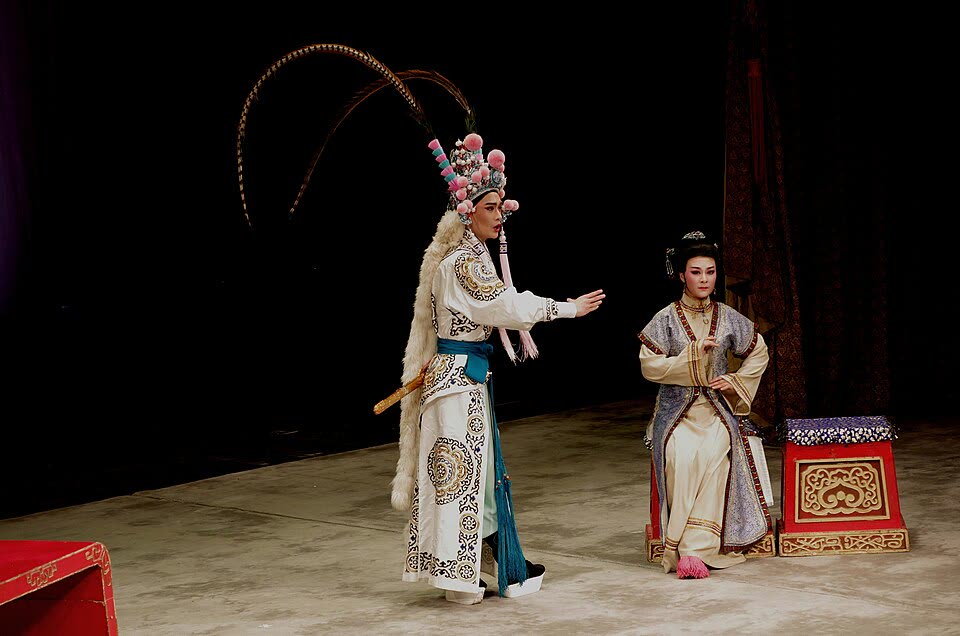
The national account discusses stage design as part of Yue opera's development rather than a decorative addition. Settings, lighting, costume and makeup contribute to the world in which the characters act. A visitor can therefore look beyond individual garments and ask how the visual choices organise the relationships in a scene.
Notice whether the setting draws attention towards a particular entrance, a shared space or a separation between characters. The design may make a social distinction visible before it is explained in dialogue. Alternatively, a relatively restrained setting may give the performers more responsibility for establishing the imagined environment. Both approaches should be considered in relation to the specific production.
Costume movement also matters. A garment that looks striking in a still image behaves differently when a performer walks, turns or pauses. Look at how the actor works with that movement, and how the visual line supports the role's presentation. This is not an invitation to assign a fixed meaning to every colour or to borrow a costume dictionary from another genre.
The existing photograph on this page is credited as a student Yue opera performance at Shanghai's Tianchan Theatre. That description is kept intact. It is not recast as a photograph of the NCPA production discussed above, a current tour inclusion or a professional cast whose identity has not been established. The image illustrates an actual performance context, while the article's other examples are separately sourced.
Language support without losing the performers
Do not infer the performance language from the city where you buy a ticket. A regional theatre production in Shanghai is not automatically sung in ordinary spoken Mandarin. Ask what language support is available for that event, especially if you need an English introduction, synopsis or surtitles to follow the story comfortably.
Those forms of support are not interchangeable. A synopsis can explain the plot before the evening begins; surtitles can help with meaning during the scene; a spoken introduction may supply a smaller amount of context. Ask which is actually provided and whether it is included in the event rather than assuming that a venue's English website means the performance itself has English text.
Once seated, give yourself permission to alternate between reading and watching. The surtitles may state the literal meaning quickly, while the performers continue shaping the exchange. Keeping your eyes only on the translation can make the drama seem less active than it is. Read enough to remain oriented, then return to the relationship on stage.
If a line or reference remains unclear, you do not have to solve it immediately. A later response may clarify its function, and a programme can be reread afterwards. The aim of preparation is to make attention possible, not to create a test in which every unfamiliar word must be decoded before you are allowed to enjoy the music or understand an emotional change.
Choosing between a full production and selections
A full production offers time for relationships and circumstances to accumulate. Selected scenes can offer a more concentrated introduction, especially when the event explains their context. Neither format is automatically more suitable for every visitor. Decide how much uninterrupted attention you can give and what kind of preparation is available.
For a selection programme, ask whether all scenes belong to one work or several. A change of costume or cast may signal a different story rather than the next episode of the same one. A list of scene titles and a short explanation of each can prevent avoidable confusion without requiring extensive reading in advance.
For a longer production, check the stated duration, intervals and finish time for that particular event. Do not generalise the timing of one NCPA listing to all Yue opera performances. Production length is a practical fact attached to a version, not an inherent property of the genre. Transport and other commitments should be planned around the confirmed event information.
A mixed cultural evening asks another question: how much of it is actually Yue opera? An excerpt may be only one part of a programme containing other arts. That can be enjoyable if it matches your interests, but it should not be described as a full Yue opera production. Clarity about format protects both your expectations and the accurate presentation of the performers' work.
Theatre geography and travel planning
Zhejiang and Shanghai are important cultural contexts for Yue opera, but touring and institutional exchange mean that relevant performances can take place elsewhere too. Choose on the basis of a confirmed event rather than assuming a nightly show in every associated city. A historical reputation and a current performance calendar answer different questions.
The Shanghai journeys collection offers regional routes to compare if you are planning several days in eastern China. A theatre evening should be considered against the daily itinerary, not added automatically because the trip includes Shanghai. Arrival fatigue, transfers and the time needed to reach the venue can affect whether the experience is realistic.
For a route connecting several Jiangnan cities, examine the Shanghai, Hangzhou and Suzhou Triangle journey. The link gives geographical planning context, not a promise that a specific Yue opera ticket or artist encounter is included. Any such activity must be stated in the confirmed itinerary with its actual conditions.
When discussing a bespoke trip, describe whether you want a full play, an excerpt programme, a particular work or an introduction to the genre. Mention language and access needs at the same time. A precise request can be checked against real availability; an unspecified request for "opera" leaves too much room for an unrelated show to be substituted without a clear conversation.
What recognition does and does not establish
The national record identifies Yue opera in the first national heritage batch of 2006 under code IV-53. That recognition concerns a performing tradition. It does not certify every current event using the name, guarantee the accuracy of a seller's description or amount to a UNESCO endorsement of a particular performance package.
Historical accounts of changes in audience and institutional support should also be read with their dates and context. This guide does not convert an old statement about difficulties into a current headcount or market claim. A living tradition can face challenges and still contain varied contemporary activity; both deserve evidence rather than a dramatic sales narrative.
A visitor can support accurate presentation by asking clear questions, using legitimate ticket channels and respecting the performers' working conditions. That does not require claiming that one purchase rescues a whole art form. Attending thoughtfully and describing the programme accurately are reasonable aims on their own.
After the performance, retain the event information if you share photographs or write about the experience. Identify what you actually saw rather than applying a generic caption to any costumed theatre. A scene from one production is not the complete repertoire, and a single visit is not a basis for declaring that every current performer follows the same style. Specific observations make a better account than borrowed superlatives.
Questions about Yue opera
Is Yue opera Cantonese opera?
The Yue opera discussed here is 越剧 from the Zhejiang and Shanghai context, not Cantonese 粤剧. Romanisation can create confusion in English listings. Ask for the genre's Chinese name or the responsible troupe if the description is ambiguous. The city where an event takes place is not enough to settle the question because regional companies can perform outside their home areas.
Are all Yue opera performers women?
Women performers have a major place in the genre's history, and the national account describes the development of all-women performance. Do not use that history as a substitute for checking the actual cast of a current production. Describe the named performers and roles accurately, and keep the identity of an actor separate from the character they portray.
Why might a woman play Liang Shanbo?
The role belongs to a theatrical performance tradition in which trained portrayal is distinct from the performer's personal identity. Look at how the actor creates the character through voice, movement and relationships rather than treating the casting only as a novelty. The programme should identify the performer. Do not infer their private life from the role or from an onstage relationship.
Is The Butterfly Lovers always presented as Yue opera?
No. The legend appears in different theatrical, musical and other artistic forms. A familiar plot does not identify the genre. Check the production information, cast and format. A violin concerto or ballet linked to the same story offers a different experience, and even two Yue opera productions may make different choices about scenes, music, staging and duration.
Should I read the whole story before attending?
A short synopsis of the actual version and the names of the principal characters are usually a useful starting point. If you are attending excerpts, establish where each scene sits in the larger work. Knowing the outline need not spoil the performance: the interest also lies in how the actors develop the relationships and bring familiar situations into the present moment.
Is Yue opera simply a more romantic kind of Kunqu?
No. It has its own historical development and musical and performance practices. Artistic borrowing does not make the forms interchangeable. Our Kunqu guide introduces that separate tradition. Compare specific scenes and productions rather than reducing one genre to an emotional variation of another or assuming that a shared story means the same stage language.
Does a named artistic school determine exactly how a role is played?
A lineage can provide important context, but it should not be treated as a claim that every performer is identical to a teacher or that interpretation stops developing. Use reliable programme information to establish the connection, then attend to the actual performance. A short unlabelled clip is not enough to assign a performer to a school by guesswork.
Will a Shanghai performance have English surtitles?
Not necessarily. Confirm the support available for the specific event. English website information, an English synopsis and line-by-line surtitles are different things. Seat position may also affect visibility of displayed text. If language support is important to your enjoyment, clarify it before booking rather than assuming it from the city's international profile.
Can I bring children to any Yue opera performance?
Check the event's admission policy, content, duration and facilities. A lyrical musical style does not establish suitability for every child, and different venues set different rules. The requirements of one production should not be copied onto another. Plan according to the particular event and the children's needs, without assuming that a cultural activity is automatically family-ready.
Does the Shanghai stage photograph show the NCPA cast?
No. The image retains its original identification as a student performance at Tianchan Theatre in Shanghai. The NCPA page is a separate source used for one production's story and context. They are not merged into a single event. The photograph also does not establish a currently bookable tour inclusion or identify any person as a ChinaTourly employee or customer.
Are theatre tickets included in the linked routes?
Only when they are explicitly included in the confirmed itinerary. The links provide relevant regional planning options. A particular performance, seating arrangement, date and language support require separate confirmation. Raise the interest directly when discussing the journey instead of assuming that the word cultural or a link from this article guarantees the event you have in mind.
Why is there no matched performance video on this page?
No appropriately verified and licensed Yue-opera clip has yet been confirmed for this page. Footage of another theatre form or a generic Zhejiang scene would not demonstrate the subject. A future video needs an accurate genre, source and performance caption. The credited still image is retained for its documented context rather than used to imply that an unverified clip or booking exists.
Sources and further reading
- National heritage record: Yue opera, Shanghai entry, IV-53. Historical development, role categories, repertoire and the integration of performance approaches; not current ticket or audience statistics.
- NCPA production information: The Butterfly Lovers. Used for the described version's synopsis and named performance context, not as a general timetable, universal running time or current availability guarantee.
Reviewed 2 November 2026. Scene interpretation is editorial analysis, distinct from the cited synopsis and from confirmed travel services.