The Butterfly Lovers is the legend of Liang Shanbo and Zhu Yingtai, a relationship remembered through stories of study, disguise, separation and transformation. Its cultural life includes local narration, Yue opera and a violin concerto. For a traveller, the best starting point is to choose which form to encounter, rather than treating every place or performance bearing the name as interchangeable.
You may know the melody before you know the characters. You may have seen two butterflies on a poster without realising that the image closes a much longer human story. Or you may recognise the English comparison with Romeo and Juliet and assume that you already understand the plot. Each is an opening into the subject, but none is a complete account.
The story's force lies partly in the space between what its characters feel and what they can say or arrange. Education, identity, family expectation and timing are not merely background to a romance. They shape the possibilities available to the two protagonists. A thoughtful encounter follows those pressures instead of jumping directly to the butterflies.
This guide is for readers planning a cultural visit, a performance or a first serious listen. It separates the legend from its adaptations and from claims made about physical sites. It also offers ways to pay attention without requiring specialist knowledge of theatre or music. No particular performance, guide or visit is included in a journey merely because it is discussed here.
What belongs to the heritage tradition?
The national record for the Liang-Zhu tradition lists project I-7 in the folk-literature category, inscribed in 2006. The entry used here is associated with Shangyu and links to other place entries, including Ningbo, Hangzhou, Yixing, Jining and Runan. It recognises a transmitted narrative tradition, not the exclusive ownership of the story by one attraction.
That distinction matters because the same title can identify very different things. A legend can be told in conversation; an opera gives it voices and staged action; a concerto gives it a musical form; a memorial makes a public statement about remembrance. These forms can influence one another without becoming identical evidence of the past.
When someone describes a work as traditional, ask what they mean. They may mean that the story is inherited, that a performance uses a particular artistic convention, or simply that audiences have known that production for a long time. Those meanings are related but not interchangeable. A precise answer helps you decide what kind of encounter you are being offered.
The heritage record also helps resist an overly narrow idea of preservation. Keeping a story alive is not only a matter of maintaining a monument. It involves people remembering how to tell it, choosing what to emphasise and finding an audience willing to listen. A large building can be part of that setting, but it cannot perform the act of telling on its own.
For visitors, this suggests a practical priority: look for interpretation that connects the names, relationships and local account. A short, knowledgeable explanation can add more than an impressive entrance sign. Ask what a place contributes to understanding the tradition, not only whether its name appears in a famous story.
The relationship before the famous ending
Liang Shanbo and Zhu Yingtai are the names to keep in view. In a familiar outline, Zhu seeks education while presenting herself as male and develops a close bond with Liang through their studies. Recognition and separation become entangled with expectations about marriage, and the story is remembered for its transformation into butterflies. Individual versions arrange and interpret that sequence differently.
The NCPA account of a Xiaobaihua Yue opera production supplies one specific synopsis. Its farewell includes hints that Liang does not understand; later recognition comes after a marriage has already been arranged elsewhere. This is a useful example of how timing and misunderstanding drive a production, not a requirement that every local telling reproduce every detail.
Read the early relationship slowly. If you hurry to the tragic outcome, the time spent studying together can seem like a mere introduction. Yet shared daily experience is what makes later separation meaningful. Ask how the version establishes companionship before asking how it establishes romance. Does it rely on conversation, humour, repeated gestures or the audience's prior familiarity?
There is also a difference between knowing the story's secret and watching a character discover it. An audience may understand something long before Liang does. That difference can create tenderness, frustration or comedy, depending on the presentation. Notice which response a scene invites and whether your response changes as the consequences become clearer.
Do not assume that knowing the ending spoils the experience. Familiar stories often ask an audience to care about how an event is approached rather than to be surprised by what happens. A farewell can still be moving when you know it leads to separation. The attention shifts from prediction to the particular way the moment is performed.
Education is a desire, not just a plot device
Zhu Yingtai's wish to study gives the story an aim before the romantic relationship develops. Reading it only as a love story can make that first ambition disappear. Ask what the version allows her to learn, what risks it attaches to entering the educational setting and how it presents the life she wants beyond the choices expected of her.
This opens a more interesting discussion than a quick statement that she is brave. What requires courage in the particular telling: leaving home, maintaining a disguise, forming a friendship or revealing a feeling? Each involves a different kind of uncertainty. A production may make one highly visible and leave another in the background.
At the same time, avoid using a legendary character as a simple survey of historical education. A story can illuminate questions that people have found meaningful without documenting the circumstances of every person in an era. Distinguish interpretation of the narrative from claims that would need separate historical evidence.
For a visitor looking at an exhibition or a scene set in a place of learning, consider what makes the setting legible. Are there books, furniture, costume choices or patterns of behaviour that tell you how the characters relate? Ask which details come from the production's design and which are supported by evidence about a real institution.
The educational beginning also changes the meaning of departure. Leaving is not only a separation from another person; it can mean leaving a way of living and an opportunity to participate. Keep both losses in view. That makes the story larger than a romance in which the surrounding world exists only to obstruct a couple.
Disguise, recognition and what the audience knows
Disguise creates two simultaneous versions of an interaction: what one character believes is happening and what another understands. The audience may hold both at once. When a scene seems light or playful, ask whether that double awareness is doing the work. The tension need not depend on elaborate scenery; it can emerge from a pause or a response that arrives slightly too late.
Recognition is similarly more than the delivery of information. A character can learn a fact without immediately understanding its emotional meaning. Watch for the interval between hearing and responding. Does the performance allow time for surprise, embarrassment, relief or regret? A written synopsis compresses those possibilities into a sentence that an actor may unfold over a whole exchange.
It is easy to judge Liang from the audience's privileged position. You may know what Zhu is trying to communicate and wonder why he does not. Before deciding that the character is simply foolish, consider how the work establishes what he has reason to believe. That does not require excusing every response; it makes your judgment more attentive to the scene.
The same care applies to Zhu. Indirect expression may be clever, playful, constrained or several things at once. Ask what prevents a direct statement in that version. Is it a social expectation, uncertainty about the response, or a theatrical convention that lets the audience enjoy the gap between expression and understanding?
These questions can support a conversation across languages. Rather than asking a guide for a single moral, point to the moment you found puzzling and ask what a local audience is likely to recognise. A concrete scene gives both of you something to discuss. It is less likely to produce a sweeping generalisation about culture than a question beginning with why everyone behaves a certain way.
Listen to the farewell as a conversation
A farewell scene may carry more than one purpose. One person may be trying to prolong companionship while also moving towards departure. Another may hear ordinary words where the audience hears a hint. Before focusing on the beauty of a melody or a costume, identify what each person is trying to achieve through the exchange.
In an opera, notice whether the characters share a musical phrase, answer one another or seem to move at different emotional speeds. You do not need technical terminology to hear repetition or contrast. If a phrase returns, ask whether its meaning feels the same now that the situation has changed.
Watch physical distance as well. A few steps can become important when leaving is the subject of the scene. Does one person continue forward while another pauses? Does a turn suggest hesitation or an invitation? Treat these as observations about the performance before assigning a fixed symbolic meaning to every movement.
If surtitles are available, decide when to read and when to look back at the performers. Trying to read every word can cause you to miss the exchange that gives those words their force. A synopsis read beforehand may free some attention for the stage. The aim is not perfect comprehension of every line but a connected experience of the scene.
Afterwards, compare the farewell with another moment of parting in the same work. What has become possible to say, and what is now too late? This comparison stays close to the performance rather than importing a moral from outside it. It can be especially rewarding when a production gives a familiar scene a different emotional weight.
The concerto is a work with its own identity
The violin concerto commonly called The Butterfly Lovers is associated with composers He Zhanhao and Chen Gang. The Hong Kong Chinese Orchestra's historical programme notes record its Shanghai premiere in 1959 and discuss its relationship with Yue opera. This musical work belongs to the story's later artistic life; it is not an ancient soundtrack preserved unchanged with the legend.
The Naxos publishing catalogue identifies the composers and lists arrangements for different performing forces. That is a useful reminder to check which version you are hearing. A violin with orchestra, a chamber arrangement and another instrumental treatment may share material while producing different textures and balances.
Before a first listen, note the work's title, composers, soloist and ensemble if that information is available. These details identify the performance you may want to return to. They also prevent a common confusion: treating every recording with the same title as if it were the same arrangement or interpretation.
You do not need to translate every phrase into an episode. A musical narrative can suggest relationship, conflict and release without illustrating each event literally. Programme notes can provide a starting framework, but listening should leave room for the qualities of the sound itself: pace, weight, colour, silence and the relation between a solo line and the ensemble.
One useful first pass is simply to follow contrast. Where does the music become more intimate or more forceful? When does an earlier idea seem to return? On a second listen, compare those impressions with the programme's interpretation. Agreement is not a test score; a difference may show where the music communicates more ambiguously than a plot summary.
Three ways to listen without specialist training
First, follow a line rather than the whole orchestra. Choose the solo instrument when it is prominent and notice where a phrase seems to begin, gather energy and settle. You can describe the shape with ordinary words. Long, hesitant, rising or interrupted may be more useful to you than a borrowed term whose meaning you do not yet know.
Second, shift your attention to what surrounds that line. Does the ensemble seem to support it, answer it or create a contrasting atmosphere? This is a listening question, not a claim that every musical exchange represents a specific conversation between the lovers. Let the relationship between sounds interest you before deciding what it signifies.
Third, listen for memory. When something sounds familiar, ask what has changed around it. A return can feel different because of what came before, even if you cannot identify the technical change. This is one reason a complete performance can offer more than a short excerpt chosen for an immediately recognisable melody.
If you use a recording, resist reading a continuous description while it plays. Try listening once with only a short outline, then read the notes afterwards. You may discover that a passage which interested you is not the one the commentary treats as central. That gives you a reason to listen again rather than a reason to distrust your attention.
For a concert visit, check the complete programme. The Butterfly Lovers may be one work among several, and the surrounding works can affect the evening's length and character. Confirm the actual venue and date with the organiser. A historical programme linked as a source in this guide is not evidence that the same concert is available during your trip.
Yue opera, ballet and other ways of telling
Our Yue opera guide is a useful companion when the work you plan to see belongs to that tradition. Keep the art form distinct from the story: Yue opera has a wider repertoire, and the Butterfly Lovers has a life beyond Yue opera. Understanding that relationship helps you choose the right introduction for the actual programme.
A Hong Kong performing-arts listing for a ballet adaptation describes a different creative approach, including an original score. That example demonstrates why a familiar title does not guarantee that you will hear the famous violin concerto. Read the credited music and artistic form rather than assuming them from the subject.
Comparing opera and dance can sharpen your attention. In a sung exchange, text and vocal delivery can explain a character's position. In a dance work, relationships may be established more through movement and staging. Neither approach is merely an illustrated version of a summary; each organises the story through its own artistic resources.
Ask what the adaptation chooses to make difficult or easy for the audience. Does it introduce the characters clearly, or assume you know them? Does it linger on study, departure or the ending? A production can be intelligible without following every familiar episode, but you should know whether it expects prior knowledge before choosing it as a first encounter.
For anyone travelling primarily for performance, the programme should lead the itinerary, not the other way around. First establish that an appropriate work is actually being presented. Then consider how it fits with transport and other plans. Do not promise yourself a specific artistic experience based solely on the fact that a city has a strong theatrical tradition.
Places of transmission are not a single route
The national directory connects the tradition with several places. Read that as a network of transmission, not as a ready-made sequence of stops. Ningbo, Hangzhou and Shangyu have different geographical positions and local contexts, while other entries extend beyond Zhejiang. An itinerary needs practical planning separate from a list of cultural associations.
At a place that interprets the legend, ask what the local account contributes. Does it foreground education, a family association, a memorial or the act of storytelling itself? You may hear familiar names in an unfamiliar arrangement. Record the source of that account so you can compare it thoughtfully rather than folding every detail into an imaginary universal version.
A claimed connection to a character does not date a present-day building. If a site has a memorial, garden or reconstructed feature, ask what is being commemorated and when the feature was made. These questions are not hostile to cultural memory. They allow you to appreciate commemoration without mistaking it for archaeological proof of every event in the story.
For a short visit, one well-interpreted place can be enough. The purpose is not to collect a photograph at every associated marker. Give yourself time to listen to the account, look at the setting and ask how the story is remembered locally. That is a different experience from checking an attraction name off a list.
If you have a special interest in oral narration, ask about that specifically. A museum display, a theatrical extract and a conversation with a knowledgeable guide are not automatically a session with a recognised storyteller. Exact arrangements, language and availability need confirmation before you base a journey on them.
A monument abroad and the limits of comparison
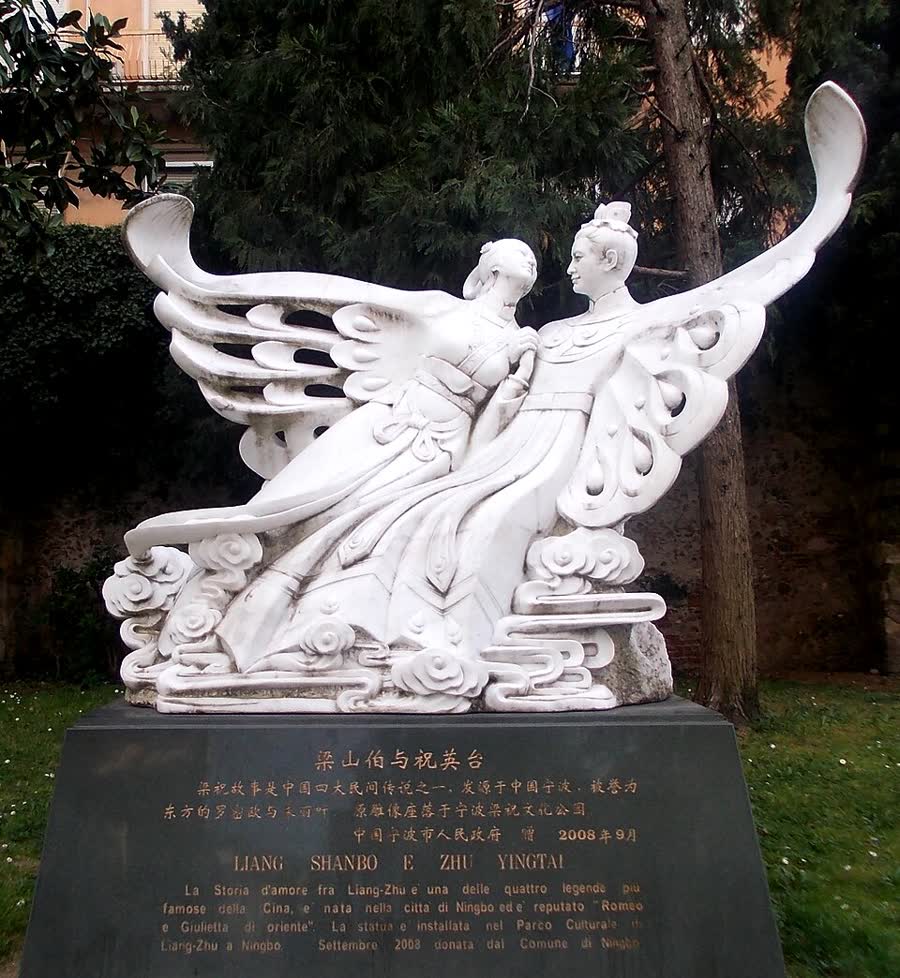
The photograph in this section shows a monument to Liang Shanbo and Zhu Yingtai in Verona, Italy. It is included to discuss the story's reach, not to illustrate a site in Ningbo or Hangzhou. Keeping the location in the caption matters: images travel easily, and an attractive photograph can acquire an incorrect destination label when separated from its source.
The familiar comparison with Romeo and Juliet can help an English-speaking newcomer recognise that love and obstruction are central concerns. It should remain a starting analogy, not a replacement title that makes the two works seem identical. Education, disguise, delayed recognition and butterfly transformation give Liang-Zhu its own narrative shape.
Try comparing a question rather than declaring the stories equivalent. How does each work organise what the lovers know? Which institutions or relationships constrain their decisions? What does the ending ask the audience to imagine? These questions preserve differences while allowing you to bring an existing reading experience to an unfamiliar tradition.
A public monument also makes a different kind of statement from a performance. It selects an image of remembrance and places it in a shared space. You can ask what viewers are invited to recognise, what an inscription explains and what knowledge is assumed. Those questions concern the monument's reception, not proof that its location is the story's original setting.
When sharing an image from your own travels, retain the location, date and creator information available to you. Avoid captioning an overseas monument as a local Chinese heritage site, or calling people in the photograph performers from a production without evidence. Accurate small details allow a cultural story to travel without taking on a false history along the way.
Reading the ending without turning it into a slogan
The butterfly image can be read as freedom, continuity or a transformation beyond the conditions that constrained the human relationship. Those are interpretations, not a single compulsory explanation. Ask which meaning the version you encountered prepares you to feel. A gentle visual ending can follow a story that remains disturbing in its treatment of choice and loss.
Do not let the image make the earlier conflict disappear. If a performance invites relief at reunion or transformation, you can still ask what opportunities the characters were denied while alive. Holding those responses together can be more attentive than insisting that the ending is either simply happy or simply tragic.
Nor is the story an instruction to romanticise death or to treat self-destruction as proof of love. Its imaginative resolution can be discussed as literature and performance without turning it into advice for real relationships. For younger audiences, a conversation about the characters' choices and alternatives may be more useful than presenting sacrifice as the only meaningful response to constraint.
Compare your response with someone else's after the performance. One person may remember the friendship of the early scenes; another may focus on the ending's imagery. Ask what in the work led them there. You may find that the difference comes from a scene you overlooked, or from the life experience each of you brought to it.
Building a cultural visit around your actual interest
If music is the main interest, start with a recording or confirmed programme and allow time for a conversation afterwards. A concert followed by a quiet meal may serve that purpose better than a full day of unrelated attractions. If literature is the interest, a local account and a thoughtfully chosen site may matter more than a major performance.
For a Hangzhou stay, the Hangzhou planning guide provides a separate framework for combining cultural interests. A Longjing visit adds a craft-and-landscape subject; the White Snake tradition offers another way to read local narrative associations. They are distinct subjects, not parts of a single combined legend.
Choose only the connections that genuinely interest you. Combining several traditions can be rewarding, but a day overloaded with interpretation leaves little time for attention. Tell a guide whether you prefer listening, looking, discussion or performance. That is more useful than requesting an authentic experience without specifying what you want to understand.
Practical needs should be as explicit as cultural interests. Ask about the language of interpretation, time spent standing or walking, seating, event duration and how much background knowledge the activity assumes. A famous title does not tell you whether the format will suit your party.
ChinaTourly's bespoke planning page can be used to describe those priorities and your dates. A proposed itinerary should confirm the actual experience separately. This guide does not promise a particular troupe, artist, storyteller or performance, and a destination appearing in a route does not automatically mean a Liang-Zhu activity is included.
Questions about the Butterfly Lovers
Who are Liang Shanbo and Zhu Yingtai?
They are the central figures of the Butterfly Lovers tradition. A familiar account begins with Zhu studying in disguise and forming a close bond with Liang, then follows recognition and separation under social expectations. Read the specific version you plan to encounter rather than assuming every retelling includes identical scenes or assigns the same motives to its characters.
Is the story also called Liang-Zhu?
Liang-Zhu is a shortened way of referring to the two protagonists and their story. When searching a programme, keep both the English title and the personal names in view. A listing may foreground a production, an opera or the concerto, so the shared name alone does not establish which artistic form you have found.
Is the violin concerto an ancient composition?
No. The concerto associated with He Zhanhao and Chen Gang belongs to the twentieth century; the Hong Kong Chinese Orchestra source cited above records its premiere in 1959. The inherited story and the later composition have different histories. Recognising that distinction lets you appreciate the musical work as a creative response rather than an unchanged relic of the legend's beginnings.
Will a ballet use the famous concerto?
Not necessarily. Check the actual production's music credits. The ballet example linked here uses an original score, which shows why the story title cannot identify the soundtrack. The same care applies to other adaptations and arrangements. Choose according to the work being presented, not an assumption that every Butterfly Lovers programme contains the recording you already know.
Is a visit to Ningbo necessary to understand the legend?
No single visit is a prerequisite. Ningbo is among the places connected with the tradition, but reading, listening and attending a well-explained performance offer other entrances. If you travel to an associated site, ask what its local interpretation adds. A visit should deepen an interest rather than become an obligation to prove that you have understood the story.
Are all claimed tombs or memorials historical proof?
A memorial demonstrates commemoration; it does not by itself authenticate every biographical or supernatural claim attached to a legend. Ask for the site's own history and the evidence behind specific statements. It is possible to value a place's cultural role while remaining careful about the difference between remembrance, reconstruction and a documented historical event.
Why is an Italian monument shown on a China travel page?
It illustrates the story's cultural reception outside China. The image is explicitly located in Verona and is placed in the discussion of overseas remembrance, not used as a photograph of Hangzhou or Ningbo. Its value here is comparative. It should not be used to choose a Chinese sightseeing stop or to infer the location of an episode in the legend.
How much should I read before a performance?
Start with the central relationship and the production's own brief synopsis. If you enjoy surprises, stop before the detailed ending. If unfamiliar language is likely to be challenging, knowing the larger sequence may free attention for movement and music. There is no need to master every adaptation before encountering one carefully selected work.
What if I cannot follow every line of an opera?
Check for an English synopsis or translated surtitles in advance, then use relationships and changes of attention to stay oriented. It is reasonable to miss details in an unfamiliar form. After the show, return to the programme and identify the moment that puzzled you. A focused question can produce a better explanation than asking for the entire performance to be summarised again.
Can I use a concerto recording in my travel video?
Do not assume that a familiar cultural work or publicly accessible recording is free to reuse. A composition, arrangement, performance and recording may involve separate rights. Use material only with permission that covers your intended use. Listening through an official source is different from downloading its audio and adding it to your own published film.
Is the Butterfly Lovers simply China's Romeo and Juliet?
The comparison can introduce a story of love under constraint, but it leaves out important differences. Liang-Zhu's educational setting, disguise and transformation deserve attention in their own terms. Use the analogy to begin a conversation, then compare specific narrative choices rather than treating one work as a translated version of the other.
What should I ask when arranging a story-focused visit?
Ask what form the encounter takes, which local account or production it uses, how interpretation is provided and what practical arrangements are confirmed. State whether your interest is narration, opera, music or a physical site. That gives an organiser a clear brief and helps prevent a generic sightseeing stop from being substituted for the experience you actually wanted.
Sources and further reading
- National heritage record: Liang-Zhu, Shangyu entry, project identity and links to other transmission-place entries.
- NCPA: Xiaobaihua Yue opera production, a specific synopsis and production, not a current ticket guarantee.
- Hong Kong Chinese Orchestra: 2019 programme and concerto notes, composers and 1959 premiere; historical event information is not reused as current availability.
- Naxos publishing: The Butterfly Lovers, composition identity and arrangements; no score or recording reproduced.
- Hong Kong performing-arts programme: ballet adaptation, an example of a different artistic form and original score.