What "North China" actually means for travel
Geographically: everything north of the Qinling-Huai line, including Beijing, Tianjin, Hebei, Shanxi, Henan, Shandong, and Shaanxi. For travel purposes: the imperial heartland — where almost every Chinese dynasty between 221 BCE and 1912 placed its capital.
North China is the most logistically efficient region of the country to visit. The major destinations are connected by 4-5 hour high-speed rail at most. Beijing to Xi'an is 4 hours 18 minutes; Xi'an to Pingyao is 3 hours; Pingyao to Beijing is 4 hours. A two-week trip can cover four imperial capitals end to end without a single domestic flight.
What you actually see across the region:
- The imperial-axis layer. The Forbidden City in Beijing (980 surviving buildings on 72 hectares, the largest imperial palace complex on earth). The Tang Daming Palace foundations in Xi'an. The Northern Song reconstruction at Kaifeng. The Eastern Han foundations at Luoyang.
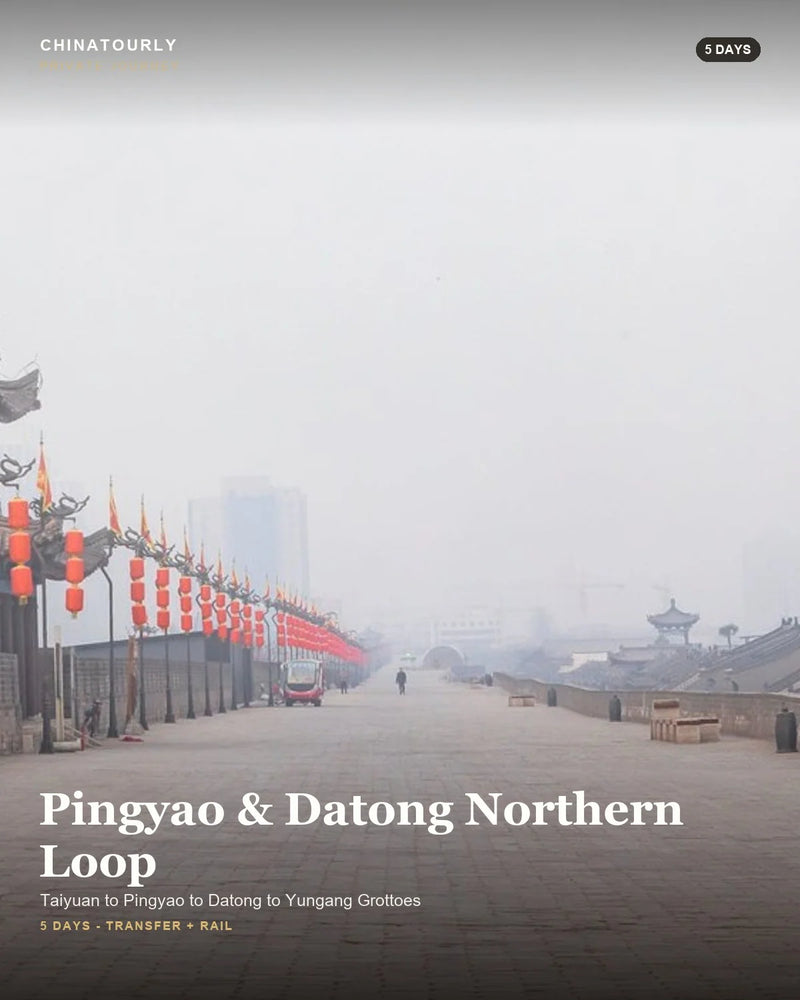
- The wall and tomb layer. The Mutianyu Great Wall (1570s Ming construction), Pingyao's 6-kilometre Ming city wall (entirely intact), Xi'an's 1370 city wall (14-kilometre circuit), the Ming Tombs north of Beijing, the Qianxian Tang imperial tombs north of Xi'an.
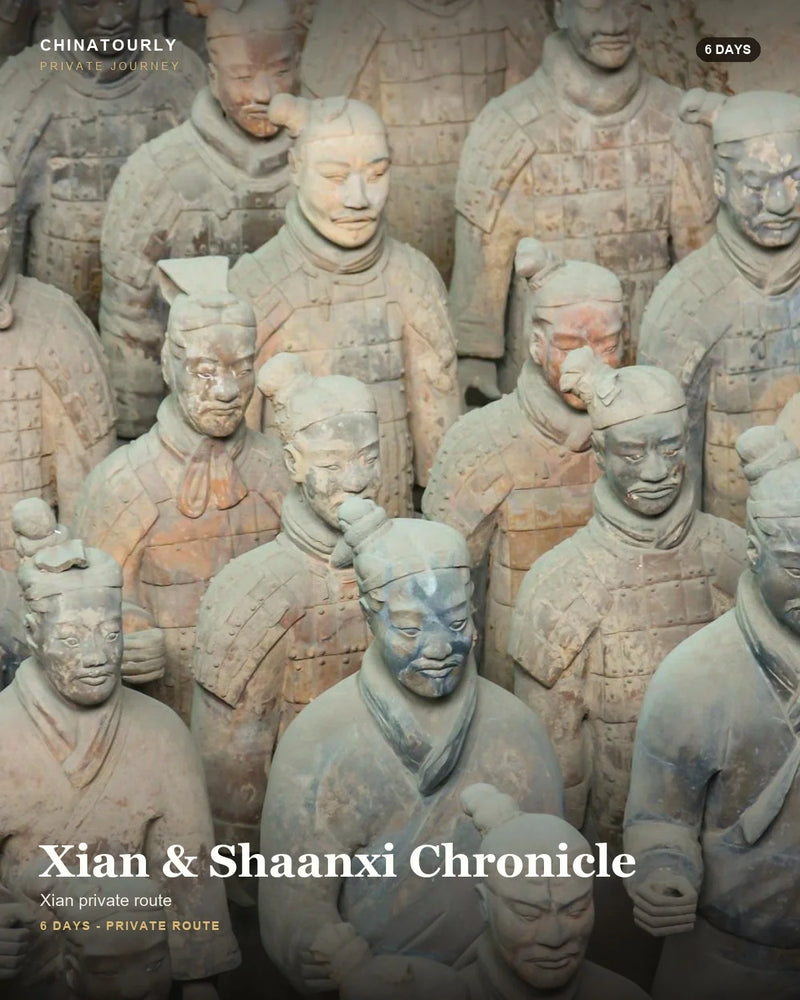
- The Buddhist art layer. Yungang Grottoes outside Datong (Northern Wei, 460 CE), Longmen Grottoes outside Luoyang (Northern Wei start 493 CE), Maijishan in southern Gansu (5th-7th c.), all reachable from the corridor.
What this region does not have, to be clear: tropical forests, towering karst landscapes, southwest minority villages, or the West Lake-style soft scenery of the Yangtze delta. For those, you want our Yunnan route collection or the Jiangnan route collection. North China rewards travellers who came for history, scale, and the imperial layer.
A two-week trip can cover four imperial capitals end to end without a single domestic flight.